
Mortgage Database Reactivation Made Simple for Growth
Mortgage Database Reactivation makes follow-up faster and easier, helping loan officers recover lost leads and drive more qualified applications. Act today.

Mortgage Database Reactivation can help loan officers recover overlooked opportunities from old CRM records, dormant inquiries, incomplete applications, and past borrower lists. The challenge is rarely a total lack of contacts. It is usually a lack of structure around who should be contacted, why the person originally inquired, when the last conversation happened, and what the next appropriate step should be.
A modern reactivation program is not a bulk text blast or a one-time email to every name in the system. It combines database cleanup, consent review, lead-source tracking, segmentation, CRM stages, SMS, email nurture, AI-assisted support, appointment booking, reminders, human handoff, reporting, and compliance-aware communication.
This guide explains how purchase, refinance, FHA, VA, USDA, conventional, first-time buyer, referral, and past borrower contacts may need different workflows. It also covers database stages, message examples, performance measurement, appointment paths, and the compliance review needed before launch.
Results are not guaranteed. Performance depends on database quality, contact age, lead source, consent records, borrower intent, market conditions, message quality, CRM configuration, response speed, follow-up consistency, compliance review, and loan officer execution.
What Is Mortgage Database Reactivation?
Mortgage Database Reactivation is a structured process for reviewing, cleaning, segmenting, contacting, and nurturing older mortgage contacts. Its purpose is to identify people who may still benefit from a relevant conversation and move them toward an appropriate next step without treating every record as an active borrower.
That next step could be a purchase-readiness discussion, refinance review, cash-out refinance conversation, pre-approval consultation, incomplete application follow-up, annual mortgage review, referral conversation, or long-term nurture path. A useful program also recognizes when a record is invalid, uninterested, opted out, or unsuitable for further outreach.
Contact storage only preserves names, phone numbers, email addresses, and notes. Database cleanup corrects duplicates and incomplete records. A basic campaign sends messages. A complete reactivation system connects record quality, borrower context, approved outreach, response routing, appointment booking, CRM stage changes, and licensed follow-up.
Mortgage databases may include website forms, Google Ads leads, Facebook lead forms, mortgage calculator users, rate requests, pre-approval inquiries, buyer-guide downloads, refinance inquiries, down payment assistance contacts, incomplete applications, purchased leads, Realtor referrals, and past borrowers.
RealtyCTL’s mortgage growth infrastructure is designed to connect lead generation, CRM organization, follow-up, appointment workflows, reporting, and execution support rather than treating database outreach as an isolated campaign.
Why Do Mortgage Leads Become Inactive?
A mortgage contact may become inactive because the original response was slow, the borrower was not ready, the message was generic, the home search paused, the borrower needed more education, or the team stopped following up after one attempt. A cold status does not always mean the original inquiry had no value.
Timing matters. A purchase lead may have delayed a move, while a refinance prospect may have decided to wait for different market conditions. A first-time buyer may have needed help understanding preparation steps. An incomplete application may have stalled because the next action was unclear.
Internal process gaps can also create inactivity. Staff changes, CRM migrations, inconsistent notes, missing ownership, disconnected calendars, duplicate records, and unclear pipeline stages can leave valid contacts without a defined next action.
- Contacts have no reliable lead-source tags.
- Purchase and refinance inquiries are mixed together.
- Past borrowers are grouped with unconverted prospects.
- Last-contact dates and conversation notes are missing.
- Duplicate, invalid, and opted-out records are not clearly identified.
- Leads received one call or message and no longer-term follow-up.
- Incomplete applications have no dedicated workflow.
- Messages do not reflect the person’s original request.
- There is no booking link, reminder sequence, or no-show process.
- Reporting counts activity without showing qualified conversations.
Reactivation should not replace a loan officer’s expertise. It should organize contact attempts, preserve context, and route interested people to an appropriately licensed professional when they need mortgage guidance.

What Should a Mortgage Database Reactivation System Include?
A complete system begins with a protected export or backup before changes are made. The team can then review duplicate records, invalid contact data, consent history, opt-outs, original source, date created, last contact, last response, assigned owner, and existing notes.
Clean records should be segmented by relationship and intent. Useful categories may include purchase, refinance, cash-out refinance, FHA, VA, USDA, conventional, first-time buyer, incomplete application, Realtor referral, past borrower, long-term nurture, invalid contact, and do-not-contact.
A well-organized mortgage CRM structure should show each contact’s current stage, source, history, next action, owner, and communication status. It should also prevent one person from entering conflicting sequences.
The workflow layer may include a permission-based first message, email education, phone tasks, AI-assisted classification, reply routing, calendar scheduling, appointment reminders, no-show follow-up, loan officer assignment, long-term nurture, and clear stop conditions.
Operational capacity matters after people reply. Approved virtual assistant support may help with defined non-licensed work such as CRM cleanup, contact organization, scheduling coordination, status updates, and task monitoring.
A mortgage database creates value only when the system behind it can turn a relevant response into a real conversation, qualified appointment, application step, referral opportunity, or appropriate nurture path.
How Should Different Mortgage Database Segments Be Reactivated?
Database segments should be based on evidence in the record, not assumptions about a person’s finances or eligibility. Lead source, age, original intent, response history, relationship type, last known timeline, and CRM stage provide a practical starting point.
How Should Purchase Leads Be Reactivated?
Recent purchase leads may need a direct timeline check and an easy appointment path. Older purchase leads usually need a softer question that acknowledges plans may have changed. First-time buyers may also benefit from educational content before being asked to schedule.
How Should Refinance and Cash-Out Refinance Leads Be Reactivated?
Refinance contacts should be approached around their original goal, not a promise of savings. A cash-out refinance inquiry may have been connected to debt consolidation, renovation, education, or another stated objective, but the current conversation should confirm whether that goal still exists.
How Should FHA, VA, USDA, and Conventional Leads Be Reactivated?
Program-related contacts may benefit from a short review of their current home-buying timeline and a human conversation about possible next steps. Outreach should not imply eligibility, approval, a particular rate, or a guaranteed program outcome.
How Should Incomplete Applications Be Reactivated?
Incomplete applications need a clear, helpful next-step message. A connected mortgage process automation workflow can create an internal task, identify the stalled stage, and direct the applicant to an approved secure process without collecting sensitive information through casual channels.
How Should Realtor Referral Contacts Be Reactivated?
Referral contacts carry transferred trust. The team should preserve the source, acknowledge the introduction appropriately, contact the borrower professionally, and manage updates according to privacy rules and company policy. A structured Realtor relationship workflow helps protect both the borrower experience and the partner relationship.
Mortgage and real estate teams may also coordinate approved buyer education, events, or lead resources through a connected real estate lead generation system. Responsibilities, consent, data access, and follow-up ownership should be defined before any shared campaign begins.
How Should Past Borrowers Be Reactivated?
Past borrowers should receive relationship-based communication rather than being treated like new internet leads. Annual mortgage reviews, homeownership education, service check-ins, review requests, and referral conversations may be appropriate when supported by consent, company policy, and relevant context.
| Database Segment | Recommended CRM Stage | Best Reactivation Approach | Primary Risk |
|---|---|---|---|
| Recent purchase lead | Attempting contact | Timeline check, call task, and booking option | Slow response or excessive contact |
| Aged purchase lead | Reactivation started | Permission-based question about changed plans | Assuming the person is still buying |
| Refinance inquiry | Needs review | Goal-based mortgage review invitation | Unsupported savings claims |
| Cash-out refinance inquiry | Needs information | Confirm the original objective and offer a conversation | Assuming equity, suitability, or approval |
| FHA or VA lead | Needs nurture | Program education with licensed handoff | Implying eligibility or approval |
| Incomplete application | Application follow-up | Clarify the secure next step and assign a task | Requesting sensitive data improperly |
| Realtor referral contact | Priority follow-up | Professional acknowledgment and fast human contact | Damaging transferred trust |
| Past borrower | Past-client nurture | Annual review or helpful relationship check-in | Irrelevant or overly promotional outreach |
How Do Segmentation, CRM Stages, and Automation Work Together?
Segmentation explains who the contact is and why the record matters. CRM stages show where the person is in the current process. Automation coordinates approved tasks and messages based on those facts.
Useful reactivation stages may include needs data review, eligible for outreach, reactivation started, attempting contact, positive response, needs information, long-term nurture, ready to book, appointment booked, appointment completed, application restarted, document collection, past borrower, invalid contact, opted out, and do not contact.
A recent purchase inquiry may receive a prompt call task and booking option. A multi-year-old lead may receive a softer permission-based message. A past borrower may enter an annual review sequence. An opt-out must stop the applicable outreach and update connected systems according to approved procedures.
Mortgage marketing automation can support short SMS messages, educational emails, internal reminders, response classification, appointment confirmations, and nurture. It should not independently give product advice, quote pricing, determine eligibility, evaluate creditworthiness, or promise an outcome.
- Send an approved first message matched to source and segment.
- Create a follow-up task when there is no response.
- Route positive replies to the correct loan officer.
- Record negative replies, invalid data, and opt-outs accurately.
- Offer a booking link when the contact is ready to speak.
- Send appointment reminders and a respectful no-show follow-up.
- Change the CRM stage after each verified event.
- Move not-ready contacts into an appropriate nurture path.
- Preserve notes and conversation history for human review.
AI-assisted tools may summarize replies, identify basic intent, recommend routing, or draft messages within approved boundaries. A human should take over when a person asks about loan options, rates, pricing, qualification, approval, payments, financial choices, or another topic requiring licensed judgment.
What Mortgage Database Reactivation Messages Can Start a Conversation?
Good reactivation messages are clear, short, relevant, and easy to answer. They acknowledge that the person’s plans may have changed and avoid pressure, unsupported urgency, or assumptions about financial circumstances.
What Can a Purchase Lead Message Say?
“Are you still planning to buy a home, or has your timeline changed?” A first-time buyer variation could ask, “Would it help to review the next step and make the process easier to understand?”
What Can a Refinance Message Say?
“Would a quick mortgage review help you understand whether revisiting your options makes sense?” A cash-out variation could ask, “Are you still exploring ways to use home equity for your original goal?”
What Can an FHA or VA Lead Message Say?
“Would you like to review your current home-buying timeline and possible next steps?” This keeps the conversation open without implying eligibility, approval, pricing, or a specific result.
What Can an Incomplete Application Message Say?
“Would you like help understanding what remains before your next application step?” The reply should be routed to the correct person, and any documents or sensitive details should move through an approved secure channel.
What Can a Realtor Referral Message Say?
“I received your information through a real estate partner and wanted to check whether mortgage guidance would still be helpful.” The sender should identify the company and follow approved consent, privacy, and referral procedures.
What Can a Past Borrower Message Say?
“Would an annual mortgage review be useful this month?” A relationship check-in should remain helpful and should not state or imply that refinancing, borrowing, or another transaction is suitable.
What Can an Appointment Reminder Say?
“This is a reminder about your scheduled mortgage conversation. Reply here if you need to adjust the time.” A no-show message can offer a simple rescheduling option without repeated pressure.
These examples are educational starting points only. They should be reviewed for company policy, licensing, consent, TCPA, CAN-SPAM, Fair Housing, fair lending, ECOA, RESPA, TILA, NMLS, privacy, opt-out, disclosure, and state requirements before use.
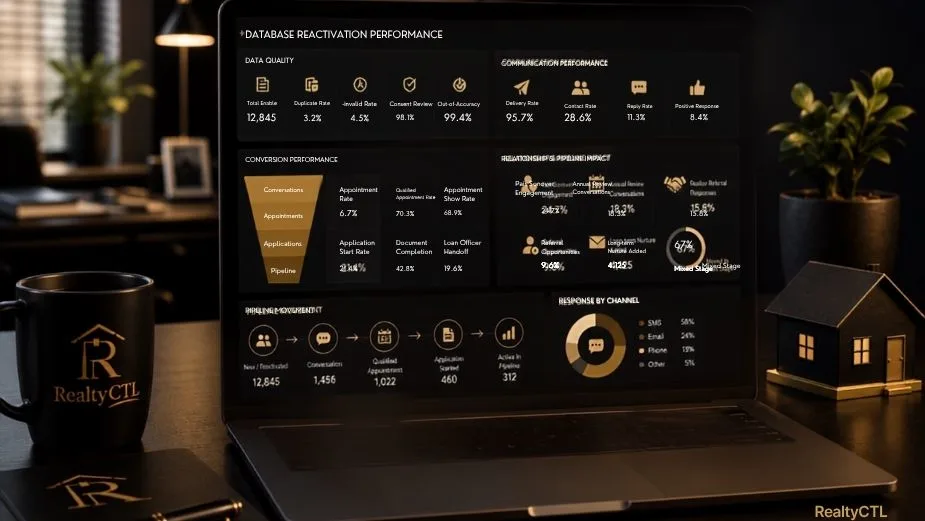
How Should Mortgage Database Reactivation Performance Be Measured?
Database size and message volume do not show whether a campaign is producing meaningful opportunities. Measurement should begin with data quality and continue through conversations, appointments, application steps, referrals, and pipeline movement.
Data-quality metrics may include total eligible contacts, duplicate rate, invalid contact rate, missing-source rate, consent-review status, and opt-out accuracy. Communication metrics may include delivery rate, contact rate, reply rate, positive response rate, negative response rate, SMS response, email engagement, and call connection.
Conversion metrics may include appointment booking rate, qualified appointment rate, appointment show rate, no-show rate, application restart rate, application start rate, document completion, loan officer handoff, and verified movement between CRM stages.
Relationship metrics may include past borrower engagement, annual review conversations, Realtor referral responses, referral opportunities, and the number of contacts placed into appropriate long-term nurture.
Teams should distinguish message delivery from borrower interest, replies from qualified replies, bookings from completed qualified appointments, and application starts from funded loans. A large response count can still be misleading when replies are mostly opt-outs, wrong numbers, or people with no current interest.
Segment-level reporting is especially useful. It may show that recent purchase leads respond differently from aged refinance inquiries, or that past borrowers need a different channel and message cadence. Results vary by database quality, source, contact age, consent, market conditions, messaging, offer, CRM configuration, team follow-up, and borrower intent.
What Compliance Considerations Apply to Mortgage Database Reactivation?
This section provides general educational information and is not legal, compliance, lending, financial, or mortgage advice. Current federal, state, company, lender, broker, vendor, and platform requirements should be verified before a campaign is activated.
Calls and texts should be reviewed against the current 47 CFR 64.1200 delivery restrictions and relevant FCC TCPA information. Teams should evaluate consent, revocation, identification, timing, technology, recordkeeping, and opt-out handling.
Commercial email workflows should be reviewed using the FTC CAN-SPAM compliance guide. Sender identity, subject lines, physical-address requirements, unsubscribe processing, and suppression lists require approved controls.
Borrower segmentation, outreach, and response routing should be reviewed with the HUD Fair Housing Act overview, the Department of Justice Fair Housing guidance, and CFPB Regulation B requirements in mind. Workflows should not create discriminatory treatment, discouragement, or unapproved credit decision logic.
Referral arrangements, settlement-service communication, and related co-marketing activity may require review under CFPB Regulation X guidance. Advertising and credit-term communication should also be reviewed against CFPB Regulation Z guidance.
Company and individual licensing information may be checked through NMLS Consumer Access. Required company, NMLS, state, licensing, and disclosure information should be added wherever applicable.
Past-client reviews and testimonials used in reactivation campaigns should be reviewed using the FTC endorsements and reviews guidance. Claims must be accurate, appropriately disclosed, and consistent with mortgage advertising requirements.
Data privacy should be built into the workflow. Access should be limited, sensitive records should be handled through approved systems, and retention, deletion, vendor access, authentication, and incident procedures should be documented. An automated platform should never be assumed to provide compliance by itself.
Compliance-aware communication can still be persuasive when it focuses on clarity, relevance, borrower choice, honest next steps, and respectful permission. The workflow should stop or escalate when a person opts out, disputes the contact, raises a complaint, or asks a question requiring professional review.
How Should Loan Officers Choose a Mortgage Database Reactivation Partner?
A capable partner should understand mortgage lead sources, borrower intent, database cleanup, CRM stages, consent records, SMS and email workflows, appointment booking, licensed handoff, long-term nurture, and reporting. Generic campaign experience is not enough when the database contains mortgage inquiries and borrower information.
Ask how the partner will protect the original data, remove duplicates, identify invalid records, preserve opt-outs, segment contacts, document message approval, route replies, create stop conditions, and measure qualified outcomes. The implementation plan should also explain who owns each task after a contact responds.
Look for realistic expectations. A responsible partner should not promise a fixed response rate, a guaranteed number of appointments, guaranteed applications, funded loans, or ROI. It should explain how performance may change by segment, source, lead age, database quality, consent, market conditions, message quality, and team execution.
RealtyCTL may be a strong fit for mortgage professionals who want a connected reactivation system rather than a one-time blast, random call list, generic email sequence, or disconnected calendar tool. The system can connect CRM organization, AI-assisted support, appointment workflows, mortgage lead generation, reporting, content, and defined operational support.
What Should Mortgage Professionals Know About Database Reactivation?
What is Mortgage Database Reactivation?
It is the structured process of cleaning, segmenting, contacting, tracking, and nurturing older mortgage records. A complete program connects approved outreach with CRM stages, response routing, appointments, human follow-up, long-term nurture, and reporting.
Why should loan officers reactivate old mortgage leads?
Old databases may contain people whose plans changed, paused, or were never followed up properly. Reactivation may create useful conversations while helping the team organize invalid records, opt-outs, past borrowers, and future nurture opportunities.
What contacts should be included in a mortgage reactivation campaign?
Potential segments include purchase leads, refinance inquiries, incomplete applications, program-specific leads, Realtor referrals, and past borrowers. Eligibility for outreach should depend on data quality, consent, relationship context, company policy, and compliance review.
Can automation replace a loan officer’s personal follow-up?
No. Automation can support acknowledgments, tasks, reminders, routing, summaries, scheduling, and nurture. Licensed professionals should handle mortgage advice, product discussions, pricing, qualification, approval, financial recommendations, and relationship-sensitive conversations.
How should Mortgage Database Reactivation performance be measured?
Measure record quality, valid contacts, replies, positive conversations, qualified appointments, completed meetings, application steps, pipeline movement, past-borrower engagement, referrals, opt-outs, and segment performance rather than relying only on messages sent.
Should loan officers hire a database reactivation partner?
A partner may help when a team lacks time, CRM expertise, workflow design, message planning, appointment coordination, or reporting capacity. The partner should understand mortgage workflows, define responsibilities clearly, support compliance review, and avoid guaranteed claims.
Last Updated: 28th June 2026
Reviewed By: Atiq Md Rezaul Hoque Turjo
Written By

Atiq Rezaul Hoque Turjo
Founder & CEO, NextCTL
Software architect with 16 years of experience, founder and CEO of NextCTL, and the builder behind the CTL stack: BackCTL, H22T and RealtyCTL.