
Mortgage Marketing Automation Made Simple for Lenders
Mortgage Marketing Automation gives loan teams faster lead response, smarter CRM follow up, and clearer pipeline tracking. Book your strategy call today.

Mortgage marketing automation for loan officers is not just a drip email sequence or a few automated text messages. Many mortgage professionals already generate leads, but they still struggle to get replies, consultations, pre-approval appointments, refinance conversations, application starts, and qualified borrower opportunities.
A modern mortgage automation system should connect lead source tracking, CRM stages, borrower segmentation, SMS, email nurture, AI-assisted replies, appointment booking, reminders, loan officer handoff, database reactivation, reporting, and compliance-aware messaging.
This guide explains speed to lead, mortgage CRM automation, purchase lead nurture, refinance lead nurture, Realtor referral follow-up, AI follow-up, appointment reminders, database reactivation, qualified appointment tracking, and compliance-safe communication.
Results are not guaranteed. Automation performance depends on market conditions, lead source, offer, message quality, CRM setup, response speed, automation quality, follow-up process, loan officer execution, compliance review, and borrower intent.
What Is Mortgage Marketing Automation for Loan Officers?
Mortgage marketing automation for loan officers means using CRM workflows, lead source tracking, SMS, email, AI-assisted responses, lead segmentation, appointment booking, reminders, lead routing, task management, reporting, and database systems to help mortgage professionals manage borrower opportunities.
The goal is not to remove the loan officer from the process. The goal is to protect leads from being forgotten, organize follow-up, and move qualified borrowers toward the right conversation at the right time.
Manual follow-up depends on memory and discipline. Generic drip emails can educate, but they often ignore borrower intent. CRM task reminders can help, but they do not create a complete borrower communication workflow. AI chat replies can support response speed, but they should not replace licensed mortgage guidance. Appointment booking tools can make scheduling easier, but they do not solve lead quality, segmentation, or long-term nurture.
A complete mortgage marketing automation system connects all of these pieces. It helps loan officers manage website leads, Google Ads leads, Facebook leads, mortgage calculator leads, pre-approval inquiries, refinance inquiries, rate quote requests, Realtor referrals, past borrowers, old lead lists, referral partners, and social media leads.
The best systems connect lead generation and automation instead of treating them as separate tasks. RealtyCTL helps mortgage professionals build connected lead generation, CRM automation, follow-up, AI support, appointment booking, and reporting systems that support better borrower conversations.
Why Mortgage Marketing Automation Often Fails
Mortgage automation often fails because it is built as a collection of disconnected messages instead of a clear borrower conversion system. A loan officer may have a CRM, a few text templates, and a calendar link, but still lose leads because the workflow does not match the borrower’s intent.
Many mortgage leads are not lost because they were worthless. They are often lost because the first response was slow, the follow-up was generic, the lead source was unclear, or the CRM did not show what should happen next.
Purchase leads, refinance leads, FHA leads, VA leads, USDA leads, conventional leads, rate quote leads, Realtor referral leads, and past borrowers do not all need the same workflow. A buyer asking about pre-approval may need fast scheduling. A refinance lead may need longer education. A Realtor referral may need immediate professional follow-up that protects partner trust.
Common automation problems include:
- Generic messages sent to every lead
- No lead source tagging
- No purchase or refinance segmentation
- Slow first response
- Missed calls with no text-back
- No follow-up after the first attempt
- No appointment booking link
- No appointment reminders
- No reporting on contact rate or appointment rate
- No long-term nurture for future borrowers or past clients
- Too much automation without a clear human handoff
Marketing automation does not replace a loan officer’s expertise. It helps protect opportunities until the right licensed mortgage conversation can happen.
The Core Parts of a Mortgage Marketing Automation System
A strong mortgage automation system usually begins with lead source tracking. A refinance page lead, a mortgage calculator lead, a Realtor referral, and a first-time home buyer guide lead should not be treated the same way.
The next part is CRM pipeline structure. Loan officers need clear stages such as new lead, attempting contact, contacted, needs nurture, ready to book, appointment booked, application started, document collection, in process, closed loan, past borrower, and referral partner.
Lead tagging and segmentation help the system understand borrower intent. Tags may include purchase, refinance, cash-out refinance, FHA, VA, USDA, conventional, first-time buyer, down payment assistance, rate quote, Realtor referral, past borrower, hot lead, warm lead, cold lead, or long-term nurture.
The system should also include an instant new lead response, SMS follow-up, email nurture, phone follow-up support, missed call text-back, AI-assisted reply support, appointment booking, appointment reminders, no-show follow-up, lead routing, loan officer handoff, Realtor referral partner tracking, past borrower nurture, database reactivation, reporting, and conversion tracking.
Mortgage automation is only valuable if it helps turn borrower interest into a real conversation, qualified appointment, application, or next step.
The automation system should not stop after one call, one text, or one email. Mortgage leads often need multiple helpful touches, different message paths, and clear pipeline movement before they become ready for a consultation.
Many mortgage campaigns fail because follow-up is slow, generic, incomplete, or disconnected from the CRM and appointment workflow. RealtyCTL’s mortgage lead generation and automation systems can connect done-for-you lead generation, CRM automation, AI follow-up, appointment booking, reporting, and conversion infrastructure into one organized mortgage growth system.
Automation Workflows by Mortgage Lead Type
Different mortgage leads need different automation workflows. A purchase lead may need fast follow-up around timeline, budget, location, loan readiness, and pre-approval scheduling. The automation goal is often to move the borrower toward a helpful consultation quickly.
A refinance lead may need a slower nurture path. The system should identify the borrower’s goal, current loan situation, equity context, timeline, and interest in a refinance review.
A cash-out refinance lead may need careful messaging around purpose, equity discussion, payment sensitivity, and whether a review call makes sense. The workflow should avoid unsupported savings, approval, or payment claims.
FHA, VA, USDA, and conventional leads may need different education paths. FHA and VA borrowers may need simple next-step guidance, eligibility discussion, and pre-approval support. First-time home buyer leads may need education before they are ready to book.
Realtor referral leads need fast, professional follow-up because the referral partner relationship is also involved. Past borrowers and old database contacts may need annual mortgage reviews, refinance check-ins, move-up buyer conversations, market updates, and referral prompts.
| Lead Type | Best Automation Goal | Recommended Workflow | Main Risk |
|---|---|---|---|
| Purchase lead | Book a pre-approval or buyer consultation | Fast SMS, call task, timeline question, booking link, reminder | Slow response that loses the borrower to another lender |
| Refinance lead | Understand refinance goal and timing | Email education, short SMS, review offer, long-term nurture | Pushing too hard before the borrower is ready |
| Cash-out refinance lead | Clarify goal and review fit | Purpose question, equity discussion prompt, review call offer | Making unsupported savings, payment, or approval claims |
| FHA or VA lead | Offer helpful eligibility and next-step guidance | Education sequence, pre-approval prompt, loan officer handoff | Using generic messages that ignore borrower concerns |
| Realtor referral lead | Respond quickly and protect partner trust | Immediate confirmation, call task, partner note, consultation path | Slow response that damages referral confidence |
| Past borrower database lead | Restart a useful mortgage conversation | Annual review, market update, refinance check-in, referral prompt | Sending generic blasts with no context |
Each workflow should feed into pipeline stages, nurture paths, appointment booking, reminders, loan officer handoff, and reporting. That is how automation becomes a mortgage conversion system instead of a random drip campaign.
Pipeline Stages, Lead Temperature, and Human Handoff
Mortgage pipeline stages help automation stay organized after the first reply. Without clear stages, leads may sit in the CRM with no next step, no owner, and no useful reporting.
Common stages include new lead, attempting contact, contacted, needs nurture, ready to book, appointment booked, appointment completed, application started, document collection, in process, closed loan, past borrower, and lost or not ready.
Lead temperature should also affect the workflow. A hot lead may need an immediate call and appointment link. A warm lead may need a few helpful touches. A cold lead may need long-term nurture. A Realtor referral may need fast human attention. A past borrower may need an annual review or market update.
SMS is useful for fast, short, conversational follow-up. Email is better for education, document reminders, next steps, and long-term nurture. AI-assisted follow-up can help respond, summarize, route, and qualify basic intent. CRM automation keeps the loan officer organized and prevents leads from being forgotten.
Appointment booking reduces friction when a borrower is ready for a conversation. Appointment reminders and no-show follow-up help keep the workflow moving after the booking is made.
Human handoff is essential when the borrower needs licensed mortgage guidance, loan product discussion, pricing, approval guidance, or financial recommendations. AI follow-up should support the loan officer, not replace licensed mortgage guidance, underwriting judgment, pricing guidance, approval decisions, or relationship-building.
Useful workflow elements include instant auto-reply, personalized first message, lead source-specific messaging, purchase or refinance segmentation, appointment booking link, follow-up if there is no reply, appointment reminders, no-show follow-up, long-term nurture, re-engagement messages, task reminders, loan officer assignment, stop and opt-out handling, notes, conversation history, and sensitive data boundaries for casual SMS or AI follow-up.
Message and Workflow Examples for Mortgage Automation
Message quality, timing, segmentation, and stage logic often decide whether a mortgage lead ignores follow-up or books a real consultation. Strong automation should feel helpful, short, clear, and matched to the borrower’s stated goal.
A new purchase lead may receive a message that asks about buying timeline and whether a pre-approval review would help. A new refinance lead may receive a message that asks whether the borrower wants to compare their current situation. A cash-out refinance lead may receive a careful prompt about whether a review call would help them understand fit.
Useful message angles include:
- Purchase angle: “Would it help to review your buying timeline and pre-approval options?”
- Refinance angle: “Would a quick refinance review help you compare your current situation?”
- Cash-out angle: “Would you like to discuss whether a cash-out refinance fits your goal?”
- First-time buyer angle: “I can walk you through the next step without making it complicated.”
- FHA loan angle: “Would a quick FHA pre-approval conversation help you understand your next step?”
- VA loan angle: “Would you like to review basic VA loan options and next steps?”
- Realtor referral angle: “I received your information and can help you understand the next mortgage step.”
- Past borrower angle: “Would an annual mortgage review be helpful this month?”
- Database reactivation angle: “Are you still thinking about buying, refinancing, or reviewing options?”
- Appointment reminder angle: “Just confirming our mortgage review appointment. Does this time still work for you?”
These are examples only. They should be reviewed for company policy, licensing, TCPA, CAN-SPAM, Fair Housing, fair lending, NMLS, disclosure, and compliance requirements before use.
Good automation messages should avoid misleading promises, rate guarantees, approval guarantees, payment claims, savings claims, exaggerated urgency, discriminatory language, or unsupported financial claims. The goal is to guide the borrower toward a useful conversation with a qualified mortgage professional.
How to Measure Mortgage Marketing Automation Performance
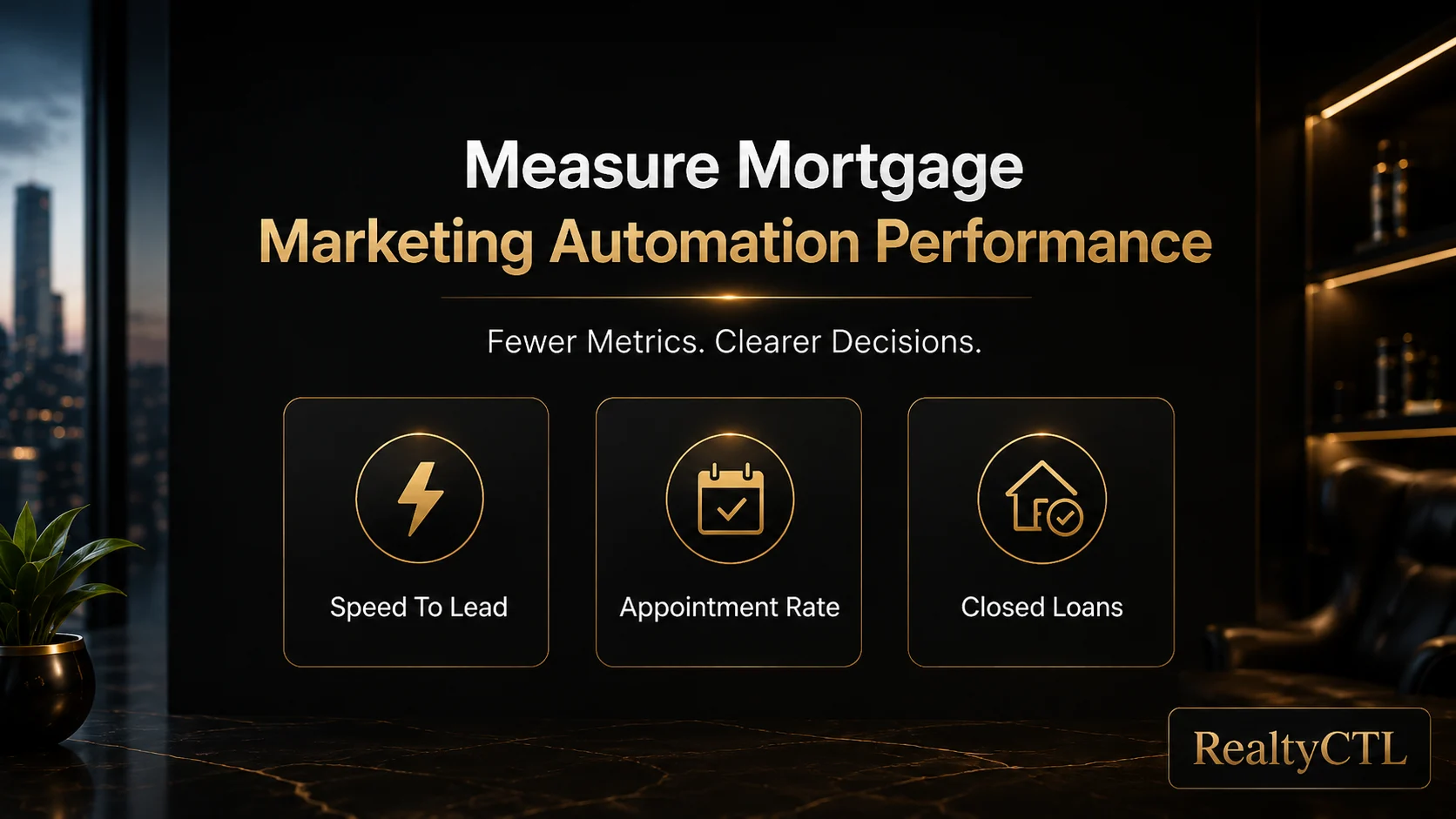
Lead volume alone can be misleading. A marketing automation system is not successful only because it sends messages. It should be judged by the quality of replies, conversations, appointments, applications, pipeline movement, and long-term borrower opportunities it creates.
Mortgage professionals should look at full-funnel performance instead of only asking how many leads came in or how many messages were sent. A cheaper lead that never replies may be less useful than a more expensive lead that books a qualified consultation.
Important metrics include:
- Speed to lead
- Contact rate
- Reply rate
- SMS response rate
- Email engagement
- Call connection rate
- Appointment booking rate
- Qualified appointment rate
- Appointment show rate
- No-show rate
- Application start rate
- Document collection rate
- Loan officer handoff rate
- Lead source quality
- Cost per qualified appointment
- Pipeline movement
- Database reactivation rate
- Past borrower engagement
- Realtor referral response rate
A strong reporting process helps loan officers see which lead sources are producing real conversations, which nurture paths need improvement, and which database segments deserve more attention.
Do not invent benchmark numbers or expected outcomes. Results vary by market, lead source, budget, offer, message quality, CRM setup, follow-up speed, automation quality, compliance, and loan officer execution.
Compliance, Consent, and Trust in Mortgage Automation
Mortgage marketing automation for loan officers must be handled carefully because mortgage professionals communicate with consumers through calls, SMS, emails, ads, landing pages, forms, CRM workflows, testimonials, referral channels, and follow-up sequences.
This article does not provide legal advice. Automation workflows, SMS messages, email sequences, AI replies, call scripts, landing pages, forms, claims, testimonials, disclosures, licensing language, and follow-up questions should be reviewed by the appropriate compliance professional, lender, broker, legal reviewer, licensing reviewer, or company reviewer before launch.
Text and phone communication rules should be reviewed before using automated SMS, missed call text-back, recurring follow-up, prerecorded messages, or phone sequences. Teams can review the official eCFR TCPA rule text and confirm how requirements apply to their workflow.
Commercial email workflows should also be reviewed before launch. The FTC CAN-SPAM compliance guide explains requirements related to commercial email, including sender accuracy, physical address, and opt-out handling.
Fair Housing and fair lending awareness should also be considered in mortgage marketing workflows. Teams can review the HUD Fair Housing Act overview and the CFPB’s Regulation B and ECOA resource.
Compliance-aware workflows should consider consent for automated SMS or calls, CAN-SPAM awareness, Fair Housing awareness, fair lending awareness, ECOA, RESPA and TILA awareness where relevant, NMLS and licensing disclosure awareness, accurate advertising language, opt-out language, permission-based communication, data privacy, secure handling of borrower information, review and testimonial compliance, company requirements, state requirements, platform policy changes, and clear brand trust.
Compliance-aware mortgage automation can still be persuasive when it focuses on clarity, helpfulness, borrower choice, and next steps.
How to Choose a Mortgage Marketing Automation Partner
Before hiring a mortgage marketing automation partner, loan officers, mortgage brokers, branch managers, and mortgage teams should look beyond basic CRM setup. The right partner should understand mortgage lead intent, borrower follow-up, appointment booking, compliance-aware messaging, reporting, and loan officer handoff.
Look for mortgage industry experience, understanding of purchase and refinance intent, CRM and automation experience, pipeline stage strategy, lead source tracking setup, SMS and email nurture strategy, AI follow-up knowledge, appointment booking workflows, appointment reminder processes, database reactivation strategy, Realtor referral partner workflows, reporting transparency, content quality, and realistic expectations.
A strong partner should also understand where virtual assistant support may help. For example, mortgage virtual assistant support can help with CRM cleanup, appointment coordination, inbox support, database organization, and follow-up tasks where appropriate.
For loan officers who work closely with agents, a connected system can also support Realtor partner follow-up and co-marketing workflows. RealtyCTL’s real estate lead generation experience can support collaboration between mortgage and real estate partners where appropriate.
RealtyCTL is a strong fit for mortgage professionals who want a full system instead of random drip emails, disconnected CRM tasks, generic automations, or basic appointment reminders. RealtyCTL can help connect mortgage lead generation, landing pages, CRM automation, AI-powered lead capture, SMS, email, appointment workflows, reporting, database reactivation, content, and conversion strategy into one organized process.
Mortgage Marketing Automation for Loan Officers FAQs
What is Mortgage marketing automation for loan officers?
Mortgage marketing automation for loan officers is the use of CRM workflows, lead source tracking, SMS, email, AI-assisted replies, appointment booking, reminders, reporting, and database systems to help loan officers nurture borrower opportunities from first inquiry to long-term follow-up.
How does marketing automation help loan officers?
Marketing automation can help loan officers respond faster, organize leads, segment borrowers, send consistent follow-up, reduce missed opportunities, book consultations, reactivate old databases, and track pipeline movement. Results vary by lead source, offer, message quality, CRM setup, compliance review, and loan officer execution.
What should a mortgage automation system include?
A mortgage automation system should include lead source tracking, CRM pipeline stages, borrower segmentation, SMS follow-up, email nurture, AI-assisted support, appointment booking, appointment reminders, no-show follow-up, lead routing, task reminders, database reactivation, reporting, and human handoff.
Can automation replace a loan officer’s follow-up?
No. Automation should support the loan officer, not replace licensed mortgage guidance or relationship-building. It can help confirm interest, ask basic questions, organize conversations, and schedule appointments, but loan advice, pricing, product discussion, approval guidance, and financial recommendations should remain with qualified mortgage professionals.
How should loan officers measure mortgage marketing automation?
Loan officers should measure speed to lead, contact rate, reply rate, appointment booking rate, qualified appointment rate, show rate, application start rate, loan officer handoff rate, cost per qualified appointment, pipeline movement, database reactivation, and past borrower engagement.
Should loan officers hire a mortgage marketing automation partner?
Loan officers may benefit from a partner if their follow-up is inconsistent, their CRM is messy, leads are going cold, appointments are not being booked, or reporting is unclear. The right partner should understand mortgage workflows, compliance-aware messaging, CRM automation, AI support, appointment booking, and realistic performance expectations.
Last Updated: 1st June 2026
Reviewed By: Atiq Md Rezaul Hoque Turjo
Written By

Atiq Rezaul Hoque Turjo
Founder & CEO, NextCTL
Software architect with 16 years of experience, founder and CEO of NextCTL, and the builder behind the CTL stack: BackCTL, H22T and RealtyCTL.