
Social Media Marketing for Realtors Made Simple Today
Social Media Marketing for Realtor helps turn visibility into buyer and seller leads with clear content and smart campaigns. Schedule your call today.

Many Realtors know they need to stay visible online, but creating reels, captions, carousels, stories, listing posts, and local content every week can become a full-time job. Posts may get likes, but not enough buyer inquiries, seller conversations, referrals, or listing appointments.
Done for you social media marketing for Realtors is designed for real estate professionals who want more than attractive graphics. Modern Realtor marketing needs strategy, brand positioning, content planning, design, captions, short-form video, lead magnets, landing pages, CRM, follow-up, trust signals, compliance awareness, and performance tracking.
This guide explains how Realtor social media marketing can support listing promotion, buyer and seller content, local authority, Instagram, Facebook, LinkedIn, YouTube Shorts, TikTok, reels, carousels, CRM automation, AI follow-up, lead nurturing, and compliance-safe marketing. Results are not guaranteed. Performance depends on market conditions, content quality, audience fit, offer, platform changes, posting consistency, creative quality, compliance review, follow-up process, local demand, and sales execution.

What Is Done for You Social Media Marketing for Realtors?
Done-for-you social media marketing means outsourcing the strategy, planning, content creation, design, captions, posting support, and performance direction needed to help Realtors stay visible and create more business conversations.
It is not the same as simply posting a few graphics every week. Posting content can create visibility. Building a brand helps people remember and trust the agent. Lead generation creates a path for buyers and sellers to raise their hand. Appointment booking moves qualified prospects into real conversations. Listing marketing helps promote properties in a way that speaks to the right audience.
Realtors may use Instagram, Facebook, LinkedIn, YouTube Shorts, TikTok, reels, carousel posts, stories, local market updates, listing content, buyer guides, seller education, email nurture, CRM automation, and referral partner marketing. The best approach depends on the agent’s market, audience, listing inventory, brand voice, and follow-up capacity.
The strongest systems connect content and follow-up instead of treating posts as isolated tasks. A seller valuation post should connect to a valuation offer. A buyer education reel should connect to a buyer consultation or guide. A listing post should connect to an open house, inquiry form, or showing request.
RealtyCTL helps Realtors build connected real estate marketing systems that combine content, lead capture, CRM automation, follow-up, reporting, and real estate lead generation support.
Build a Realtor Marketing System
Why Random Posting Does Not Create Predictable Growth
Random posting is common, and it is understandable. Realtors are busy with showings, inspections, offers, listing appointments, client calls, and follow-up. Posting online often gets pushed to the end of the day.
Occasional posts, copied captions, generic templates, and listing-only content may still create some visibility. DIY social media can work for Realtors who enjoy content creation, understand their audience, and can stay consistent. The problem is that most random posting does not have clear positioning, CTAs, lead capture, CRM connection, or follow-up.
A done-for-you system is not automatically better just because someone else handles it. The strategy, brand voice, creative quality, local relevance, offer, and follow-up process still matter. A weak outsourced posting service can look busy without supporting real business goals.
The difference is structure. A connected content-to-conversation workflow gives Realtors more control over brand positioning, audience trust, lead nurture, retargeting audiences, CRM data, follow-up workflows, and long-term marketing assets.
Common random posting problems include:
- Inconsistent posting
- Generic content that does not feel local
- Weak calls to action
- Listing posts with no story or buyer angle
- Engagement without real conversations
- No connection to CRM or follow-up
- No long-term content strategy
Many Realtors need a marketing process that creates owned attention and audience trust instead of relying only on referrals, portals, cold outreach, or sporadic posts. Social media works better when it is part of a larger business development system.
The Core Parts of a Realtor Social Media Marketing System
Successful done for you social media marketing for Realtors usually includes several connected parts. The goal is not to post more for the sake of posting. The goal is to create content that attracts the right people, builds trust, gives them a next step, and supports follow-up.
A Realtor social media system should begin with a clear target audience. A first-time buyer needs different content than a luxury seller, investor, relocation client, homeowner, or referral partner. The content should speak to specific buyer and seller segments instead of trying to reach everyone at once.
Local market positioning also matters. Generic templates often fail because they do not show what the Realtor knows about specific neighborhoods, buyer concerns, seller questions, pricing trends, lifestyle factors, or local demand.
A complete content and follow-up framework may include:
- Clear target audience and buyer or seller segment
- Local market positioning
- Content pillars for education, listings, local authority, trust, and conversion
- Monthly content calendar
- Reels and short-form video ideas
- Carousel and educational posts
- Listing promotion strategy
- Strong captions and CTAs
- Brand-consistent design
- Lead magnets or landing pages
- CRM connection
- Comment and message follow-up
- Email and SMS nurture
- Appointment booking
- Reporting and performance tracking
- Sales process after the lead comes in
A social media post is only valuable when the system behind it can turn attention into trust, conversations, and qualified opportunities.
A campaign should not stop when a post is published. Many Realtor campaigns fail because there is no follow-up process after someone comments, clicks, sends a message, saves a post, or downloads a guide. RealtyCTL supports this gap with done-for-you marketing, real estate content creation, automation, and real estate lead generation infrastructure.
Best Social Media Content Types for Realtors
Different content types serve different business goals. No single format is always best. The right mix depends on the Realtor’s market, audience, listing inventory, brand personality, compliance approval, content resources, and follow-up capacity.
Reels and short-form video can help build personality and trust. They work well for listing moments, quick education, neighborhood tips, behind-the-scenes content, and simple buyer or seller advice. The weakness is that video takes planning, consistency, and a clear message.
Carousel posts are useful for buyer education, seller tips, market insights, checklists, and step-by-step guidance. They can create saved-post value when the topic is practical. Stories help maintain daily presence through polls, listing reminders, behind-the-scenes moments, quick Q&A, and event updates.
Listing posts should do more than announce a property. Strong listing content explains the property story, neighborhood benefit, buyer fit, open house details, and next step. Local authority content can cover neighborhoods, schools, commute value, lifestyle, local businesses, and market updates.
Seller attraction content can discuss home value, preparation, pricing, timing, and common mistakes. Buyer education content may cover financing, inspections, offers, relocation, first-time buyer questions, and market expectations. Testimonials and reviews may support trust when approved and compliant.
| Content Type | Best Use | Audience Intent | Main Risk |
|---|---|---|---|
| Reels | Personality, quick education, listing moments, local tips | Discovery and trust-building | Can become random without a clear strategy |
| Carousel posts | Buyer guides, seller tips, market insights, checklists | Education and saved-post value | Can feel generic if not local or specific |
| Stories | Daily presence, reminders, polls, behind-the-scenes updates | Relationship and engagement | Can disappear without follow-up or CTA |
| Listing posts | Property promotion, open house awareness, buyer fit | Property interest | Can become only a flyer without a story |
| Local market updates | Neighborhood authority, seller education, buyer context | Market understanding | Can confuse people if not explained simply |
| Testimonials or reviews | Trust signals and proof of client experience | Confidence and credibility | Must be approved, accurate, and compliance-reviewed |
Each content type should connect to a CTA, landing page, CRM stage, nurture sequence, or reporting goal. That is what turns content into a business asset instead of a temporary post.
Practical Social Media Campaign Examples for Realtors
Realtor content becomes stronger when it is organized around business campaigns instead of isolated posts. Each campaign should match a clear goal, audience, offer, and follow-up path.
- Just listed campaign: Go beyond a basic listing announcement. Use a property story, neighborhood benefits, buyer fit, open house details, a short-form video, a carousel post, story reminders, a landing page link, and follow-up for comments or inquiries.
- Open house campaign: Promote the event with teaser content, neighborhood context, event reminder stories, registration CTA, same-day follow-up messages, and post-event nurture for visitors who are not ready to buy immediately.
- Seller valuation funnel: Use seller education posts, home value content, pricing mistake content, a seller checklist lead magnet, valuation CTA, CRM tagging, and appointment follow-up.
- Neighborhood authority series: Create posts about communities, lifestyle, local businesses, schools, commute value, market trends, and buyer questions. This can help Realtors become more memorable in a specific area.
- Past client nurture posts: Share homeowner tips, maintenance reminders, market updates, home anniversary posts, soft referral reminders, and review requests where appropriate.
- Local business spotlight: Feature local businesses to build community trust, improve local visibility, create relationship-based content, and support referral conversations.
These examples show why posting more often is not always the answer. A just listed campaign should support showings. A seller valuation funnel should support listing conversations. A local authority series should support trust. A past client nurture campaign should support repeat business and referrals.
Realtors can also build campaigns around relocation guides, first-time buyer education, seasonal homeowner tips, home value updates, referral partner content, and client testimonial posts where approved and compliant.
The key is to connect content to lead capture, CRM tagging, and follow-up. When someone comments on a seller post, clicks a valuation CTA, or downloads a guide, the system should help the Realtor respond quickly and continue the conversation.
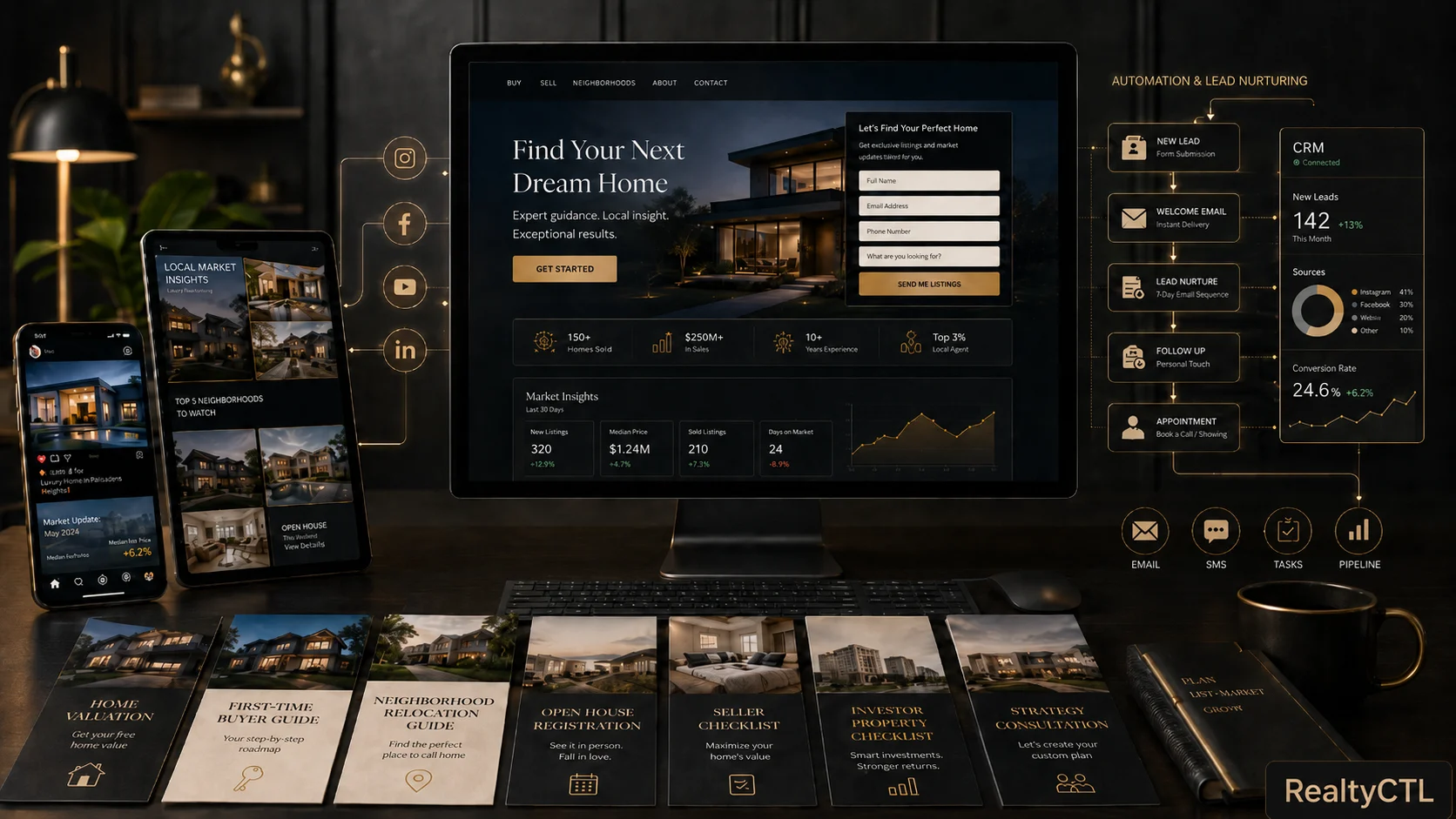
Lead Magnets, Landing Pages, and CTAs for Realtor Social Media
Sending social media attention to a generic homepage or relying only on “DM me” can underperform because the audience has no specific next step. A better Realtor social media funnel usually matches one audience intent with one clear offer.
Useful lead magnet and CTA ideas include:
- Home valuation request
- Seller preparation checklist
- First-time buyer guide
- Neighborhood relocation guide
- Open house registration
- Buyer consultation
- Seller consultation
- Listing appointment request
- Market update download
- Downsizing guide
- Investor property checklist
- New construction buyer guide
A good landing page should have a clear headline, a specific buyer or seller benefit, a short form, trust signals, brokerage and compliance details where needed, approved reviews or testimonials, a simple CTA, fast page speed, mobile-friendly layout, CRM connection, and tracking setup.
Lead magnets should educate and qualify, not just collect contact information. A seller checklist can reveal timeline and motivation. A relocation guide can identify the target area and moving date. A buyer consultation CTA can help separate active buyers from casual browsers.
Social media should create the next step for the audience. Interested buyers and sellers should not be left wondering what to do after they watch a reel, save a carousel, or click a profile link.
Content Calendar, AI Support, CRM, and Follow-Up
Consistency and follow-up are often the biggest gaps in Realtor social media marketing. Buyers and sellers may watch a Realtor’s content for weeks or months before they reach out. A content calendar helps the agent stay visible without guessing what to post every day.
A monthly plan may include weekly themes such as buyer education, seller attraction, listing promotion, neighborhood authority, local business content, market updates, client trust content, and referral reminders. Caption writing, design, reels planning, and scheduling support help keep the content organized and on-brand.
Automation helps once someone engages. A comment, DM, form submission, missed call, or guide download can trigger the next step. That may include an instant confirmation message, SMS follow-up, email nurture, missed call text-back, lead routing, lead tagging, CRM pipeline stages, appointment reminders, and long-term buyer or seller nurture.
AI-assisted responses can help with speed, consistency, conversation summaries, suggested replies, and routing. AI should not replace human relationship-building, licensed real estate advice, broker oversight, or compliance review. The Realtor should remain involved when the conversation requires judgment, pricing strategy, negotiation, representation, or sensitive advice.
Real estate teams may also need support with inbox management, content scheduling, CRM cleanup, appointment coordination, and lead follow-up tasks. RealtyCTL can connect content workflows with virtual assistant support for Realtors where helpful.
The best social media-to-CRM path helps the Realtor know who engaged, what they wanted, when they should be contacted, and what message should come next.
Build a Realtor Marketing System
How to Measure Social Media Performance and ROI
Likes and followers alone can be misleading. A post may look successful because it performs well visually, but still fail to create qualified conversations, appointments, listing inquiries, or pipeline opportunities.
Realtors should look at full-funnel performance. Useful metrics include reach, profile visits, saves, shares, comments, direct messages, link clicks, landing page conversion rate, lead source quality, cost per lead if paid promotion is used, appointment booking rate, listing consultation requests, buyer consultation requests, CRM pipeline movement, follow-up response rate, and long-term nurture opportunities.
Social media ROI may include both direct and indirect value. Direct value can include buyer leads, seller leads, consultation requests, open house registrations, and listing inquiries. Indirect value can include brand trust, repeat visibility, referral confidence, listing presentation support, and stronger recognition in the local market.
For example, a market update carousel may not create an appointment the same day, but it may be saved by homeowners who are thinking about selling later. A neighborhood video may help a relocation buyer remember the agent. A client story may support trust before a listing consultation.
Do not judge content only by surface-level engagement. A smaller audience with better local relevance and stronger follow-up may be more valuable than a larger audience that never becomes part of the CRM. Results vary based on content quality, market demand, audience intent, budget, offer, landing page, follow-up speed, and sales process.
Real Estate Social Media Compliance and Trust Signals
Realtor social media marketing must be handled carefully because real estate professionals operate in a regulated and reputation-sensitive industry. This section is for general marketing education and should not be treated as legal, compliance, financial, or real estate advice.
Marketing should be reviewed by the appropriate broker, brokerage compliance reviewer, MLS, legal reviewer, or local real estate authority before publishing when needed. Current advertising and compliance requirements should be verified before publishing. Platform algorithms and ad policies can change.
Key areas to review include Fair Housing awareness, accurate advertising language, avoiding misleading listing claims, avoiding guaranteed results claims, brokerage name and licensing details where required, MLS and listing permission considerations, clear disclaimers, data privacy, permission-based communication, review and testimonial compliance, influencer or paid partnership disclosures where applicable, co-marketing considerations, and consistent brand trust.
Helpful official resources include the HUD Fair Housing rights and obligations, the FTC endorsements, influencers, and reviews guidance, the FTC CAN-SPAM Act compliance guide, and the NAR Code of Ethics.
Compliance-aware marketing can still be persuasive when it focuses on education, clarity, local expertise, accurate property information, and clear next steps. A qualified reviewer should confirm claims, disclaimers, brokerage requirements, listing permissions, and advertising language.
How to Choose a Done-for-You Social Media Marketing Partner
Before hiring a done-for-you social media marketing agency or real estate marketing partner, Realtors should look for real estate industry experience. The partner should understand buyer and seller intent, local content strategy, listing marketing, reels, carousels, captions, design quality, brand voice, CRM automation, paid ads, organic content, reporting, compliance-aware workflow, and follow-up support.
The partner should also set realistic expectations. They should not promise guaranteed leads, appointments, clients, closings, followers, engagement, viral content, ad approval, or ROI. Marketing performance depends on campaign quality, content consistency, follow-up, budget, market demand, audience intent, creative quality, and sales execution.
RealtyCTL is a strong fit for Realtors who want a full real estate growth engine instead of disconnected social media tasks. RealtyCTL can support done-for-you content, content calendars, Instagram, Facebook, LinkedIn, TikTok, and YouTube Shorts strategy, reels, carousels, listing content, local authority content, landing pages, CRM pipelines, AI-powered lead capture, follow-up automation, reporting, and conversion tracking.
For Realtors who work with lenders or referral partners, RealtyCTL can also support aligned buyer education and co-marketing strategies through mortgage lead generation support. For broader brand and marketing infrastructure, RealtyCTL helps real estate professionals connect content, campaigns, CRM, automation, and reporting.
Build a Realtor Marketing System
Done for You Social Media Marketing FAQs for Realtors
What is done for you social media marketing for Realtors?
Done for you social media marketing for Realtors means a marketing partner helps plan, create, design, write, schedule, and guide content for real estate business goals. A strong system may include reels, carousels, captions, listing posts, local authority content, lead magnets, CRM connection, and follow-up support.
Does social media marketing help Realtors get leads?
Social media marketing can help Realtors create buyer leads, seller leads, referral opportunities, listing inquiries, and local brand trust when the strategy is clear. Results vary by market, content quality, audience fit, offer, consistency, landing page, follow-up speed, and sales process.
What should Realtors post on social media?
Realtors can post buyer education, seller tips, listing stories, open house content, market updates, neighborhood guides, local business spotlights, relocation content, client stories where approved, homeowner tips, and referral reminders. The best mix depends on the audience and business goal.
Is done-for-you social media better than posting myself?
Not always. DIY posting can work for Realtors who enjoy creating content and can stay consistent. Done-for-you support may be better for agents who need strategy, consistency, design, captions, video planning, scheduling, CRM connection, and follow-up structure.
Why is follow-up important after social media engagement?
Engagement does not automatically become a client opportunity. When someone comments, clicks, sends a message, downloads a guide, or asks about a listing, follow-up helps move the conversation into the CRM, qualify intent, and create a clear next step.
Should Realtors hire a done-for-you social media marketing agency?
Realtors may benefit from hiring a done-for-you partner when they lack time, consistency, content strategy, design support, lead capture, CRM workflows, or performance tracking. The right partner should understand real estate marketing, compliance awareness, buyer and seller intent, and follow-up systems.
Last Updated: 1st June 2026
Reviewed By: Abdullah Al Maruf
Written By

Abdullah Al Maruf
Co-founder, NextCTL
Co-founder of NextCTL who leads growth and product, with 16+ years across software and marketing, an MS in Data Science and AI and an MBA in Marketing.