
Loan Officer Marketing to Realtors for Better Referrals
Loan Officer Marketing to Realtors gives you targeted campaigns, smarter follow-up, and stronger partnerships that drive quality referrals. Book a call now.
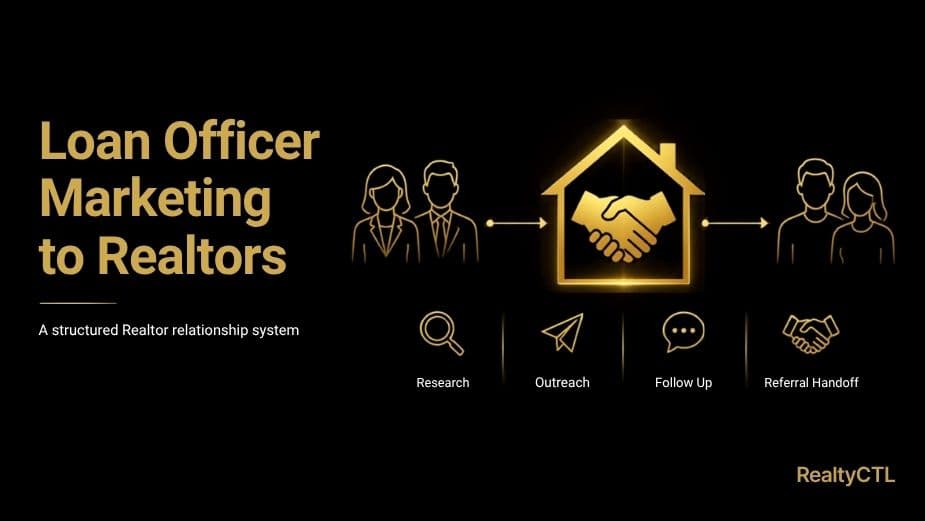
Loan Officer Marketing to Realtors works best as a structured relationship system, not a series of random coffee meetings, generic emails, or occasional requests for referrals. Many loan officers understand the value of agent partnerships, yet their outreach is inconsistent, difficult to track, and disconnected from the borrower experience.
A stronger approach connects agent research, personalized outreach, educational content, partner segmentation, CRM stages, referral acknowledgment, borrower handoff, reporting, and long-term nurturing. This guide explains how those pieces work together.
Results are not guaranteed. Performance varies by market, partner fit, reputation, communication quality, borrower service, follow-up speed, compliance review, and execution.
RealtyCTL approaches Realtor outreach as one connected mortgage growth system rather than a set of isolated marketing tasks.
What Is Loan Officer Marketing to Realtors?
Loan Officer Marketing to Realtors is the process of building, nurturing, and managing professional relationships with real estate agents who may serve the same home-buying audience. It includes more than networking. A complete approach combines research, outreach, value-based content, meeting workflows, relationship tracking, referral handling, and consistent communication.
Networking may create an introduction, but relationship marketing determines what happens afterward. Contact storage keeps a name and phone number. Partner management records why the relationship matters, what the agent specializes in, where the connection came from, what has already been discussed, and which next step would be genuinely useful.
Co-marketing is another supporting component. A loan officer and Realtor may collaborate on buyer education, workshops, open-house resources, neighborhood content, or home-financing explanations. These activities should support the audience first and should be reviewed for applicable advertising, licensing, disclosure, cost-allocation, and referral requirements.
A structured Realtor referral growth system may include:
- Local agent research and partner qualification
- Warm introduction and cold outreach workflows
- Relationship stages and follow-up reminders
- Educational content for agents and buyers
- Meeting scheduling and post-meeting actions
- Referral acknowledgment and borrower handoff
- Partner communication during the mortgage process
- Post-closing follow-up and long-term nurturing
- Reporting on conversations, referrals, applications, and repeat activity
The best systems connect Realtor relationship development with mortgage lead generation and borrower follow-up. An agent’s trust can be damaged when a referred borrower receives slow, unclear, or inconsistent communication, even when the original outreach campaign was strong.
Why Do Many Loan Officers Struggle to Earn Realtor Referrals?
Many loan officers struggle because their outreach begins with what they want rather than what the agent needs. A message that immediately asks for referrals can feel premature when the Realtor has not yet seen the loan officer’s communication style, reliability, market knowledge, or ability to support buyers.
Weak differentiation creates another problem. Many agents hear similar promises about fast closings, great service, competitive programs, and constant availability. Without a clear reason to engage, the loan officer becomes one more name in an already crowded contact list.
Common problems include:
- Sending the same message to every agent
- Failing to research the Realtor’s market, audience, or business model
- Talking only about rates, products, or personal achievements
- Asking for referrals before providing useful value
- Forgetting to follow up after an event or meeting
- Failing to acknowledge a referral quickly
- Providing inconsistent borrower updates
- Using automation without personalization
- Tracking contact volume but not relationship progress
- Ignoring inactive or past referral partners
Realtors often judge a lender by the experience their client receives. Professional response times, clear expectations, useful updates, and respectful communication can matter as much as the initial pitch. Poor borrower follow-up may damage both the current opportunity and the agent relationship behind it.
Random networking also creates gaps. A loan officer may attend several events, collect dozens of contacts, and remember only the most recent conversations. A structured system may help preserve context, organize follow-up, and reduce the risk that valuable relationships disappear when the loan officer becomes busy with active files.
What Should a Realtor Referral Marketing System Include?
A complete system begins with accurate partner data: brokerage, service area, buyer profile, specialty, relationship source, first-contact date, preferred channel, recent activity, referral history, and next action.
Source and timing matter. A warm introduction should not be handled like an unrequested cold message, and an event contact may respond best to follow-up tied to the discussion.
Useful relationship stages include prospect identified, first contact, reply received, meeting scheduled, meeting completed, active nurture, collaboration opportunity, active partner, inactive partner, and re-engagement.
The system should also support shared audience growth. Loan officers and agents may collaborate through real estate lead-generation campaigns, buyer resources, events, or local content when responsibilities and compliance requirements are clearly defined.
A Realtor relationship system is valuable when it turns visibility into useful conversations, professional collaboration, well-managed borrower introductions, and clear next steps.
The process continues after a referral arrives. The loan officer needs a workflow for acknowledging the introduction, contacting the borrower, recording communication status, updating the agent appropriately, and following up after the outcome.
Reporting should show which conversations, resources, events, and follow-up patterns create productive partnerships—not merely how many contacts were added.
How Should Marketing Change for Different Realtor Relationships?
Different Realtor relationships require different communication. New agents may need buyer education and confidence-building support, while high-volume teams may prioritize service standards, workflow visibility, and capacity.
Buyer agents often value pre-approval preparation and milestone updates. Listing agents may focus on buyer readiness and appraisal expectations. Brokerage leaders may respond better to team education or scalable resources.
| Relationship Type | Recommended Marketing Approach | Main Risk |
|---|---|---|
| New Realtor contact | Personalized introduction, useful resource, light follow-up, discovery conversation | Asking for business before building relevance |
| Warm introduction | Reference the mutual connection, respond promptly, suggest a clear next step | Using a generic message that wastes transferred trust |
| Active referral partner | Fast acknowledgment, borrower updates, post-closing review, ongoing collaboration | Damaging trust through slow or unclear communication |
| Inactive partner | Personal re-engagement, relevant market topic, relationship review | Sending an impersonal mass message |
| First-time-buyer agent | Educational guides, preparation checklists, simple process explanations | Overloading the agent or buyer with jargon |
| High-volume team | Service standards, team training, reporting, defined escalation process | Offering a one-size-fits-all partnership |
An agent with an active buyer may need a fast human response. A Realtor who already has a preferred lender may require patient nurturing and relevant education rather than repeated sales pressure.
Which Marketing Strategies Help Loan Officers Build Realtor Trust?
How Can Personalized Outreach Create Better Conversations?
Personalized outreach should reflect something relevant about the Realtor’s business, such as the neighborhoods, buyer types, events, or professional connections associated with their work.
The goal is a relevant opening, not a display of excessive research. A short message tied to the agent’s audience is usually more useful than a long list of credentials.
How Can Educational Content Support Realtor Relationships?
Educational content helps a loan officer stay visible without repeatedly asking for referrals. Useful topics include pre-approval preparation, document checklists, appraisal expectations, and common mortgage delays.
Program-related content may cover FHA, USDA, conventional, and VA buyer lead and follow-up workflows. Keep it general and route product-specific questions to a licensed mortgage professional.
How Can Events and Open Houses Create Useful Touchpoints?
Workshops, brokerage presentations, webinars, and open-house support can demonstrate value when they solve a real problem instead of becoming long sales presentations.
Follow-up should reference the actual conversation or resource. Same-day or next-business-day contact may preserve context, although results vary.
How Does Borrower Communication Protect Partner Trust?
The system cannot stop when an agent sends a borrower. Response speed, clarity, and follow-through become part of the marketing experience and can affect partner trust.
How Do CRM Stages and Follow-Up Support Realtor Marketing?
A referral partner CRM helps loan officers manage relationships rather than simply store contacts. Each partner record should show the current stage, communication history, meeting notes, resources shared, referral activity, follow-up date, and next recommended action.
CRM automation can support task reminders, meeting confirmations, event follow-up, approved email sequences, content delivery, and re-engagement dates. It should not replace the personal conversations required to build trust, discuss collaboration, resolve service problems, or respond to borrower-specific questions.
A practical workflow may include:
- Record the contact source and date created
- Tag the Realtor by audience, area, specialty, and relationship type
- Send a personalized first response or assign a call task
- Schedule and confirm a discovery conversation
- Record the agent’s priorities and preferred communication style
- Share a relevant resource based on the conversation
- Set the next follow-up date and relationship stage
- Acknowledge any borrower referral promptly
- Connect the borrower to the appropriate appointment workflow
- Maintain approved updates, notes, and post-closing follow-up
AI-assisted tools may help summarize notes, categorize intent, draft message options, or route replies. Every outward-facing message should still be reviewed for accuracy, tone, personalization, company policy, licensing, and compliance. Human handoff is essential when an agent or borrower needs mortgage guidance, pricing discussion, approval information, or financial recommendations.
Operational support may also matter. A trained team member or virtual assistant for CRM and scheduling support may help organize records, maintain approved tasks, schedule meetings, and support database reactivation under proper supervision.
What Outreach Messages Can Loan Officers Use With Realtors?
Strong outreach is brief, relevant, and connected to a real context. These are adaptable message angles, not universal scripts.
What Can a New Realtor Introduction Say?
“I work with buyers who need clear financing guidance. Would a brief conversation about the clients you serve in [market] be useful?”
What Can a Warm Introduction Say?
“[Mutual contact] suggested we connect. I would like to learn about your business and how you prefer lender communication to work.”
What Can a Post-Event Follow-Up Say?
“It was good meeting you at [event]. I wanted to send the first-time-buyer checklist we discussed.”
What Can a Co-Marketing Invitation Say?
“Would a short buyer resource or workshop around a common client question be useful?”
What Can an Open-House Support Message Say?
“I can provide an approved financing FAQ for the open house. What would fit your audience and brokerage requirements?”
What Can a Referral Acknowledgment Say?
“Thank you for the introduction. I received the buyer’s information and will follow the approved contact process.”
What Can a Past Partner Re-Engagement Message Say?
“I wanted to reconnect. Which financing questions are appearing most often in your market?”
What Can a Post-Closing Message Say?
“Thank you for the opportunity to support your client. I would value feedback on our communication process.”
Avoid approval guarantees, rate promises, unsupported savings claims, and pressure. Confirm consent, opt-out handling, channel rules, and company policy before use.
What Co-Marketing Ideas Can Loan Officers Offer Realtors?
Co-marketing works best when it solves a shared audience problem. A guide, workshop, or video can coordinate buyer education without turning the content into a sales pitch.
The content should clearly separate general education from individualized real estate, mortgage, legal, tax, or financial advice.
- First-time-home-buyer guides
- Pre-approval preparation checklists
- Home-buying webinars and local workshops
- Open-house financing FAQ sheets
- Neighborhood and relocation content
- Short educational videos for social media
- Email campaigns for buyer education
- Home-buyer document checklists
- Co-branded landing pages
- Local market question-and-answer content
Co-marketing can support Realtor and lender audience-growth campaigns. Review costs, branding, lead ownership, disclosures, referral handling, and anything of value before launch.
How Should Loan Officers Measure Realtor Marketing Performance?
Contact counts do not show whether a referral strategy is working. A large database may produce few conversations when records are outdated or follow-up lacks relevance.
Compare performance by relationship type, date, source, message angle, timing, and stage. Warm introductions and cold contacts should not be evaluated as if they were identical.
- Valid Realtor contact rate
- Reply rate by outreach source
- Meeting booking and completion rates
- Number of active referral partners
- Referrals received and acknowledged
- Time from referral to first response
- Qualified borrower conversations
- Application starts connected to partner referrals
- Pipeline movement by referral source
- Repeat partner activity
- Inactive partner reactivation
- Relationship-stage progression
Before-and-after reviews can show operational improvement, such as whether more contacts have clear stages and next actions, without implying guaranteed revenue.
Measure meaningful movement: conversations, collaboration opportunities, managed referrals, applications, repeat activity, and partner-pipeline visibility.
Which Compliance Issues Should Loan Officers Review?
Realtor marketing may involve email, text messages, calls, testimonials, co-branded content, referral arrangements, landing pages, and borrower communication. Requirements can change and may depend on channel, consent, company policy, state, licensing, and message content.
Commercial email campaigns should be reviewed against the FTC CAN-SPAM compliance guide. Calling and texting practices should be reviewed using the current 47 CFR 64.1200 requirements and relevant FCC TCPA information.
Housing-related marketing should be reviewed for fair housing and fair lending concerns. Official references include the HUD Fair Housing Act overview, the Department of Justice Fair Housing Act information, and the CFPB Regulation B and ECOA resource.
Co-marketing, settlement-service relationships, and anything of value may require review under the CFPB Regulation X and RESPA resource. Mortgage advertising and credit-related statements may also require review under the CFPB Regulation Z and TILA resource.
Licensing information may be checked through NMLS Consumer Access. Testimonials, reviews, endorsements, and material connections should be evaluated using current FTC endorsement and review guidance.
Before launch, teams should review:
- Consent for automated calls or text messages
- Commercial email identification and opt-out processes
- Accurate sender, brokerage, company, and licensing information
- NMLS and state-specific disclosure requirements
- Co-marketing costs and anything of value
- Referral fee and settlement-service concerns
- Fair Housing, fair lending, and ECOA implications
- Rate, payment, approval, savings, and closing claims
- Testimonials, reviews, and endorsements
- Secure handling of borrower and partner data
What Should You Look for in a Realtor Marketing Partner?
A qualified partner should understand both mortgage operations and Realtor relationship development. Generic outreach may create activity without improving partner quality, borrower handoff, or reporting.
Ask how outreach connects to what happens after a Realtor responds or refers a borrower. A complete plan should define ownership of research, message approval, meetings, notes, referral acknowledgment, borrower follow-up, reporting, and re-engagement.
- Mortgage and real estate audiences
- Realtor research and segmentation
- Relationship-based content strategy
- Partner CRM stages and referral tracking
- Email, SMS, appointment, and follow-up workflows
- Co-marketing and compliance-aware messaging
- Borrower handoff and lead-source visibility
- Database reactivation
- Reporting and realistic performance expectations
- Human and virtual assistant execution support
When internal capacity is limited, virtual assistant support for partner follow-up may help maintain approved scheduling, database, and administrative workflows under proper supervision.
RealtyCTL is positioned for mortgage professionals who want a connected system spanning strategy, content, CRM organization, Realtor outreach, borrower lead handling, appointments, reporting, and execution.
No provider should promise guaranteed Realtor referrals, applications, funded loans, closings, or ROI. A credible partner should explain its process, responsibilities, review points, risks, and performance variables.
What Questions Do Loan Officers Ask About Marketing to Realtors?
What Is Loan Officer Marketing to Realtors?
It is a structured process for researching, contacting, educating, nurturing, and supporting real estate agent relationships through outreach, content, meetings, referral tracking, and follow-up.
How Can Loan Officers Build Relationships With Realtors?
Understand the agent’s audience, provide useful information, communicate consistently, follow through on commitments, and create a professional borrower experience before requesting referrals.
What Do Realtors Want From a Loan Officer?
Needs vary, but many agents value responsiveness, reliability, buyer education, accurate expectations, and appropriate updates. Ask each partner what matters most.
How Often Should Loan Officers Follow Up With Realtors?
There is no universal schedule. Follow-up should reflect the relationship stage, previous conversation, active opportunities, and the recipient’s stated preferences.
What Content Should Loan Officers Share With Real Estate Agents?
Useful topics include pre-approval preparation, buyer documents, appraisal expectations, financing timelines, down payment assistance, and common causes of delays.
Can CRM Automation Replace Personal Realtor Follow-Up?
No. Automation can support reminders, scheduling, nurture, and recordkeeping, but relationships and borrower-specific conversations require qualified human involvement.
How Should Loan Officers Measure Realtor Referral Marketing?
Measure replies, meetings, active partners, response time, borrower conversations, applications, pipeline movement, repeat referrals, reactivation, and stage progression.
Should Loan Officers Hire a Realtor Marketing Partner?
A partner may help when strategy, content, CRM organization, reporting, or execution is inconsistent. Evaluate experience, capacity, budget, and compliance awareness.
Last Updated: 20th June 2026
Reviewed By: Abdullah Al Maruf
Written By

Abdullah Al Maruf
Co-founder, NextCTL
Co-founder of NextCTL who leads growth and product, with 16+ years across software and marketing, an MS in Data Science and AI and an MBA in Marketing.