
AI Avatars in Listing Videos: California's 2027 Disclosure
From January 1, 2027, California ads that prominently feature an AI-generated presenter or voice need a clear disclosure. Here is what agents and loan officers using AI video should change.

An AI presenter can make a listing video look polished in minutes. Starting in 2027, that same presenter could make a California ad noncompliant if viewers are not told what they are seeing.
Synthetic performer disclosure becomes a California advertising requirement on January 1, 2027. Under SB 1050, ads that prominently feature certain realistic AI-generated human performers or voices must clearly tell consumers that a synthetic performer appears. For real estate teams, the practical move is to review avatar-led tours, narrated ads, and mortgage promotions before publication.
What does California SB 1050 actually require?
California SB 1050, Chapter 246, was approved September 16, 2026. It adds Business and Professions Code Section 17610. Under Article IV, Section 8(c) of the California Constitution, this regular-session, non-urgency law takes effect January 1, 2027.
In plain language, it becomes unlawful to create and cause to be published in an advertising medium an advertisement that prominently includes a synthetic performer without a clear and conspicuous disclosure.
The definitions matter more than the technology's marketing label:
- Synthetic performer: A digital figure, voice, or representation created wholly or partly using generative AI that gives the realistic impression of a human performer who is not recognizable as an identifiable real person.
- Prominently: The performer appears in the foreground demonstrating or illustrating the offering, delivers on-camera or off-camera narration or the commercial message, or illustrates or reacts to that narration.
- Advertisement: An audio, video, or audiovisual message, including an online message, intended to induce someone to buy goods or services.
- Clear and conspicuous: Difficult to miss, easy to understand, and likely to be noticed by a reasonable consumer considering the medium and format.
The disclosure must be substantially similar to “this performance features a synthetic performer” or “no human performer is depicted.” That is much more specific than the vague AI disclosure in ads that many teams use today, such as a note that AI helped produce the video.
Which real estate videos and mortgage ads are likely covered?
Think about the role the generated person or voice plays in the commercial message, whether it is an AI avatar real estate video tour or AI voiceover real estate ads. An AI avatar that walks viewers through a home's features is not the same as software that removes background noise from your recording.
| Video or ad element | Synthetic performer under SB 1050? | What to do from 1 Jan 2027 |
|---|---|---|
| Realistic AI avatar presenting a listing | Likely, when foregrounded as the presenter | Add a clear, prominent synthetic-performer disclosure; check with counsel on placement |
| AI voiceover narrating a property tour | Likely, when a realistic synthetic human voice delivers the commercial narration | Disclose the synthetic narration in a way viewers or listeners will notice |
| AI-generated “buyer” actors in a loan officer ad | Likely, if they realistically depict human performers and illustrate the message | Disclose their synthetic nature; review the complete ad with counsel |
| Your own recorded voice translated by AI | May be excluded under the translation carve-out | Confirm the use fits the exception; check with counsel if the result changes the performance |
| AI captions and editing only | Generally not, if no synthetic performer is created | Keep accurate captions and edits; review other applicable advertising obligations |
| Non-human cartoon mascot | Generally outside the definition if it gives no realistic impression of a human | Check with counsel if the character becomes humanlike or realistic |
Where should the AI disclosure appear in a listing video or reel?
Treat the disclosure as part of the creative, not as an afterthought hidden in the last line of a description. The statutory test is whether an ordinary consumer can notice and understand it in that format.
For a video featuring a visible avatar, place readable text close to the performer and keep it on screen long enough to read. In a short reel, put it in the opening frames rather than waiting until viewers have already heard the pitch. For an audio-only ad, use a clear spoken disclosure at the beginning.
You can also repeat the disclosure in the ad copy and video description. That gives viewers another chance to see it, but description text alone may not satisfy the requirement when the performance itself is prominent.
For example, use: “This performance features a synthetic performer.” If no human performer appears, the alternative statutory wording is “No human performer is depicted.” Avoid relying solely on softer language such as “AI enhanced.”
When building real estate Facebook ads, make the disclosure readable on a phone-sized screen. For your broader real estate social media marketing, create a reusable disclosure treatment for vertical videos, landscape tours, and audio-first clips.

A visible projection reminds viewers that the presentation is a constructed performance.
Planning AI-led property videos for 2027? Book a strategy call to review a practical video-ad workflow with RealtyCTL.
What happens if a California ad omits the disclosure?
SB 1050 treats a violation of its synthetic-performer disclosure requirement as a violation of California's false advertising law, Business and Professions Code Section 17500, enforceable through the state's unfair competition law under Section 17200.
The statute also directs an advertising medium to stop publishing or disseminating a noncompliant advertisement after it has been served with a court order finding that the ad violates the section. That makes the issue relevant not only to the person commissioning the creative but also to the channels carrying it.
This article provides general information, not legal advice. Have qualified California counsel assess uncertain campaigns, especially when the generated figure resembles a real person or the creative combines multiple production techniques.
Does an AI disclosure make the whole ad accurate?
An AI presenter disclosure answers one question: Is the person or voice delivering the commercial message synthetic? It does not answer whether the property, financing terms, or claims in the ad are accurate.
A disclosed AI narrator can still deliver a misleading claim about square footage, availability, features, or what a buyer can expect. Disclosure is not a substitute for factual review.
There is also an important distinction between a generated performer and a modified property image. Virtual staging, removed objects, and AI-edited listing photographs raise separate accuracy and disclosure questions. Our guide to virtual staging disclosure addresses that different problem.
AI tools are already part of many agents' content workflows, as explored in our overview of REALTOR® AI usage in 2026. The right response is not to stop experimenting. It is to put a consistent review step between AI output and public advertising.
For every video, ask two different questions: Is the performer synthetic and disclosed where required? And does the entire advertisement accurately represent the property or service?
Could using your real face and voice be the better marketing choice?
Often, yes. A real agent walking through a property can show details that matter to a buyer: how natural light reaches the kitchen, the transition from living room to patio, or why a particular layout works. A loan officer explaining a process in their own voice can also make the message feel more direct.
You do not need a synthetic spokesperson to benefit from AI in your video workflow; an AI generated real estate video does not have to mean an AI presenter. Film yourself with your real voice, then use AI to draft a script, tighten an edit, prepare captions, or translate your recording. Translation and accessibility uses may fall within SB 1050's exception when they meet its terms.
Our AI for Realtors guide explores where automation can support marketing without replacing the relationship at its center.
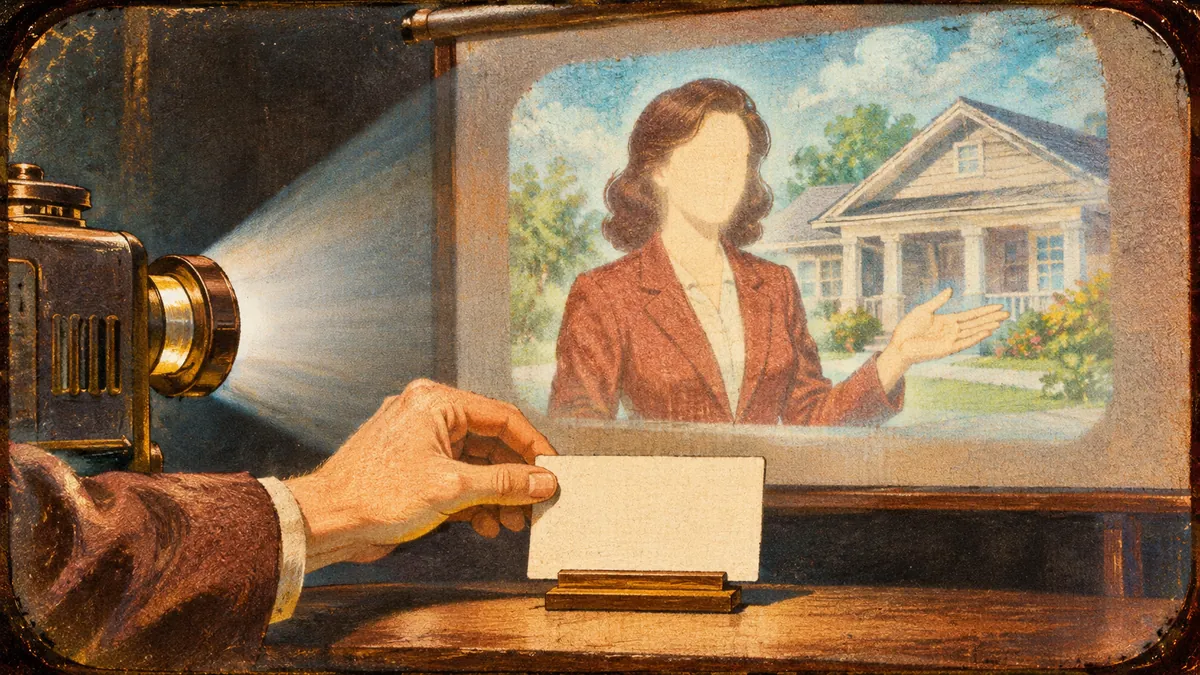
Keep the disclosure close to the synthetic presenter rather than hiding it elsewhere.
What belongs on your 2027 video-ad checklist?
Before publishing a California-facing listing tour, open-house promotion, reel, pre-roll video, or loan officer ad, run through this review:
- [ ] Identify every AI-generated humanlike figure, narrator, and voice in the creative.
- [ ] Determine whether each gives a realistic impression of a human performer.
- [ ] Check whether that performer is prominent in the commercial message.
- [ ] Confirm whether the video or audio is an advertisement published in California.
- [ ] Evaluate any claimed translation, accessibility, or other statutory exception.
- [ ] Use disclosure language substantially similar to the statute's examples.
- [ ] Place the disclosure where viewers or listeners can readily notice it.
- [ ] Check readability and timing on the actual mobile and desktop ad formats.
- [ ] Review property facts, mortgage claims, and visual edits separately for accuracy.
- [ ] Save the approved creative and ask counsel to review borderline cases.
Ready to plan videos that are both useful and publication-ready? Book a strategy call with RealtyCTL to build a reviewable real estate video marketing workflow for 2027.
FAQ
What is a synthetic performer under California law?
Under SB 1050, a synthetic performer is a digital figure, voice, or representation created wholly or partly with generative AI that gives a realistic impression of a human performer who is not recognizable as an identifiable real person. The law focuses on realistic humanlike performances, not every AI tool used during editing. Whether a particular creative qualifies depends on what it depicts and how it is used.
Do I have to disclose an AI voiceover in a listing video?
Likely yes if the video is an advertisement published in California and a realistic synthetic human voice prominently narrates the tour or delivers the commercial message. SB 1050 expressly includes on-camera and off-camera narration in its definition of prominent use. A clear disclosure should be perceptible in the relevant format. Have counsel check unusual voice-generation or mixed-media cases.
Does SB 1050 apply to AI-translated videos of myself?
The statute includes a carve-out for translation and accessibility uses, so translating your own recorded performance may be excluded. The details of how the recording was produced and altered matter. Do not assume a completely generated spokesperson becomes exempt merely because it speaks another language. Document your workflow and check with counsel when the output goes beyond translating or making your original recording accessible.
When does California's synthetic performer disclosure rule start?
The requirement takes effect January 1, 2027. SB 1050 was approved on September 16, 2026, and its effective date follows the California Constitution's rule for regular-session, non-urgency statutes. Agents and loan officers advertising to California consumers should review planned 2027 creative now, especially reusable avatar templates, synthetic narration, and paid-video campaigns that may continue running after the start date.