
Realtor Website Design Services That Drive Your Real Growth
Choose Realtor Website Design built for speed, mobile users, local SEO, and lead conversion. Create a stronger online presence and request your quote today.

Real Estate Web Design should do more than make an agent, team, or brokerage look professional. It should help the right visitors understand who you serve, find useful property or market information, and move toward a buyer consultation, seller conversation, showing request, home valuation review, or another appropriate next step.
Many real estate professionals already have a website, but the site may function like a digital brochure. It may contain listings, an agent biography, and a contact form without connecting local SEO, buyer and seller journeys, lead capture, CRM routing, appointment booking, follow-up, analytics, accessibility, and compliance-aware communication.
A stronger website connects those components into one organized system. This guide explains website strategy, IDX and MLS integration, local content, mobile usability, conversion paths, CRM connections, website performance, reporting, accessibility, and trust. Results are not guaranteed. Performance depends on competition, market conditions, domain history, content quality, technical implementation, traffic quality, offers, follow-up, compliance review, and agent execution.
What Is Real Estate Web Design?
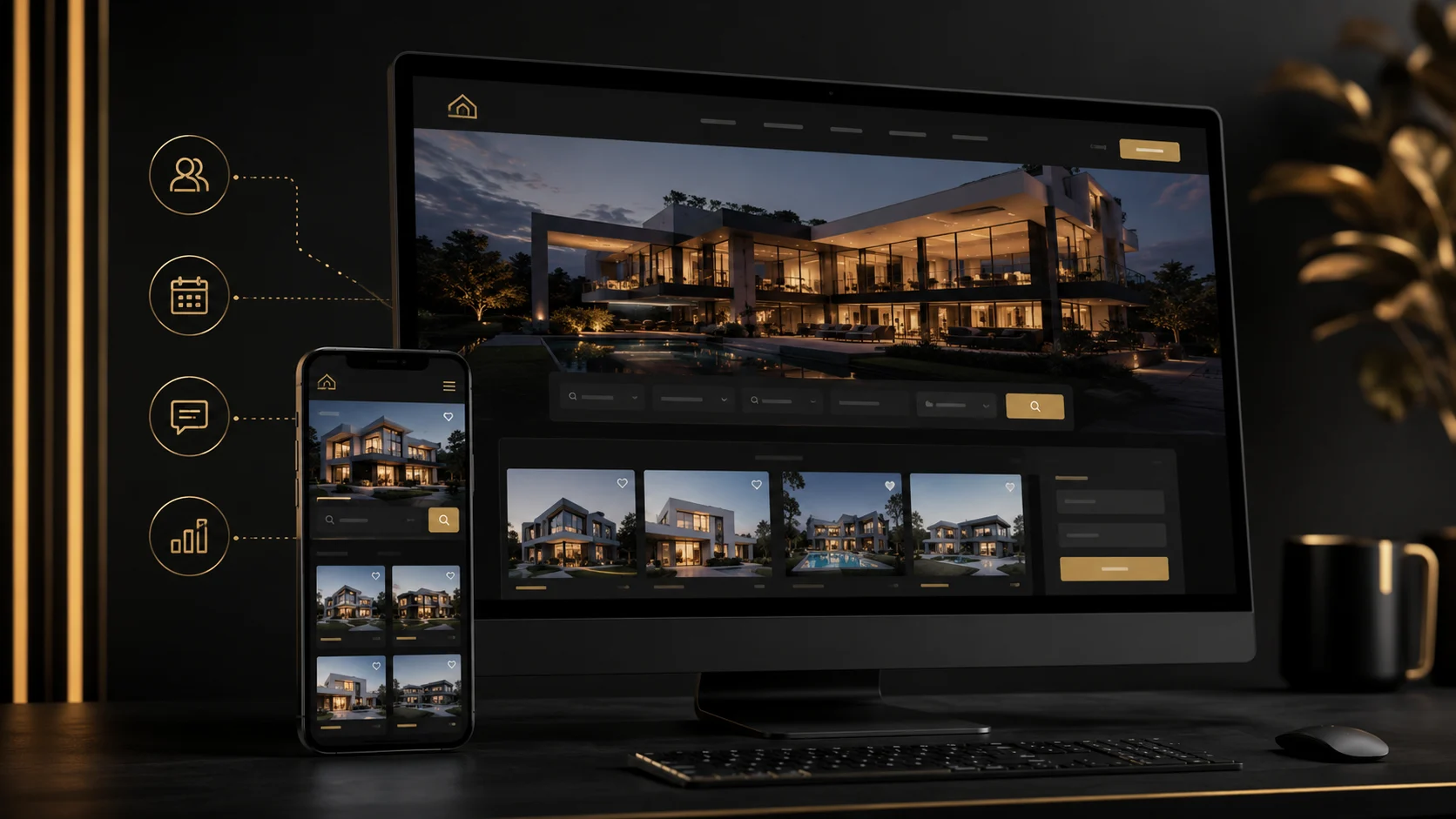
Real Estate Web Design is the process of planning, creating, developing, optimizing, and maintaining a website specifically for agents, Realtors, teams, and brokerages. The design must account for how real estate consumers search, compare professionals, explore properties, evaluate local expertise, and request help.
A complete real estate website may combine brand positioning, responsive design, user experience, local SEO, IDX property search, listing pages, neighborhood content, buyer and seller resources, lead forms, CRM integration, appointment scheduling, analytics, security, and ongoing maintenance.
That is different from a basic brokerage profile page. A brokerage profile may give an agent visibility, but it usually offers limited control over branding, content strategy, tracking, local pages, conversion paths, and follow-up integrations.
A generic website template provides a starting layout, while a basic IDX website focuses heavily on property search. A standalone landing page supports one campaign. A brochure website introduces the business. A complete website conversion system connects all of these functions around a clear client journey.
Visitors may arrive from Google Search, paid ads, Instagram, Facebook, listing promotions, open houses, email campaigns, referrals, QR codes, or direct searches for the agent’s name. The website should preserve that context and guide each person toward the most relevant next step.
RealtyCTL helps real estate professionals think beyond isolated pages by connecting website strategy with real estate lead generation systems, landing pages, CRM automation, appointment workflows, content, and reporting.
Why Real Estate Websites Fail to Generate Qualified Opportunities
A website can look polished and still fail to support meaningful business growth. Attractive colors, professional photography, animation, and listing feeds cannot compensate for unclear positioning, confusing navigation, weak calls to action, or a disconnected follow-up process.
Visitors usually arrive with a specific question. A buyer may want to search within a price range. A seller may want to understand the listing process. A homeowner may be considering a valuation. A relocation prospect may need local guidance. A past client may want a market update.
When the website presents the same generic message to every visitor, it creates friction. People may leave because they cannot quickly determine whether the agent serves their location, understands their situation, offers the service they need, or provides an easy way to continue the conversation.
Common website problems include:
- One generic message for buyers, sellers, investors, and past clients
- No clear buyer or seller journey from the homepage
- IDX search without useful guidance or local context
- Slow loading on mobile devices
- Thin city and neighborhood pages with repeated content
- Generic stock photography that does not support local trust
- Contact forms that do not explain what happens next
- No consultation or appointment-booking option
- Website submissions sent to an unmonitored inbox
- No CRM tagging, assignment, or lead source tracking
- No measurement of calls, forms, bookings, or qualified inquiries
- Outdated biographies, listings, market information, or disclosures
- Accessibility, privacy, or compliance issues left until after launch
A website does not replace the agent’s expertise, market knowledge, negotiation ability, or relationship-building. Its role is to help visitors find relevant information, build confidence, and reach the right human conversation with less confusion.
The website also needs a clear process after conversion. A strong form is not useful when nobody receives the submission, the requested listing is lost, or the prospect waits too long for a response. Website design and business operations must support each other.
The Core Parts of a High-Converting Real Estate Website
A high-converting real estate website is not defined by one page, plugin, or property-search feature. It is built from connected components that support discovery, trust, usability, conversion, and follow-up.
Clear positioning and audience-specific messaging
The homepage should quickly explain who the business serves, where it operates, and what type of help it provides. A visitor should not need to read several paragraphs to determine whether the agent works with buyers, sellers, relocations, investors, luxury properties, or another audience.
Logical navigation and homepage routing
The homepage does not need to explain every service in detail. It should route visitors toward focused pages such as buying, selling, property search, home valuation, featured listings, communities, relocation, and contact or consultation booking.
Buyer and seller service pages
Buyer and seller pages should address different concerns. Buyers may need property search, financing-readiness information, representation guidance, and consultation scheduling. Sellers may need pricing-process information, preparation guidance, marketing strategy, local proof, and a listing consultation.
IDX, property search, and listing pages
IDX can help visitors search active properties, explore maps, and review listing details. It should support the client journey rather than consume the entire website. Featured listing pages, property inquiry options, and showing requests should connect with the CRM and preserve the property context.
Local content and expertise
Neighborhood, community, city, and market pages should provide original value. Useful content may include property types, price considerations, commute information, local amenities, transaction processes, relocation guidance, and objective market context.
Conversion paths and forms
Calls to action should match visitor intent. A person reviewing a listing may want details or a showing. A homeowner may want a valuation review. A relocation visitor may want a planning call. A first-time buyer may prefer a guide before scheduling a consultation.
CRM and follow-up integration
After a form submission, the system should preserve the traffic source, page visited, requested service, property interest, location, form context, assigned agent, and appointment status where available. It should then trigger the appropriate notification, task, or permission-based follow-up process.
Analytics, security, and maintenance
The website needs analytics, conversion tracking, security controls, backups, spam protection, software updates, broken-link monitoring, and content maintenance. Without ongoing management, even a well-planned launch can lose accuracy and performance over time.
A real estate website is valuable when it helps the right buyer, seller, or referral partner understand the next step and move into a qualified human conversation.
RealtyCTL approaches the website as part of a wider growth system that may include design, landing pages, SEO, CRM integration, AI-assisted response, appointment booking, reporting, content, and conversion support.
Website Journeys for Different Real Estate Audiences
Different visitors need different pages, information, forms, and calls to action. Sending every visitor to the same contact form makes it difficult to understand intent and can weaken the follow-up process.
Buyer website journey
A buyer may begin with property search, a neighborhood page, a listing, or a buyer guide. The website can help the visitor narrow location, property type, general budget, timeline, and desired next step without requesting unnecessary sensitive information.
The conversion path may lead to a property inquiry, saved search, showing request, or buyer consultation. The CRM should record the source page and basic intent so the agent can respond with context.
Seller website journey
A seller may need to understand the agent’s local expertise, marketing approach, preparation process, communication method, and listing strategy. Testimonials, case examples, service explanations, and a consultation option can support trust.
The primary action may be requesting a personalized home value review or scheduling a seller conversation. The page should avoid making unsupported claims about price, timing, or guaranteed outcomes.
Home valuation journey
An automated estimate can create initial interest, but it should not be presented as a definitive listing price. A useful valuation page explains that property condition, improvements, location, comparable activity, and current market factors may require a professional review.
Listing inquiry and showing request journey
Listing visitors often want availability, details, similar homes, or a tour. The requested property should be attached to the lead record. Showing requests should make clear that availability and scheduling may require confirmation.
Open house journey
An open house page can include event details, listing information, directions, registration, property documents, and a reminder option. After the event, follow-up should acknowledge the property viewed rather than sending a generic buyer message.
Relocation journey
Relocation prospects may need objective neighborhood comparisons, timelines, property options, process support, and a local consultation. The page should avoid subjective descriptions that could create Fair Housing concerns.
Expired listing and FSBO journey
These audiences need respectful, value-based content. The website may offer a listing review, marketing checklist, pricing discussion, or seller resource without using pressure, fear, or exaggerated claims.
Past-client and referral journey
Past clients may return for a market update, home value check-in, annual real estate review, referral introduction, or future move planning. A dedicated path makes the website useful after the transaction closes.
| Visitor Type | Primary Website Goal | Recommended Conversion Path | Main Risk |
|---|---|---|---|
| Buyer | Find suitable properties and guidance | Property search, buyer resource, consultation, or showing request | Treating an early researcher like an immediate client |
| Seller | Evaluate expertise and selling options | Seller page, value review, marketing explanation, consultation | Using unsupported price or timing promises |
| Home valuation prospect | Understand potential property value | Estimate request followed by local professional context | Presenting an automated estimate as definitive |
| Listing inquiry | Get details or view a property | Property-specific form, similar listings, or showing request | Losing the requested listing information |
| Open house visitor | Review and visit a property | Registration, event reminder, property details, post-event follow-up | Using generic follow-up after the event |
| Past client or referral | Reconnect or introduce an opportunity | Annual review, market update, referral form, or consultation | Providing no useful reason to return |
Real Estate SEO, Local Pages, and Website Architecture
Website design and SEO should be planned together. Adding SEO after design is complete may result in weak page structure, unclear search intent, duplicated content, poor internal linking, and missed local opportunities.
A keyword-to-page map assigns one primary purpose to each important page. The buying page should not compete with every neighborhood page. A seller service page should not target the same intent as a home valuation landing page. Clear separation makes the website easier for visitors and search engines to understand.
Useful architecture may include:
- A focused homepage
- Buyer and seller service pages
- Property-search and featured-listing areas
- Home valuation and consultation pages
- City, community, and neighborhood pages
- Relocation and specialty-service pages
- Agent, team, and brokerage trust pages
- Guides, market explanations, and blog resources
Local pages should contain original expertise instead of changing only the city or neighborhood name. Large groups of near-duplicate pages may create a poor user experience and provide little meaningful differentiation.
IDX listings can help users discover properties, but listing-feed content may also appear on many other websites. Agents can build stronger differentiation by adding original neighborhood guidance, buyer and seller education, service explanations, local insights, and useful answers to common questions.
Technical SEO should address heading structure, title tags, meta descriptions, internal links, image alt text, canonical tags, XML sitemaps, crawlability, indexation, structured data, mobile usability, redirects, and broken links.
Google’s guidance explains that SEO helps search engines understand content while helping users decide whether to visit a page. Current search guidance and technical recommendations should be verified during implementation because search systems and documentation can change.
Neighborhood content should use objective property, location, amenity, process, and market information. Avoid language that describes the type of people who should live in an area or suggests preferences related to protected characteristics.
Mobile Experience, Speed, Accessibility, and Trust
Design quality includes how easily people can use the website, not only how it looks on a large desktop screen. Many visitors will search properties, open listing links, complete forms, and call an agent from a mobile device.
A mobile-first real estate website should use readable text, clear spacing, thumb-friendly buttons, simple menus, stable page layouts, and short conversion paths. Sticky call or contact buttons can be helpful when they do not cover important content or create accidental clicks.
Large property images and video may support trust, but they can also slow the website. Image compression, appropriate dimensions, modern image formats, lazy loading, caching, and careful script management can improve the experience.
Google describes Core Web Vitals as metrics related to loading performance, interactivity, and visual stability. Good scores can support user experience, but they do not guarantee high search rankings. Review the current Core Web Vitals guidance when evaluating performance.
Accessibility should be considered during planning, design, development, content entry, and testing. Practical considerations may include keyboard navigation, visible focus states, color contrast, descriptive alternative text, properly labeled forms, understandable error messages, captions, readable controls, and logical heading order.
The Web Content Accessibility Guidelines provide an international standard for making digital content more accessible. A short checklist alone does not guarantee legal or technical conformance, so qualified review may be appropriate.
Trust can also be strengthened through accurate biographies, visible contact information, current licensing or brokerage details where required, professional photography, client reviews, clear service explanations, privacy information, secure forms, and transparent response expectations.
Connecting the Website to CRM, Follow-Up, and Reporting
The website should connect to the system used after a visitor calls, submits a form, downloads a resource, registers for an open house, or books an appointment. Otherwise, the business may generate activity without creating an organized pipeline.
A useful form-to-CRM connection can capture:
- Traffic source and campaign
- Landing page or content page
- Buyer, seller, or property intent
- Requested listing or service
- Location and general timeline where voluntarily provided
- Assigned agent or team
- Appointment status
- Follow-up task and conversation history
A property inquiry may create a property-specific tag and notify the appropriate agent. A seller consultation request may move into a booking workflow. A guide download may enter an educational nurture sequence. An open house registration may trigger an event reminder and post-event task.
AI-assisted systems may help acknowledge submissions, summarize messages, route leads, collect basic intent, or support scheduling. They should not replace licensed real estate guidance, negotiation advice, pricing strategy, representation decisions, disclosure review, or professional judgment.
Forms should collect only information needed for the current step. Casual website, SMS, or AI interactions should not request unnecessary sensitive financial, identity, or personal information before an appropriate secure process is available.
Real estate teams may also use virtual assistant support for content uploads, CRM cleanup, scheduling coordination, inbox organization, database work, and administrative follow-up where appropriate.
The goal is not to automate every interaction. The goal is to prevent inquiries from being lost, preserve useful context, reduce unnecessary friction, and help the agent enter the conversation at the right time.
How to Measure Real Estate Website Performance
Traffic and page views do not show the complete value of a real estate website. Performance should be evaluated by the quality of visitor actions and whether those actions move into appropriate business conversations.
Useful measurements may include:
- Organic and local search visibility
- Branded search activity
- Landing-page engagement
- Property-search usage
- Form start and completion rates
- Phone-call conversions
- Appointment-booking rate
- Qualified inquiry rate
- Buyer consultation requests
- Seller consultation requests
- Listing inquiry and showing request rates
- Home valuation submissions
- CRM handoff success
- Lead source quality
- Cost per qualified inquiry
- Cost per booked consultation
- Mobile conversion performance
- Core Web Vitals and page speed
- Indexation, broken links, and website errors
- Past-client and referral engagement
Metrics should be reviewed by traffic source, page type, device, visitor intent, campaign, and location. A neighborhood guide receiving moderate traffic may still be valuable when it produces relevant consultations. A high-traffic page may be weak when visitors leave without finding a useful next step.
Do not assume one benchmark applies to every agent. Performance varies by market, brand strength, competition, offer, website quality, traffic source, form design, follow-up speed, and audience readiness.
Compliance, Privacy, Accessibility, and Trust
Real estate websites communicate with consumers through listings, descriptions, photographs, testimonials, neighborhood pages, forms, valuation tools, IDX displays, calls, texts, emails, advertisements, and automated follow-up. Each area may require review.
This article does not provide legal advice. Requirements can vary by brokerage, state, MLS, IDX provider, advertising platform, communication method, and business structure.
Fair Housing and objective language
Website and neighborhood content should be reviewed for Fair Housing concerns. HUD explains that the Fair Housing Act prohibits housing discrimination based on protected characteristics. Review current Fair Housing information from HUD and obtain qualified guidance where needed.
Brokerage, licensing, MLS, and IDX review
Agent names, brokerage relationships, license information, listings, property details, logos, attribution, disclaimers, and IDX displays should follow applicable rules. MLS and IDX requirements can vary and may change.
Forms, calls, texts, and email
Forms should explain how submitted information may be used. Automated calls and texts may require appropriate consent and opt-out handling under applicable rules. Review the current federal telephone delivery restrictions with a qualified reviewer.
Commercial email may be subject to requirements concerning sender identification, subject lines, postal addresses, opt-out methods, and honoring unsubscribe requests. The FTC CAN-SPAM compliance guide provides official business guidance.
Privacy, tracking, and data security
Privacy policies, cookies, analytics, advertising pixels, call tracking, form storage, third-party integrations, and data retention should be reviewed. Collect only information needed for a legitimate business purpose and protect consumer data through appropriate security practices.
Testimonials, images, and content rights
Reviews and testimonials should be accurate and used with appropriate permission and disclosures. Website owners should also confirm rights to listing photographs, videos, logos, floor plans, neighborhood images, written content, and other media.
How to Choose a Real Estate Web Design Partner
The right partner should understand both website development and the real estate client journey. A visually skilled designer may not understand IDX, local SEO, buyer and seller intent, CRM routing, lead tracking, or real estate compliance.
Before hiring a provider, evaluate:
- Real estate industry experience
- Understanding of buyer, seller, listing, and referral intent
- Website strategy and discovery process
- Custom design and development capabilities
- Mobile-first UX experience
- IDX and MLS integration knowledge
- Local and technical SEO knowledge
- Content strategy and conversion copywriting
- Landing-page and form experience
- CRM, calendar, and automation integrations
- Analytics and conversion tracking
- Accessibility and privacy awareness
- Security, backups, hosting, and maintenance
- Post-launch support and reporting
- Clear ownership of the domain, content, media, and website
- Administrative access to hosting, analytics, CRM, and integrations
- Realistic expectations without unsupported promises
Be cautious when a provider promises guaranteed rankings, guaranteed leads, instant SEO results, or unclear ownership arrangements. Ask what happens after launch, who controls each account, how updates are handled, and how performance is measured.
RealtyCTL is positioned for agents, teams, and brokerages that want more than a visual redesign. Its wider growth infrastructure can connect website strategy, SEO, lead capture, landing pages, CRM automation, appointment booking, content, reporting, and follow-up into one organized system.
Real Estate Web Design FAQs
What is Real Estate Web Design?
Real Estate Web Design is the planning, design, development, optimization, and maintenance of websites for real estate agents, teams, and brokerages. It may include branding, mobile UX, IDX, local SEO, property pages, buyer and seller content, lead forms, CRM integration, appointment booking, analytics, accessibility, and security.
What should a real estate agent website include?
A real estate agent website should clearly explain the agent’s market, services, and value. It may include buyer and seller pages, an agent biography, property search, featured listings, community pages, testimonials, consultation options, lead forms, contact details, privacy information, CRM integration, analytics, and required brokerage or licensing disclosures.
Does a real estate website need IDX integration?
IDX may be useful for agents who want visitors to search active properties on their website. However, IDX alone does not create a complete website strategy. The site still needs original content, clear positioning, local expertise, buyer and seller guidance, conversion paths, follow-up, and accurate tracking.
How can a real estate website generate leads?
A website can support lead generation through property inquiries, showing requests, home valuation offers, guides, consultation booking, open house registration, local content, landing pages, and calls. Qualified inquiries also depend on traffic quality, relevant offers, trust, website usability, CRM routing, and timely follow-up.
How does SEO support Real Estate Web Design?
SEO helps organize pages around search intent, local topics, technical accessibility, crawlability, and useful content. It may include keyword mapping, location pages, neighborhood resources, internal links, metadata, structured data, image optimization, page speed, indexation management, and ongoing content development.
How much does professional Real Estate Web Design cost?
Pricing varies based on template versus custom design, page count, content needs, IDX integration, CRM connections, SEO scope, copywriting, photography, custom functionality, hosting, maintenance, reporting, and ongoing support. Agents should request a written scope that clearly explains ownership, deliverables, exclusions, and recurring costs.
Should agents hire a professional real estate web design partner?
A professional partner may be useful when an agent needs custom strategy, stronger positioning, IDX support, local SEO, lead capture, CRM integration, analytics, technical development, or ongoing maintenance. The partner should understand real estate workflows, provide clear ownership terms, and avoid guaranteed performance claims.
Last Updated: 25 th June 2026
Reviewed By: Atiq Md Rezaul Hoque Turjo
Written By

Atiq Rezaul Hoque Turjo
Founder & CEO, NextCTL
Software architect with 16 years of experience, founder and CEO of NextCTL, and the builder behind the CTL stack: BackCTL, H22T and RealtyCTL.