
Loan Officer Personal Branding Made Simple for Growth
Use Loan Officer Personal Branding to showcase expertise, earn borrower confidence, and generate more qualified applications. Build a trusted brand today.
Loan Officer Personal Branding matters when borrowers and referral partners cannot clearly explain why they should remember, trust, or contact one mortgage professional instead of another. Generic profiles, inconsistent social posts, weak local visibility, outdated reviews, and websites with little original expertise can make an experienced loan officer appear interchangeable.
A useful personal brand is not simply a logo, color palette, headshot, or posting schedule. It is a connected system that combines market positioning, consistent messaging, mortgage education, professional profiles, local search visibility, reputation, Realtor relationships, CRM nurture, appointment paths, and performance reporting through RealtyCTL mortgage growth infrastructure.
This guide explains how loan officers can define their audiences, create a clear value proposition, organize content pillars, strengthen websites and social profiles, use video and email, support local visibility, manage reviews, build Realtor-facing value, and measure business outcomes. Results vary according to audience fit, market competition, positioning, content quality, consistency, reputation, distribution, CRM setup, compliance review, and execution.
What Is Loan Officer Personal Branding?
Loan Officer Personal Branding is the strategic process of defining, presenting, distributing, protecting, and measuring how a mortgage professional is understood by borrowers, Realtors, referral partners, search engines, and local communities. It helps people recognize what the loan officer explains well, who they commonly serve, where they work, and what kind of professional experience they aim to provide.
A logo is a visual asset. Visual identity includes colors, type, photography, and presentation standards. Corporate branding represents the lender or brokerage, while personal branding explains the individual professional’s role, expertise, communication style, local relevance, and relationship value.
Social media posting is a distribution activity, not the full brand. Professional reputation includes reviews, referrals, responsiveness, and public trust. Content marketing demonstrates knowledge, while local authority helps a specific market understand the loan officer’s relevance. A complete personal-brand system coordinates all of those elements.
The brand may serve Google searchers, website visitors, paid-ad leads, social audiences, first-time buyers, purchase borrowers, refinance prospects, veterans, self-employed borrowers, past clients, Realtors, builders, and community partners. Each audience may enter through a different channel and require a different next step.
Personal branding becomes commercially useful when it connects visibility with lead capture, CRM segmentation, educational nurture, appointment booking, and timely human follow-up. RealtyCTL helps mortgage professionals connect brand positioning with content, lead generation, local visibility, reputation, nurture, appointments, and reporting.
Why Do Loan Officer Personal Brands Fail?
Many personal brands underperform because the loan officer begins with content production before defining the audience, market position, business priorities, or desired action. The result is often a collection of generic mortgage posts that could belong to any lender.
Weak differentiation does not always mean the loan officer lacks expertise. The expertise may be hidden behind broad statements such as “I help buyers achieve homeownership,” inconsistent profile language, or content that promotes services without answering specific questions.
- Profiles describe services but not the audience being served.
- Different job titles, biographies, or headshots appear across platforms.
- Content topics are selected randomly.
- Social posts rely on generic mortgage graphics.
- Website pages contain little original professional insight.
- Local pages are created by changing city names.
- Videos do not answer one focused question.
- Reviews and testimonials are unmanaged.
- Realtor content asks for referrals without providing partner value.
- Every post uses the same promotional CTA.
- Engagement is not connected to CRM nurture.
- Reporting stops at followers, impressions, and likes.
AI can assist with research organization, outlines, captions, scripts, and repurposing. However, generic AI output may remove the loan officer’s real experience and local context, so mortgage claims, examples, sources, tone, and compliance details require qualified human review.
What Should a Complete Loan Officer Personal Brand Include?
A complete system needs strategic, visual, editorial, reputation, distribution, conversion, and measurement components. These elements should reinforce the same position while performing different jobs across the borrower and partner journey.
How Should the Brand Strategy Be Defined?
Strategy should map business goals, primary audiences, secondary audiences, service areas, loan-program knowledge, common borrower questions, Realtor-partner needs, and market competition. The loan officer can then define a practical value proposition, brand promise, communication style, messaging pillars, and content pillars.
A value proposition should describe useful relevance rather than claim superiority. For example, a loan officer may focus on explaining first-time buyer preparation, supporting local purchase transactions, educating veterans about VA loan questions, or helping Realtors prepare shared clients for financing milestones.
How Should the Professional Identity Be Presented?
The identity system may include a full biography, short biography, speaker biography, profile headlines, professional photography, visual standards, brand voice, approved credentials, current company information, and clear NMLS or licensing details where required.
Consistency does not require identical content everywhere. A LinkedIn biography may emphasize professional relationships, while an Instagram profile may highlight borrower education and local visibility. The underlying identity, credentials, audience, and value should still agree.
How Should the Brand Become an Operating System?
The system should not stop after profile design or publication. Assets should be distributed, linked, repurposed, measured, updated, and connected to relevant workflows. A documented process also helps the team maintain quality when virtual assistant support for personal branding workflows is used for approved scheduling, profile updates, asset organization, or reporting.
A strong loan officer personal brand makes mortgage expertise easier to recognize, understand, trust, and act on across every important borrower and partner touchpoint.
How Should Loan Officers Position Their Personal Brands?
Positioning should clarify who the loan officer helps, which questions they understand, where they work, what professional experience they aim to provide, and what the audience can do next. It should be specific enough to be memorable without falsely implying that the loan officer serves only one type of borrower.
A loan officer may serve first-time buyers, veterans, self-employed borrowers, relocation buyers, refinance homeowners, Realtors, builders, and past clients. One or two primary themes usually create clearer recognition than “I help everyone with every loan.”
How Can a Value Proposition Remain Specific and Accurate?
A useful value proposition focuses on audience needs and the loan officer’s real capabilities. It may emphasize clear education, local process knowledge, communication with shared clients, document preparation, or experience discussing a particular loan-program category.
Positioning should avoid unsupported claims of being the best, fastest, cheapest, most approved, or guaranteed to close. It should not promise qualification, rates, savings, approval, or timing. The strongest differentiation often comes from how clearly the loan officer explains a process and supports the relationship.
How Should Personal and Company Branding Work Together?
The company brand provides institutional identity, products, policies, compliance standards, and operating structure. The personal brand provides a recognizable professional voice and local relationship layer. The two should reinforce each other rather than compete.
Profile names, employer information, titles, photographs, contact details, websites, and required disclosures should remain accurate across channels. A change in company, role, license, or service area should trigger an organized profile and content review.
Which Content Should Loan Officers Create?
Content should follow real borrower and partner questions rather than social trends alone. Different audiences, funnel stages, platforms, and relationship goals require different formats, levels of detail, and calls to action.
Purchase content can address preparation, pre-approval, documents, timelines, offers, appraisals, and closing. Refinance and cash-out refinance content should focus on goals, tradeoffs, costs, questions to ask, and the need for an individual review without promising savings or suitability.
First-time buyer content often requires foundational explanations. FHA, VA, USDA, conventional, jumbo, and self-employed borrower topics need distinct expertise because the questions, documentation, eligibility considerations, property issues, and program details are not interchangeable.
Realtor-facing content should help partners educate and prepare shared clients. Builder content may address financing communication and buyer readiness. Past-borrower content can support annual reviews, homeowner education, referrals, and long-term relationships.
| Content Type | Primary Audience | Recommended Format | Main Risk |
|---|---|---|---|
| First-time buyer guide | Early-stage and active first-time buyers | Pillar article, checklist, email sequence | Overwhelming readers or using outdated requirements |
| Purchase process video | Buyers preparing for a transaction | Short video supported by a detailed page | Making timelines or approval sound certain |
| VA or FHA article | Program-specific borrowers | Human-reviewed educational guide | Outdated eligibility, fee, or property information |
| Local mortgage page | Borrowers within a defined service area | Original local guide with useful FAQs | Thin pages created through city-name replacement |
| Realtor partner resource | Agents and shared clients | Co-branded checklist, webinar, or process guide | Unclear claims, attribution, or relationship disclosures |
| Past-borrower newsletter | Closed clients and homeowner database | Segmented email with a relevant resource | Sending generic or overly promotional messages |
A content system should combine search authority with channel distribution. Useful SEO for mortgage brokers can organize searchable website resources, while social media marketing for mortgage brokers can simplify and distribute those ideas to relevant audiences.
Each asset should connect with internal links, email nurture, CRM segmentation, lead magnets, appointment booking, and reporting. Not every post needs a consultation CTA; some may lead to a guide, FAQ, event, newsletter, or partner conversation.
How Should Websites, Social Media, Video, and Email Work Together?
Each channel has a different strategic role. The website should hold detailed, searchable, evergreen information. Social media builds familiarity and distributes selected ideas. Video can make complex concepts easier to understand, while email sustains relationships after the initial visit.
An About page should explain the loan officer’s audience, professional role, service area, communication approach, relevant experience, company relationship, and next step. Loan-program pages, local pages, articles, FAQs, and lead magnets can then demonstrate expertise around specific questions.
Email should match the recipient’s stage. An early buyer may need preparation content, an active prospect may need an appointment resource, a Realtor may need a shared-client guide, and a past borrower may value an annual review reminder.
How Can One Topic Be Repurposed Across Channels?
A first-time buyer preparation topic can become a long-form guide, LinkedIn document, Facebook post, Instagram carousel, short video, YouTube explanation, email checklist, downloadable resource, Realtor handout, and appointment-preparation message.
Every format should be adapted rather than copied. A video requires spoken clarity, a carousel requires sequence, an email requires one relevant action, and a landing page requires focused expectations about what happens after submission.
Content engagement should be recorded when practical through connected mortgage CRM workflows. This allows future communication to reflect the source, topic, audience, and stated interest instead of sending the same nurture to every contact.

How Can Local SEO, Reviews, and Reputation Strengthen a Personal Brand?
Borrowers may search a loan officer’s name, company, city, reviews, and social profiles before making contact. A recognizable brand needs accurate information across those touchpoints.
Google Business Profile eligibility, professional names, addresses or service areas, phone numbers, websites, hours, categories, and services should follow current Google guidelines for representing your business. A personal profile and company profile should not create contradictory information.
Local pages should provide meaningful geographic value, such as service-area context, local buyer questions, community resources, relocation information, and insights reviewed by a professional familiar with the market. A structured approach to local SEO for mortgage brokers should support readers rather than create duplicate pages with substituted city names.
Reviews may strengthen credibility when they reflect genuine experiences. Requests should remain neutral, public responses should protect borrower privacy, and testimonials should not imply that every borrower will receive the same outcome.
Web content should follow Google Search Essentials and Google guidance for helpful, reliable, people-first content. Meeting guidance does not guarantee crawling, indexing, local visibility, or rankings.
How Can Personal Branding Support Realtor and Referral Relationships?
Realtor-facing branding should communicate partner value rather than repeatedly ask for referrals. Agents often evaluate responsiveness, communication, educational support, local knowledge, and the quality of the shared-client experience.
Useful partner assets include buyer-preparation guides, financing milestone checklists, co-branded seminars, webinars, local resources, pre-approval education, open-house follow-up materials, and explanations of common causes of mortgage delays.
Borrower-facing content answers personal mortgage questions. Realtor-facing content helps partners prepare and support clients. Builder-facing content may focus on buyer readiness and transaction communication, while past-borrower content supports long-term homeowner relationships.
Effective loan officer marketing to Realtors should connect public visibility with direct outreach, relationship tracking, referral acknowledgment, borrower service, and long-term follow-up. Personal branding cannot compensate for poor communication with shared clients.
Co-marketing arrangements, endorsements, shared expenses, partner features, and referral relationships may require company and compliance review. The educational value should remain clear, and the content should not imply prohibited compensation or guaranteed referral outcomes.
How Should Loan Officer Personal Brand Performance Be Measured?
Followers, likes, and impressions can indicate reach, but they do not show whether the right audiences understand the brand or move toward useful conversations. Reporting should separate awareness, authority, engagement, lead generation, relationships, and pipeline outcomes.
Awareness measures may include branded search impressions, profile views, local visibility, website visits, and qualified audience growth. Content-quality measures may include engaged sessions, return visitors, saves, shares, video watch time, email engagement, and internal-link clicks.
Commercial measures may include lead-magnet downloads, forms, attributed calls, booked appointments, qualified appointments, show rate, application-path actions, application starts, assisted conversions, Realtor engagement, referral-source activity, past-borrower engagement, and pipeline movement.
Which Questions Should Brand Reporting Answer?
- Which topics attract the intended borrowers?
- Which content supports Realtor engagement?
- Which profiles drive relevant website visits?
- Which videos retain qualified viewers?
- Which articles assist appointment bookings?
- Which lead magnets create useful nurture opportunities?
- Which local pages attract service-area visitors?
- Which content is remembered by past borrowers?
- Which channels create activity but no clear next step?
- Which messages no longer match the brand position?
A hypothetical report might show that one educational article assisted several later appointments after being discovered through search, shared by a Realtor, and included in an email sequence. That example demonstrates assisted attribution; it is not a performance benchmark or expected outcome.
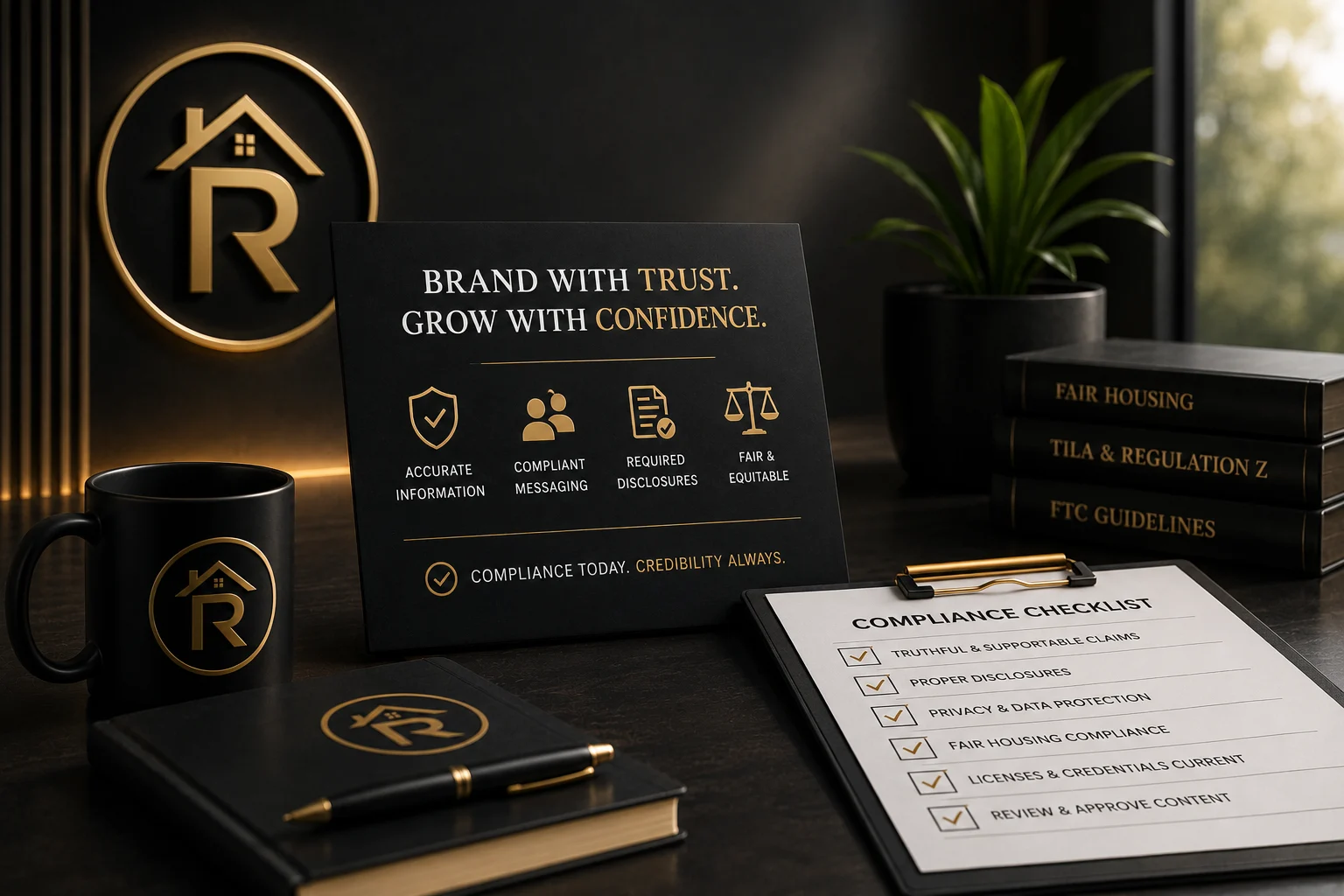
How Should Loan Officer Branding Compliance and Accuracy Be Managed?
Loan officer personal branding may include professional biographies, credentials, job titles, NMLS information, service areas, loan-program explanations, rates, payments, down payments, approval language, testimonials, social posts, email, video, landing pages, Google Business Profiles, and Realtor partnerships.
Brand claims and advertising language should be truthful, supportable, and reviewed in context. Teams can consult FTC advertising and marketing guidance while confirming lender, broker, company, state, and legal requirements.
Testimonials, reviews, influencer relationships, partner features, and other endorsements should be genuine and disclose relevant material relationships where required. Review the FTC endorsement and review guidance before publishing or repurposing social proof.
Email newsletters and nurture campaigns should use accurate sender information, suitable consent practices, and required unsubscribe processes. The FTC CAN-SPAM compliance guidance provides an official starting point, but additional requirements may apply.
Audience positioning, imagery, local content, targeting, and borrower language should be reviewed for Fair Housing and fair-lending concerns. Teams should consult HUD Fair Housing Act guidance and CFPB Regulation B and ECOA requirements with qualified reviewers.
Content involving rates, payments, costs, credit terms, or other financial claims may require additional review. Refer to the CFPB Regulation Z and TILA requirements and applicable company, product, jurisdiction, and advertising standards.
Professional credentials, employment information, state availability, and licensing details should remain current. NMLS Consumer Access licensing information may assist public verification, but required disclosures should be confirmed for every channel.
AI-assisted content should be reviewed for invented facts, outdated program information, unsupported specialization, inaccurate service areas, discriminatory language, misleading urgency, privacy exposure, and claims that require disclosures. Current rules, platform policies, and company standards should be verified because requirements can change.
What Should Loan Officers Look for in a Personal Branding Partner?
A personal-branding partner should understand mortgage audiences, positioning, content strategy, local SEO, professional reputation, video, email, Realtor relationships, CRM nurture, conversion paths, and compliance-aware review. A logo-only package or generic posting service cannot coordinate the full journey.
Ask how the partner researches audiences, develops value propositions, verifies mortgage claims, maintains profile consistency, reviews AI-assisted content, creates local resources, manages testimonials, repurposes content, connects the CRM, and measures appointments and assisted conversions.
RealtyCTL may fit mortgage professionals who need positioning, content, social distribution, local visibility, reputation, lead generation, CRM nurture, appointments, and reporting connected into one operating system. A suitable partner should set realistic expectations and avoid promises of specific follower growth, rankings, leads, applications, closings, funded loans, or ROI.
What Should Mortgage Professionals Know About Personal Branding?
What is Loan Officer Personal Branding?
It is a connected strategy for defining how a loan officer is understood, presenting professional expertise consistently, distributing useful mortgage education, building local and relationship trust, and guiding relevant audiences toward suitable next steps.
Why do loan officers need a personal brand?
A personal brand can help borrowers and partners recognize the professional behind the company name. It may strengthen clarity, trust, local relevance, and long-term recall when supported by accurate information and consistent execution.
What content should loan officers create for their brands?
Useful content may include purchase, refinance, loan-program, first-time buyer, self-employed borrower, local, Realtor, builder, and past-client education. Formats can include articles, videos, FAQs, email, social posts, checklists, webinars, and lead magnets.
How often should loan officers publish personal-brand content?
There is no universal schedule. A sustainable calendar based on audience demand, production capacity, review time, channel selection, and content quality is more useful than publishing frequently without a clear purpose.
Can AI build a loan officer personal brand?
AI may assist with research, drafts, scripts, captions, and repurposing, but it cannot replace the loan officer’s experience, judgment, voice, fact-checking, privacy review, or compliance approval. Human input is necessary for credibility.
Should loan officers hire a personal branding partner?
A partner may help when a loan officer lacks time, positioning strategy, content production, local SEO, video support, CRM coordination, or reporting. The provider should understand mortgage marketing, use human review, and avoid guaranteed performance claims.
Last Updated: 28th June 2026
Reviewed By: Abdullah Al Maruf
Written By

Abdullah Al Maruf
Co-founder, NextCTL
Co-founder of NextCTL who leads growth and product, with 16+ years across software and marketing, an MS in Data Science and AI and an MBA in Marketing.