
Facebook Ads for Mortgage Brokers | Get Better Leads
Grow faster with Facebook Ads for Mortgage Brokers designed to reduce wasted spend, improve targeting, and generate qualified mortgage leads. Book a call today.

Facebook Ads for Mortgage Brokers can help lending professionals reach home buyers, homeowners, past clients, and referral audiences across eligible Facebook and Instagram placements. The difficult part is not simply launching an advertisement. It is connecting the right campaign classification, audience strategy, creative, offer, lead path, tracking, follow-up, and reporting.
Many mortgage teams receive inexpensive form submissions that do not become useful conversations. Some leads do not remember completing an Instant Form. Others are outside the service area, interested only in a free resource, or contacted after their attention has moved elsewhere.
A complete Meta advertising system should connect campaign objectives, mortgage-specific creative, Instant Forms or landing pages, Meta Pixel, Conversions API, CRM attribution, lead routing, appointment booking, qualified-lead stages, pipeline reporting, and compliance review.
Performance is not guaranteed. Results vary by market, audience, campaign classification, objective, creative, offer, budget, placement, lead form, landing page, tracking quality, CRM setup, response speed, compliance review, and borrower intent.
What Are Facebook Ads for Mortgage Brokers?
Facebook Ads for Mortgage Brokers are paid campaigns created through Meta advertising tools to reach relevant audiences across Facebook, Instagram, and other eligible placements. Depending on current platform options, advertisers may use awareness, engagement, video, lead, website, messaging, or call-focused campaign paths.
A boosted post gives existing content additional distribution. Ads Manager campaigns offer more control over objectives, conversion locations, placements, creative variations, forms, website events, budget allocation, testing, and reporting. Boosting can support visibility, but it is not automatically a substitute for a structured lead-generation campaign.
Google Search Ads often capture active mortgage searches, while Facebook Ads may introduce an educational resource, event, or consultation before someone begins searching. Organic social media supports familiarity over time, while paid campaigns distribute selected offers faster. Neither channel repairs an unclear offer or delayed response.
RealtyCTL’s connected mortgage growth infrastructure brings paid campaigns, creative, landing pages, CRM automation, appointment booking, and reporting into one organized system.
Build Your Mortgage Facebook Ads System
Why Do Mortgage Facebook Ads Campaigns Often Fail?
Mortgage campaigns often fail because the advertisement is treated as the entire strategy. A campaign may generate impressions and form submissions while the creative, offer, lead form, CRM, and follow-up process communicate different messages.
Generic creative is another common problem. A stock photograph and broad promise may attract attention, but it gives the audience little reason to trust or remember the broker. Mixed purchase and refinance messaging can also make the offer difficult to understand.
Common problems include:
- One campaign promotes every loan product
- The advertisement could belong to any lender
- The offer is unclear or overly promotional
- The copy assumes a viewer’s private financial situation
- The Instant Form is completed with little intent
- The thank-you screen provides no relevant next step
- Leads receive a generic message unrelated to the ad
- Campaign and creative data disappear after CRM entry
- No one tracks which creative produced the inquiry
- Reports stop at cost per lead
- The team cannot connect campaigns to appointments or applications
- Policy and compliance review begin after launch
Increasing the budget does not correct weak creative, a poor offer, duplicate tracking, or slow follow-up. Campaigns should support the wider mortgage broker marketing strategy, including positioning, education, lead capture, nurture, and measurement.
What Should a Complete Mortgage Facebook Ads System Include?
A complete system begins with the market, licensing areas, borrower groups, loan priorities, and business objective. The team should decide whether the campaign is intended to educate an early-stage audience, promote a resource, create consultation requests, support an event, or re-engage a permitted first-party audience.
A practical system may include:
- Market, service-area, and licensing review
- Current campaign-classification review
- Audience and placement strategy
- Campaign and ad-set architecture
- Creative concepts and production
- Static, video, and carousel variations
- Ad copy, headlines, descriptions, and CTAs
- Educational offers and lead magnets
- Instant Forms or dedicated landing pages
- Privacy information and approved disclaimers
- Meta Pixel and Conversions API tracking
- CRM integration and source attribution
- Lead routing and immediate acknowledgment
- SMS and email follow-up where permitted
- Appointment booking and reminders
- Qualified-lead and pipeline stages
- Creative testing and budget management
- Policy and compliance review
A mortgage Facebook Ads campaign is valuable when it connects relevant creative with a clear offer, an appropriate lead path, timely follow-up, and measurable pipeline outcomes.
Campaign activity should not stop when a form is submitted. The CRM should preserve the campaign, ad set, advertisement, creative, offer, form or landing page, submission date, stated loan interest, location, assigned team member, contact result, appointment result, and later pipeline status.
This broader mortgage lead-generation system helps the business compare creative attention with qualified conversations and downstream outcomes.
Which Facebook Ads Campaign Types Can Mortgage Brokers Use?
The right campaign type depends on audience awareness, offer, creative capacity, conversion path, available data, budget, and follow-up resources. No single objective is best for every mortgage business.
| Campaign Type | Best Strategic Role | Primary Conversion Path | Data Requirement | Main Risk |
|---|---|---|---|---|
| Awareness or Video | Introduce the brand or explain a mortgage topic | Video engagement, profile visit, or later website action | Strong creative and clear audience context | Measuring views without a next step |
| Instant Form Lead Campaign | Capture inquiries with low mobile friction | Meta-hosted form and thank-you screen | Useful form questions, CRM routing, and fast response | Accidental or low-recall submissions |
| Website Lead Campaign | Provide more education and brand context | Dedicated landing page, form, or booking path | Fast page, Pixel, Conversions API, and analytics | Page abandonment or broken tracking |
| Messaging or Call-Focused | Start a direct conversation where available | Approved message or phone workflow | Staff coverage, response rules, and recordkeeping | Unmanaged inquiries or advice boundaries |
| Retargeting or Re-engagement | Reconnect with permitted prior audiences | Return visit, guide, event, or consultation | Eligible audience, consent, privacy, and policy review | Restricted use or weak audience quality |
Awareness and video campaigns can educate before asking for contact information. Lead campaigns create a faster inquiry path, while website campaigns provide more context. Messaging, call-focused, retargeting, and first-party audience paths require staffing, privacy, consent, data-security, and policy review.
How Do Special Ad Categories Affect Mortgage Facebook Ads?
Mortgage advertising may fall within Meta’s current rules for financial products and services, housing, or another applicable classification depending on the offer, market, jurisdiction, and current platform definitions. Advertisers should review the current Meta Special Ad Category guidance before publishing or editing a campaign.
Campaign classification can affect available audience controls. The current Meta audience guidance for Special Ad Categories should be checked before configuring age, gender, location, exclusions, custom audiences, retargeting, or lookalike-style tools.
Advertisers should not assume that a setting used in a previous campaign is still available or appropriate. Category names, authorization processes, audience features, geographic rules, and product options can change.
Audience limitations do not remove the need for strategy. A campaign still needs:
- Accurate service-area and licensing boundaries
- Creative matched to a real borrower question
- A clear educational or conversation-based offer
- Reliable conversion events
- CRM lead-quality stages
- Budget controls
- Compliance-aware review
Platform approval is not the same as legal, lender, broker, state, or company approval. A campaign can pass an automated review and still require changes under applicable mortgage advertising or fair-lending standards.
What Mortgage Offers Work With Facebook Ads?
The offer gives a person a reason to stop scrolling and take the next step. Because Facebook and Instagram audiences may not be actively searching for a mortgage, educational offers can be more suitable than an immediate application request.
Possible offers include:
- First-time buyer guide
- Home-buying preparation checklist
- Pre-approval document checklist
- General FHA, VA, USDA, or conventional loan guide
- Down payment assistance education
- Refinance review request
- Cash-out refinance educational resource
- Local home-buyer webinar
- Mortgage question-and-answer event
- Realtor partnership resource
- Consultation with a mortgage professional
Purchase and refinance offers should usually be separated because the audiences have different goals and timelines. First-time buyer content may need simple process education, while refinance prospects may need a longer nurture path.
VA advertising should explain general program considerations without assuming that a viewer is eligible. Cash-out refinance messaging should avoid promising that accessing equity is suitable or beneficial for every homeowner.
A strong offer supports lead generation for mortgage brokers by matching the audience, creative, form, landing page, and follow-up process.
Avoid guaranteed approvals, guaranteed rates, guaranteed savings, lowest-payment claims, unsupported eligibility statements, false urgency, and misleading government affiliation.
How Should Mortgage Facebook Ads Be Designed and Written?
Each advertisement should communicate one clear idea. A first-time buyer checklist, VA education video, refinance review, or local workshop needs its own concept rather than a graphic crowded with several offers.
Static ads can communicate a simple resource quickly. Video ads can explain a process or answer a common question. Carousel ads can present a logical sequence, such as steps to prepare for a mortgage conversation.
Video should remain understandable without sound. Use readable captions, concise on-screen text, clear pacing, and a direct CTA. Creative should use professional imagery that reflects the market and audience without implying that protected groups are preferred or excluded.
Ad copy normally includes primary text, a headline, a description, a CTA button, and the text inside the creative. These elements should support the same offer and avoid unnecessary repetition.
Useful message angles include:
- Prepare for your home-buying conversation
- Download a first-time buyer checklist
- Learn what to organize before pre-approval
- Review general purchase or refinance considerations
- Speak with a mortgage professional
- Register for a local buyer workshop
Meta’s advertising rules prohibit certain claims and targeting practices. Review the current Meta Advertising Standards and the Meta financial-products and services policy before launch.
Copy should not imply knowledge of a viewer’s vulnerable financial status or other private attributes. Instead of asking, “Are you struggling with bad credit?” use neutral language focused on the resource or service, such as, “Learn what factors mortgage professionals may review during a home-buying conversation.”
Should Mortgage Brokers Use Instant Forms or Landing Pages?
Instant Forms keep people inside Facebook or Instagram and can prefill basic information, reducing mobile friction. They may also create accidental or low-recall submissions. Landing pages provide more education, branding, trust signals, flexible qualification, and analytics, but weak pages can increase abandonment.
Useful initial fields may include:
- Name and contact information
- General purchase or refinance interest
- General timeline
- Service area
- Preferred contact method
The form and thank-you screen should remind the prospect what was requested and explain what happens next. For Instant Forms, review Meta’s current lead-ad privacy-policy guidance.
Do not request Social Security numbers, bank-account details, tax documents, credit-report data, or sensitive application records through a basic lead form. Meta’s Advertising Standards also restrict lead-ad questions that request certain financial, governmental, health, and other sensitive information without permission.
Higher friction does not automatically produce better leads, and lower friction does not automatically create poor leads. The correct choice depends on the offer, audience awareness, form questions, landing-page quality, follow-up, tracking, and compliance review.
Build Your Mortgage Facebook Ads System
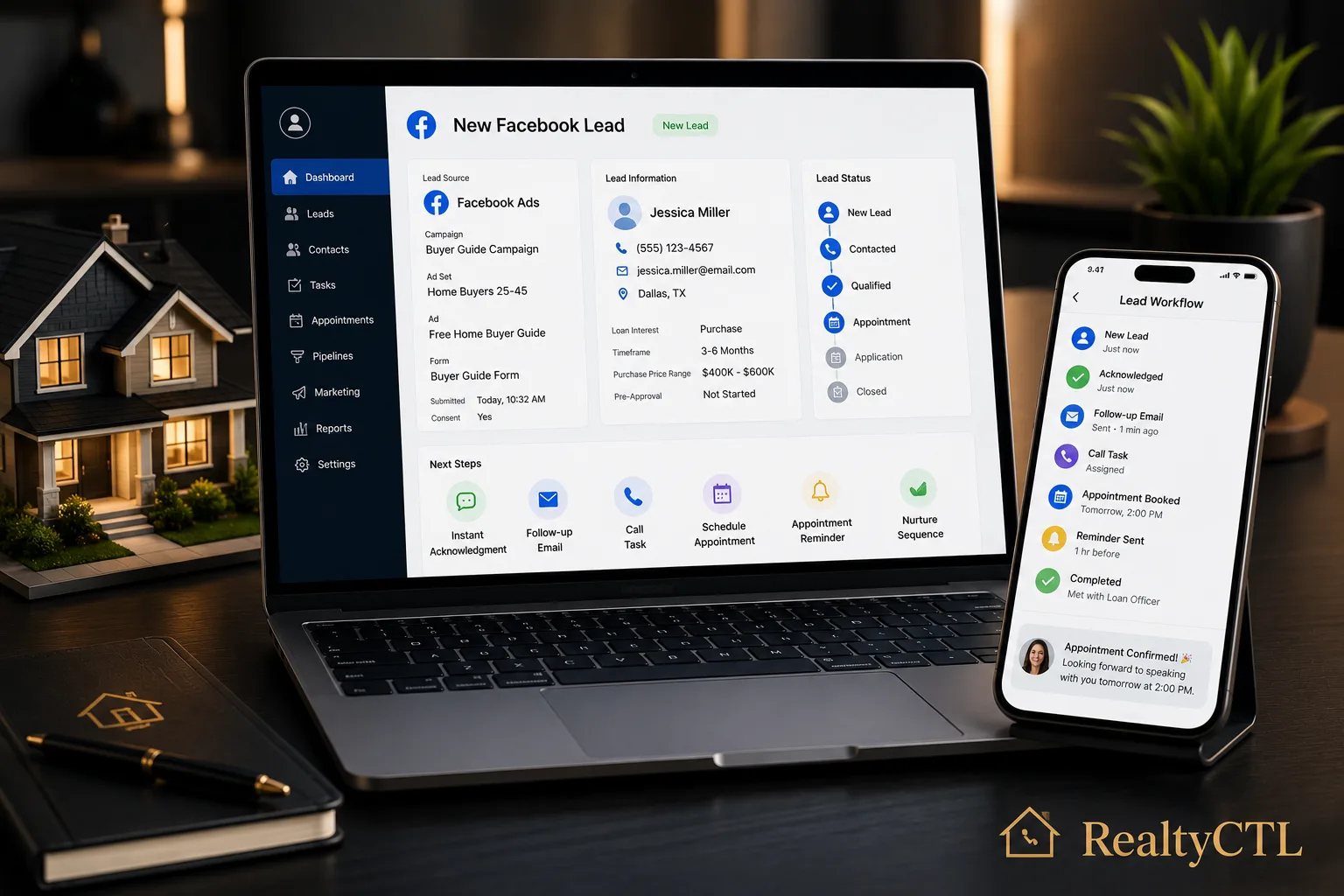
How Should Facebook Leads Connect With CRM and Follow-Up?
A Facebook lead should enter the CRM with useful source context. Fields may include campaign, ad set, advertisement, creative, offer, form or page, loan interest, service area, submission time, consent information where applicable, assigned loan officer, contact status, and appointment status.
Connected mortgage CRM workflows help distinguish a new form submission from a contacted lead, qualified conversation, appointment, application, nurture opportunity, or invalid inquiry.
The first follow-up should reference the exact guide, webinar, consultation, or advertisement that generated the lead. This reminder can reduce confusion when a person has submitted several online forms.
Mortgage marketing automation may support immediate acknowledgment, permitted SMS, educational email, call tasks, appointment reminders, no-show follow-up, and longer-term nurture.
Purchase, refinance, cash-out, FHA, VA, USDA, conventional, and first-time buyer leads may need different messages and timing. A prospect requesting a buyer checklist should not receive the same first response as someone requesting a refinance conversation.
Connected loan officer appointment workflows can support calendar selection, confirmation, rescheduling, reminders, and outcome tracking.
AI tools may assist with acknowledgment, summaries, routing, and basic intent detection. They should not independently provide mortgage advice, recommend loan products, quote unverified rates, determine eligibility, make approval decisions, or replace licensed human guidance.
How Should Meta Pixel and Conversions API Track Mortgage Leads?
Meta Pixel records selected browser-based website actions, while Conversions API can send approved marketing events through server or partner-based methods.
Meta’s official Conversions API guidance explains the role of server-side event sharing. Implementation should be reviewed for data minimization, consent, security, event quality, and prohibited-information risks.
Useful event planning may include:
- Landing-page view
- Form start
- Lead submission
- Appointment booked
- Qualified lead
- Application-stage event where appropriate
Form submission is not the same as a qualified lead. The business should define each event clearly so optimization and reporting do not treat spam, duplicates, accidental submissions, and qualified conversations as equal.
When browser and server tools send the same event, event identifiers and implementation logic may be needed to prevent duplicate counting. Pixel and Conversions API events should be tested before campaigns rely on them.
CRM outcomes may be shared back to Meta only when technically appropriate, permitted, secure, and reviewed. The team should control access, retention, hashing, consent, and the types of data sent.
How Should Mortgage Brokers Manage Budgets and Creative Testing?
No universal Facebook Ads budget fits every mortgage market. Planning depends on audience size, campaign objective, placement availability, offer, creative volume, lead path, tracking quality, and follow-up capacity.
Before increasing the budget, confirm that:
- The current campaign classification is correct
- The offer is clear and accurate
- The creative matches the form or landing page
- Privacy and disclosure elements are in place
- Pixel and Conversions API events are tested
- Duplicate events are controlled
- The CRM receives source data
- Leads receive prompt follow-up
- The team can manage additional volume
- Policies and compliance requirements have been reviewed
Creative fatigue can occur when audiences repeatedly see the same message, but no universal frequency defines it. Review trends, audience size, comments, clicks, and qualified outcomes.
Testing may compare the offer, creative concept, video opening, headline, primary text, CTA, form structure, or landing-page headline. When practical, change one meaningful variable at a time so the result is easier to interpret.
A successful creative should not be copied indefinitely without monitoring. The audience, market, platform delivery, and competitive context can change over time.
How Should Mortgage Brokers Measure Facebook Ads Performance?
Facebook Ads reporting should separate delivery, engagement, website, lead, appointment, pipeline, and operational metrics.
Delivery metrics include reach, impressions, frequency, placements, and spend. Engagement metrics may include video views, watch time, clicks, reactions, and comments. Website metrics may include landing-page views, form starts, page speed, and form completion.
Lead metrics include total submissions, cost per lead, contact rate, duplicate rate, spam rate, and qualified-lead rate. Appointment metrics include bookings, show rate, rescheduling, no-shows, and cost per qualified appointment.
Pipeline metrics may include application starts, application completion where accurately tracked, active opportunities, and funded outcomes where appropriate. Operational metrics include response time, routing failures, missed calls, and incomplete follow-up.
Cost per lead should not be evaluated alone. A low-cost lead may still be expensive when the contact information is inaccurate, the prospect does not remember submitting, the lead is outside the service area, or no appointment is booked.
CRM reporting should connect campaign, ad set, creative, offer, lead status, appointment result, and pipeline movement. This gives the business a clearer view than platform form volume alone.
Do not treat attribution as perfect. A person may watch a video, see a second advertisement, visit the website, receive a Realtor referral, and submit a form later through another channel.
Which Meta Policies and Mortgage Rules Require Review?
This section provides general education and is not legal, compliance, advertising, lending, privacy, cybersecurity, platform-policy, mortgage, or financial advice.
Mortgage advertisers should review campaign classification, audience controls, creative, forms, landing pages, tracking, data handling, follow-up, and disclosures before launch. Current requirements may vary by product, market, company, state, and jurisdiction.
Audience selection and advertising language should reflect fair and consistent practices. Review the HUD Fair Housing Act overview and CFPB Regulation B guidance when assessing targeting, discouragement risk, creative, forms, and lead handling.
Advertising involving rates, payments, costs, savings, or other credit terms should receive additional review. The CFPB Regulation Z guidance provides the official framework for Truth in Lending requirements.
Company identity, service areas, licensing context, and NMLS information should be accurate and visible where required. NMLS Consumer Access provides public licensing information for companies and mortgage professionals.
Advertisements should avoid:
- Assuming protected or private characteristics
- Discriminatory audience selection
- Misleading affiliation
- Guaranteed approvals, rates, or savings
- Unsupported payment claims
- Hidden conditions
- False urgency
- Unclear advertiser identity
- Inconsistent landing pages
- Sensitive-data collection through insecure forms
Meta approval does not guarantee legal, lender, broker, or company compliance. Confirm current requirements before launch or material changes.
What Should You Look for in a Mortgage Facebook Ads Partner?
A suitable partner should understand mortgage audiences, Meta campaign strategy, current Special Ad Category requirements, creative production, offer development, forms, landing pages, Pixel, Conversions API, CRM attribution, follow-up, appointments, reporting, and compliance-aware review.
Evaluate the partner’s process for:
- Market and licensing-area research
- Campaign classification and audience strategy
- Objective and conversion-location selection
- Static, video, and carousel production
- Mortgage-specific ad copy
- Lead magnets and offer development
- Instant Forms and landing pages
- Meta Pixel and Conversions API setup
- Event testing and deduplication
- CRM integration and lead routing
- Follow-up and appointment workflows
- Qualified-lead and pipeline reporting
- Creative testing and budget management
- Policy monitoring and compliance review
- Business Manager, account, dataset, and creative ownership
- Realistic expectations without guarantees
A capable partner should ask which states and markets are served, which licenses apply, which loan products matter, what offer will be promoted, whether the campaign will use a form or landing page, which CRM receives leads, how quickly leads are contacted, and what defines a qualified appointment.
The mortgage business should retain appropriate access to its Business Manager, ad account, Page, Instagram account, Pixel or dataset, forms, landing pages, CRM data, billing, and creative files.
RealtyCTL may fit mortgage professionals who want Meta campaigns, creative, lead capture, CRM follow-up, appointment booking, and pipeline reporting connected into one organized system.
Build Your Mortgage Facebook Ads System
What Questions Do Mortgage Brokers Ask About Facebook Ads?
What Are Facebook Ads for Mortgage Brokers?
They are paid Meta campaigns designed to reach eligible audiences across Facebook and Instagram with mortgage education, resources, events, or conversation offers. A complete system includes creative, lead capture, tracking, CRM follow-up, appointments, and reporting.
Do Facebook Ads Work for Mortgage Brokers?
Facebook Ads may create useful mortgage opportunities when the audience strategy, offer, creative, lead path, tracking, response process, and compliance review are aligned. Results vary by market, budget, and execution.
What Should Mortgage Brokers Advertise on Facebook?
Potential offers include first-time buyer guides, preparation checklists, educational FHA or VA resources, local workshops, refinance review requests, and mortgage consultations. The offer should match the audience’s awareness and intent.
Should Mortgage Brokers Use Instant Forms or Landing Pages?
Instant Forms may reduce friction, while landing pages can provide more education and trust. The better choice depends on the offer, form questions, page quality, tracking, follow-up, and compliance requirements.
How Should Mortgage Brokers Measure Facebook Leads?
Measure contact rate, qualified-lead rate, appointments, show rate, application movement, response time, duplicate rate, spam rate, and cost per qualified appointment alongside platform delivery and lead volume.
Should Mortgage Brokers Hire a Facebook Ads Partner?
A partner may be useful when the business needs campaign strategy, creative production, forms, landing pages, tracking, CRM integration, follow-up, policy review, and pipeline reporting. The partner should avoid guaranteed outcomes.
This content is intended for general Facebook Ads and mortgage-marketing education. It is not legal, compliance, advertising, lending, privacy, cybersecurity, platform-policy, mortgage, or financial advice.
Meta campaigns, classification, targeting, advertisements, creative, forms, landing pages, tracking, first-party data, rates, payment claims, follow-up, and disclosures should be reviewed before launch. Include required company, licensing, NMLS, consent, privacy, fair-lending, advertising, and disclosure language where applicable.
Facebook Ads, lead-generation, and conversion performance are not guaranteed. Results depend on market, audience, campaign objective, creative, offer, budget, lead path, tracking, CRM setup, response speed, follow-up, compliance review, and execution.
Last Updated: 27th June 2026
Reviewed By: Abdullah Al Maruf
Written By

Abdullah Al Maruf
Co-founder, NextCTL
Co-founder of NextCTL who leads growth and product, with 16+ years across software and marketing, an MS in Data Science and AI and an MBA in Marketing.