
Real Estate Appointment Setting Service Made Simple
Real Estate Appointment Setting Service gives agents a simple way to qualify leads, reduce missed calls, and book more appointments. Get started today.

A Real estate appointment setting service can help agents turn more lead activity into real buyer and seller conversations, but only when it is built as a complete lead conversion system.
If you are generating real estate leads but not booking enough buyer consultations, seller consultations, showing appointments, listing appointments, or open house follow-ups, the problem may not be lead volume alone. The issue is often slow response, weak follow-up, poor CRM visibility, missed calls, no reminders, and no clear agent handoff process.
Modern real estate appointment setting is not just calling a lead once or sending a calendar link. It should connect lead source tracking, fast response, buyer and seller qualification, CRM stages, SMS, email nurture, AI-assisted replies, calendar booking, reminders, agent handoff, reporting, and compliance-aware messaging.
This guide explains speed to lead, buyer and seller qualification, CRM automation, AI follow-up, database reactivation, appointment tracking, and compliance-safe communication.
Results are not guaranteed. Appointment setting performance depends on market conditions, lead source, offer quality, message quality, CRM setup, response speed, appointment process, agent execution, compliance review, and prospect intent.
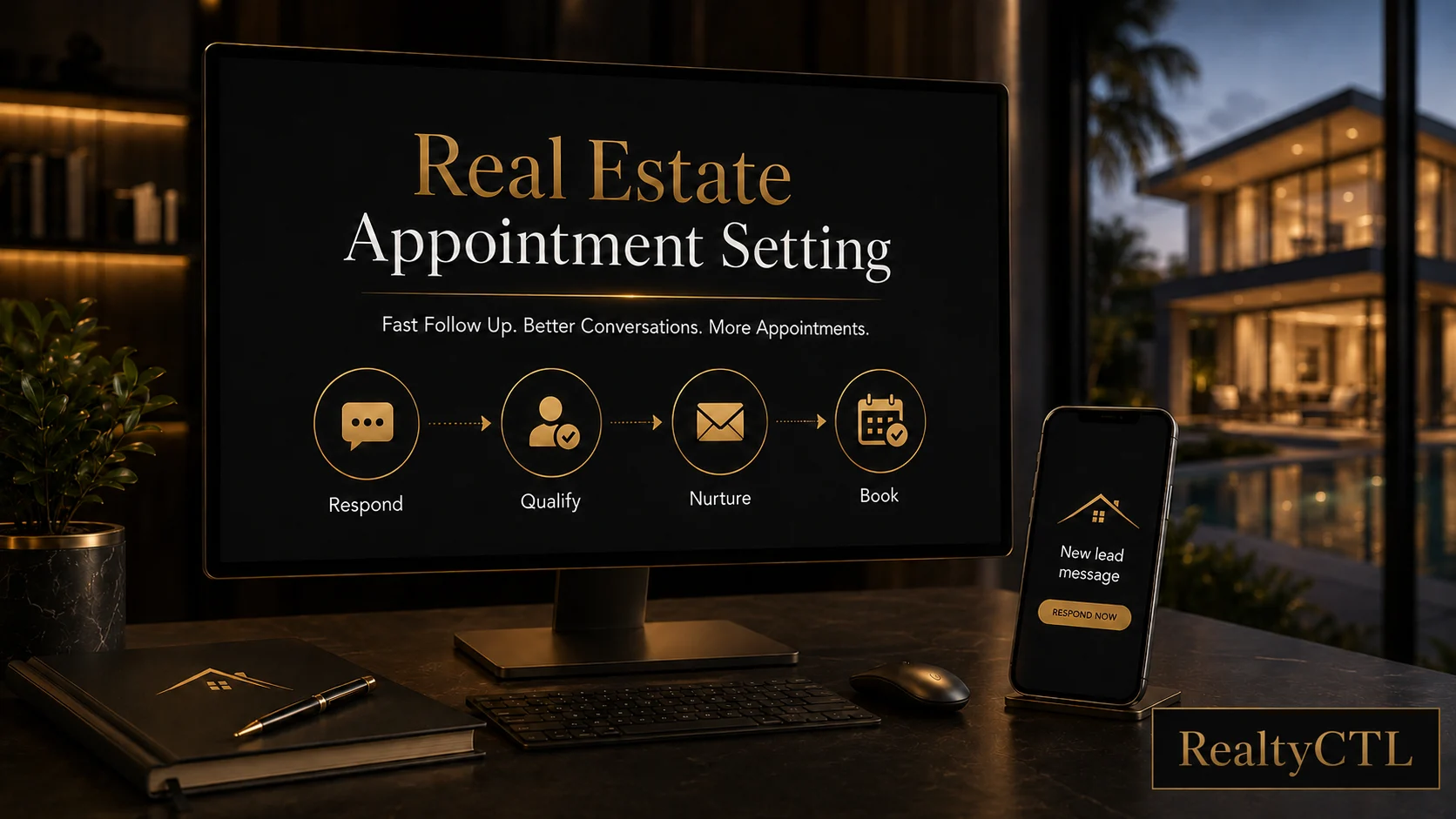
What Is a Real Estate Appointment Setting Service?
A real estate appointment setting service helps agents, Realtors, teams, and brokerages respond to leads, qualify interest, and schedule consultations or property-related conversations with people who may be ready for the next step.
It can include phone follow-up, SMS follow-up, email nurture, missed call text-back, CRM workflows, appointment booking links, appointment reminders, AI-assisted responses, lead routing, database reactivation, and basic qualification before the agent takes over.
A manual follow-up reminder only tells the agent to reach out. A basic call answering service may capture a message but usually does not manage the full lead journey. A calendar booking tool can schedule time but does not qualify intent or nurture leads. A CRM workflow can organize steps, but it still needs the right messages, timing, and human handoff.
ISA support can help with outreach, but it works best when it is connected to a clear CRM, scripts, lead source context, and appointment process. A complete real estate appointment setting system connects all of these pieces into one workflow.
Agents may need appointment setting for website leads, Google Ads leads, Facebook leads, social media leads, listing inquiries, showing requests, buyer guide leads, seller guide leads, home valuation leads, open house visitors, referral partner leads, past clients, and old lead lists.
The best systems connect marketing and appointment setting instead of treating them as separate jobs. The ad, landing page, CRM, follow-up, calendar, and reporting should all support the same conversion goal.
RealtyCTL helps real estate professionals build connected lead generation, CRM, follow-up, AI support, appointment booking, and reporting systems that support better buyer and seller conversations.
Get Real Estate Appointment Setting
Why Real Estate Leads Do Not Become Appointments
Many real estate leads are not lost because they were worthless. They are often lost because the first response was slow, the follow-up was generic, or the message did not match the lead’s intent.
A buyer who asks about a listing needs a different response than a homeowner who requests a home value review. An open house visitor needs event details, reminders, and post-event follow-up. A seller lead may need market education and trust-building before booking a listing consultation.
Agents often rely on scattered follow-up. They call once, send one text, forget to tag the lead, then move on to the next prospect. When that lead replies later, the context may be missing from the CRM.
Different lead types require different appointment paths. Buyer leads, seller leads, home valuation leads, listing inquiries, showing requests, open house visitors, relocation prospects, expired listing contacts, FSBO contacts, past clients, and old database contacts should not all receive the same message.
Common appointment setting problems include:
- Slow first response
- Missed calls with no text-back
- Generic follow-up messages
- No lead source tagging
- No buyer or seller qualification process
- No follow-up after the first attempt
- No appointment booking link
- No appointment reminders
- No CRM visibility
- No long-term nurture for future buyers or sellers
A structured appointment setting system helps protect these opportunities. It can organize leads by source, trigger a fast response, ask useful qualification questions, place prospects into the right CRM stage, and make scheduling easier.
Appointment setting does not replace the agent’s role. It protects opportunities until the agent can personally advise, show homes, discuss listing strategy, negotiate, and build trust with the prospect.
The Core Parts of a Real Estate Appointment Setting System
Strong real estate appointment setting usually requires several connected parts. The first is lead source tracking. A lead from a listing ad, home valuation page, open house QR code, buyer guide, referral partner, or past client database should not be treated the same way.
The second part is CRM pipeline structure. Leads should move through clear stages such as new lead, contacted, replied, qualified, booked, no-show, rescheduled, long-term nurture, active buyer, seller consultation, and agent handoff.
Lead tagging and segmentation help the system understand prospect intent. Tags may include buyer, seller, home valuation, listing inquiry, showing request, open house, relocation, expired listing, FSBO, past client, referral, hot lead, nurture lead, or reactivation contact.
Fast response is another core part. A new inquiry should receive an instant confirmation message that matches the source of the lead. A showing request should not receive the same message as a seller guide download or a home value request.
Phone follow-up is useful when a lead appears ready for a direct conversation. SMS is useful for short, timely messages. Email is useful for education, property details, market updates, guides, and longer nurture. Missed call text-back can protect opportunities when the agent is unavailable.
Calendar booking reduces friction when the prospect is ready. Appointment reminders can reduce no-shows and help the process feel more professional. No-show follow-up can help reschedule interested prospects instead of letting them disappear.
AI-assisted reply support can help summarize conversations, route leads, ask basic intent questions, and notify the right agent. It should support the agent, not replace licensed real estate guidance, professional judgment, representation, negotiation, or relationship-building.
A real estate lead is only valuable if the system behind it can turn early interest into a real conversation, qualified appointment, or next step.
A complete system should also include lead routing for teams, agent assignment, long-term nurture, database reactivation, reporting, conversion tracking, and a clear sales process after the appointment is booked.
Many real estate lead campaigns fail because the follow-up process is slow, generic, or disconnected from the CRM and calendar. RealtyCTL’s real estate lead generation systems can connect lead generation, landing pages, CRM automation, AI follow-up, appointment booking, reporting, and conversion infrastructure into one organized process.
Appointment Setting Workflows by Real Estate Lead Type
Different real estate leads need different appointment workflows. A buyer lead may need a fast response about location, price range, timeline, financing readiness, and showing availability. The first goal is often to book a buyer consultation or property conversation.
A seller lead usually needs a more trust-based path. Homeowners may request a value review months before they are ready to list. A strong seller workflow can include market updates, home preparation tips, equity education, and a listing consultation offer when the prospect is ready.
Home valuation leads need more than an automated estimate. They often need local market context, recent comparable activity, property condition questions, and a clear explanation of what a professional review can add.
Listing inquiry leads should receive property details, similar homes, showing options, and follow-up questions. Showing request leads need quick scheduling support because they may be talking with more than one agent.
Open house leads should receive event reminders, property details, and post-event follow-up. Relocation leads may need city guides, neighborhood comparisons, moving timelines, and a softer consultation path.
Expired listing and FSBO contacts require careful, respectful messaging. The goal should be to start a helpful conversation, not pressure the owner. Past clients and old database contacts can be reactivated through market updates, home value check-ins, referral prompts, and annual real estate reviews.
| Lead Type | Best First Message Goal | Recommended Follow-Up | Main Risk |
|---|---|---|---|
| Buyer lead | Understand timeline, location, and price range | Fast SMS, buyer guide, showing prompt, booking link | Treating casual browsers like ready buyers |
| Seller lead | Identify selling timeline and motivation | Market update, seller guide, home value review, consultation offer | Expecting immediate listing appointments from early-stage homeowners |
| Home valuation lead | Build trust around local value context | Value review message, comparable sales context, nurture sequence | Relying only on an automated estimate |
| Listing inquiry | Confirm property interest and next step | Property details, similar listings, showing request, agent handoff | Letting property interest fade after one reply |
| Open house lead | Confirm attendance or property interest | Event reminder, property details, post-event follow-up | Forgetting leads after the open house ends |
| Database reactivation lead | Restart a relevant conversation | Market update, home value check-in, referral prompt, long-term nurture | Sending generic blasts with no context |
Each workflow should feed into CRM stages, nurture paths, appointment booking, reminders, agent handoff, and reporting. That is how appointment setting becomes part of a real estate lead conversion system instead of a random calling task.
Calls, SMS, Email, AI, and CRM for Real Estate Appointments
Calls, SMS, email, AI, and CRM automation each play a different role in real estate appointment scheduling. Calls are useful when a buyer or seller is ready for a direct conversation.
SMS is useful for fast, short, conversational follow-up. A text can confirm the inquiry, ask one simple question, or send a booking link. Text communication rules should be reviewed before launch, especially when automation is involved.
Email is useful for education, listings, guides, market updates, neighborhood information, open house details, and longer nurture. It is especially helpful for prospects who are not ready for a call right away.
AI-assisted follow-up can help respond quickly, summarize replies, route contacts, and qualify basic intent. It can also help organize messy conversations inside the CRM. However, AI should support the agent, not replace licensed guidance, client representation, negotiation, or professional judgment.
CRM automation keeps the workflow organized. It can create tasks, tag leads, assign owners, track sources, store notes, and move leads through stages after each reply or appointment outcome.
Helpful workflow elements include:
- Instant auto-reply
- Personalized first message
- Lead source-specific messaging
- Buyer or seller qualification questions
- Appointment booking link
- Follow-up if there is no reply
- Appointment reminders
- No-show follow-up
- Long-term nurture
- Re-engagement messages
- Task reminders
- Agent assignment
- Stop and opt-out handling
- Notes and conversation history
Human handoff is essential when the lead is ready for advice, negotiation, property tours, seller strategy, listing consultation, representation, or contract-related conversation. For busy teams, real estate virtual assistant support can help with scheduling, CRM cleanup, inbox support, database reactivation, and follow-up tasks where appropriate.
Get Real Estate Appointment Setting
Message and Offer Examples for Real Estate Appointment Setting
Message quality, timing, and offer clarity often decide whether a real estate lead ignores the follow-up or books a real conversation. The best messages are short, helpful, clear, permission-based, and matched to the lead source.
A buyer consultation offer may focus on budget, location, timeline, and next steps. A seller consultation offer may focus on home value, market timing, preparation, and listing strategy. A listing appointment offer should feel helpful rather than pushy.
A home valuation review may focus on local context and recent market activity. An open house follow-up offer can help the visitor get property details or similar options. A showing request follow-up should make scheduling simple.
Relocation consultation offers can help prospects compare neighborhoods before making a move. Expired listing and FSBO conversations should be respectful and focused on useful insight. Past clients and old leads can be invited into an annual real estate review or market update.
Useful message angles include:
- Buyer angle: “Want help narrowing homes by budget, location, and timeline?”
- Seller angle: “Would a local home value review help you plan your next move?”
- Listing inquiry angle: “Would you like details or similar homes nearby?”
- Showing request angle: “Would you like to schedule a time to see this property?”
- Open house angle: “Want the property details before you visit?”
- Relocation angle: “Would comparing neighborhoods help with your move?”
- Past client angle: “Would a quick market update be helpful this month?”
- Database reactivation angle: “Are you still interested in buying, selling, or just watching the market?”
These are examples only. They should be reviewed for brokerage policy, licensing, Fair Housing, advertising rules, platform policies, consent, opt-out language, and compliance requirements before use.
Good appointment setting messages should be clear, helpful, matched to the lead source, and aligned with the prospect’s stated goal. Avoid misleading promises, exaggerated urgency, discriminatory language, unsupported market claims, guaranteed results, or pressure-based messaging.
How to Measure Real Estate Appointment Setting Performance
Lead volume alone can be misleading. A real estate lead is not valuable if the agent cannot contact, qualify, nurture, or convert it into a real buyer or seller conversation.
Many agents track lead count but ignore what happens after the lead arrives. A cheaper lead that never replies may be less useful than a more expensive lead that books a qualified consultation.
Appointment setting should be measured across the full funnel. That means reviewing response speed, contact quality, appointment outcomes, show rate, agent handoff, and long-term nurture value.
Important metrics include:
- Speed to lead
- Contact rate
- Reply rate
- Call connection rate
- SMS response rate
- Email engagement
- Appointment booking rate
- Qualified appointment rate
- Appointment show rate
- No-show rate
- Reschedule rate
- Buyer consultation rate
- Seller consultation rate
- Showing request rate
- Listing appointment rate
- Agent handoff rate
- Lead source quality
- Cost per qualified appointment
- Pipeline movement
- Long-term nurture opportunities
- Database reactivation rate
A strong reporting process helps agents see which lead sources are creating qualified appointments, which campaigns need better messages, and which follow-up paths are producing replies.
Real estate professionals should look at full-funnel performance instead of only asking how many leads came in or how many calls were made. Review lead source tags, CRM notes, message quality, reply quality, appointment outcomes, and agent feedback before making major decisions.
Do not invent benchmark numbers or expected outcomes. Results vary by market, lead source, offer, message quality, CRM setup, follow-up speed, appointment process, compliance, and execution.
Compliance, Consent, and Trust in Real Estate Appointment Setting
Real estate appointment setting must be handled carefully because agents communicate with consumers through calls, texts, emails, ads, landing pages, lead forms, CRM workflows, listing pages, testimonials, and referral partner channels.
This article does not provide legal advice. Appointment setting workflows, call scripts, SMS messages, email sequences, landing pages, forms, ad copy, testimonials, claims, disclosures, and follow-up questions should be reviewed by the appropriate broker, compliance professional, legal reviewer, platform policy reviewer, or licensing reviewer before launch.
Fair Housing awareness matters when agents market homes, neighborhoods, buyer services, seller services, or housing-related opportunities. Agents can review official information through the HUD Fair Housing Act overview and the DOJ Fair Housing Act resource.
Text and call workflows should be reviewed before using automated SMS, recurring follow-up, missed call text-back, or phone sequences. Teams can review the official eCFR TCPA rule text and the FCC TCPA information.
Commercial email workflows should also be reviewed before launch. The FTC CAN-SPAM compliance guide explains requirements related to commercial email, including sender accuracy, physical address, and opt-out handling.
Review and testimonial language should also be checked. Teams can review official FTC guidance through the FTC endorsements, influencers, and reviews resource.
Platform ad policies can change, so campaigns that feed appointment setting workflows should be checked before publishing. Teams running paid traffic can review official resources such as Meta Advertising Standards and Google Ads policies.
Compliance-aware workflows should consider accurate advertising and communication language, avoiding misleading listing, pricing, market, or service claims, brokerage and state licensing requirements, MLS and listing advertising review where applicable, TCPA awareness, consent for automated SMS or calls, CAN-SPAM awareness, permission-based communication, opt-out language, data privacy, secure handling of consumer information, review and testimonial compliance, platform policy changes, and clear brand trust.
Compliance-aware appointment setting can still be persuasive when it focuses on clarity, helpfulness, consumer choice, and next steps.
How to Choose a Real Estate Appointment Setting Partner
Before hiring an appointment setting partner, agents, teams, and brokerages should look beyond call volume. The right partner should understand real estate lead intent, buyer and seller psychology, CRM structure, follow-up timing, appointment booking, compliance review, and agent handoff.
Look for real estate industry experience, understanding of buyer and seller intent, the ability to qualify leads without giving unapproved advice, CRM and automation experience, phone follow-up strategy, SMS and email nurture, AI follow-up knowledge, calendar booking workflows, appointment reminders, lead source tracking, reporting transparency, and compliance-aware workflow planning.
A strong partner should also understand content and message quality, agent handoff, database reactivation, virtual assistant support where helpful, realistic expectations, and no overpromising. No appointment setting partner can guarantee leads, appointments, clients, listings, closings, ad approval, or ROI.
The partner should know when to ask basic intent questions and when to hand the prospect to the agent. Appointment setting should support the sales process, not replace the agent’s professional role.
RealtyCTL is a strong fit for real estate professionals who want a connected growth system instead of disconnected calls, random follow-up, generic scripts, or a basic calendar booking tool. RealtyCTL can help connect real estate lead generation, landing pages, CRM automation, AI-powered lead capture, appointment workflows, reporting, content, and conversion strategy into one organized process.
For agents who work with lending partners, RealtyCTL’s mortgage lead generation experience can also support lender collaboration and home loan lead workflows where appropriate.
Get Real Estate Appointment Setting
Real Estate Appointment Setting Service FAQs
What is a real estate appointment setting service?
A real estate appointment setting service helps agents follow up with leads, ask basic qualification questions, organize CRM stages, and schedule buyer or seller conversations. A strong service can include phone follow-up, SMS, email nurture, AI-assisted replies, calendar booking, reminders, reporting, and agent handoff.
How does appointment setting help real estate agents?
It may help agents respond faster, reduce missed opportunities, organize leads by source, improve follow-up consistency, and book cleaner buyer or seller conversations. Results vary by market, lead source, message quality, CRM setup, response speed, compliance review, and agent execution.
Can appointment setting replace a real estate agent?
No. Appointment setting should support the agent, not replace licensed real estate guidance, representation, negotiation, pricing strategy, or relationship-building. The workflow can help confirm interest, collect basic context, and schedule a call, but professional real estate conversations should remain with the agent.
What types of real estate leads can be booked into appointments?
Appointment workflows can support buyer leads, seller leads, home valuation leads, listing inquiries, showing requests, open house leads, relocation leads, expired listing contacts, FSBO contacts, referral leads, past clients, website leads, paid ad leads, and old database contacts.
How should real estate appointment setting be measured?
Agents should look beyond lead volume. Useful metrics include speed to lead, contact rate, reply rate, appointment booking rate, qualified appointment rate, show rate, no-show rate, buyer consultation rate, seller consultation rate, listing appointment rate, agent handoff rate, cost per qualified appointment, pipeline movement, and database reactivation rate.
Should agents hire an appointment setting partner?
Agents may benefit from a partner if they are missing calls, responding slowly, forgetting follow-up, struggling with CRM organization, or failing to turn leads into consultations. The right partner should understand real estate workflows, compliance-aware communication, lead qualification, CRM automation, and realistic performance expectations.
Last Updated: 2nd June 2026
Reviewed By: Atiq Md Rezaul Hoque Turjo
Written By

Atiq Rezaul Hoque Turjo
Founder & CEO, NextCTL
Software architect with 16 years of experience, founder and CEO of NextCTL, and the builder behind the CTL stack: BackCTL, H22T and RealtyCTL.