Mortgage Reputation Management Made Simple for Growth
Use Mortgage Reputation Management to improve reviews, strengthen borrower confidence, and attract more qualified applications. Build your trusted brand today.

Mortgage Reputation Management becomes important when a loan officer delivers strong service but has an inconsistent online presence. Old reviews, unanswered complaints, inaccurate business profiles, or conflicting branch information may cause a qualified borrower or Realtor partner to hesitate before starting a conversation.
Modern reputation management is not simply collecting more five-star ratings. It connects borrower experience, accurate profiles, ethical review requests, professional responses, complaint escalation, local SEO, CRM workflows, content, reporting, and compliance-aware oversight through RealtyCTL mortgage growth infrastructure.
This guide explains how mortgage professionals can manage Google Business Profiles, borrower reviews, Realtor feedback, review automation, negative-review responses, testimonials, social proof, local visibility, AI-assisted monitoring, and reputation performance. Results vary based on borrower experience, review authenticity, market competition, profile quality, local authority, platform policies, compliance review, and execution.
What Is Mortgage Reputation Management?
Mortgage Reputation Management is the structured process of monitoring, building, protecting, responding to, and measuring how borrowers, referral partners, and local searchers perceive a mortgage professional online. It may apply to an individual loan officer, a branch, a mortgage brokerage, a lender, or a company with multiple locations.
Review collection is only one component. Google Business Profile management keeps public information accurate, monitoring identifies new feedback and brand mentions, response workflows guide public communication, complaint management routes sensitive concerns, and testimonial management controls how social proof is reused.
A complete reputation system also supports local SEO, website credibility, advertising landing pages, social media, CRM nurture, and appointment decisions. Google searchers, first-time buyers, refinance prospects, past borrowers, and Realtor referrals may examine different trust signals before contacting a loan officer.
The process should connect with the borrower journey. A completed borrower experience may trigger a neutral review invitation, while a service concern should enter a private escalation workflow rather than a standard review-request sequence.
Why Do Mortgage Reputation Management Strategies Fail?
Reputation strategies often underperform because the business focuses on review volume before fixing the borrower experience and operating process behind the reviews. Sending more invitations cannot correct unclear communication, missed follow-up, inaccurate profiles, or complaints that never reach the appropriate manager.
Random review requests also create inconsistency. One employee may ask every completed borrower, another may contact only selected satisfied clients, and another may request a particular star rating. These practices make reporting unreliable and can create policy, trust, and compliance concerns.
- Review requests are sent without borrower-stage context.
- Only selected happy borrowers receive invitations.
- Staff members ask directly for five-star ratings.
- Loan officer and branch information conflict.
- Negative reviews remain unanswered.
- Public responses reveal unnecessary borrower details.
- Testimonials contain unsupported outcome claims.
- Review requests are not tracked in the CRM.
- Past borrowers receive no relationship follow-up.
- Reports focus only on average star ratings.
A weak online reputation does not always mean the company lacks satisfied borrowers. The request may arrive at the wrong time, the profile may be difficult to locate, the message may sound generic, or staff members may lack consistent response and escalation standards.
AI can organize sentiment and prepare response drafts, but it should not make decisions involving privacy, disputed loan details, discrimination allegations, licensing concerns, or active complaints without qualified human review.
What Should a Complete Mortgage Reputation Management System Include?
A structured system begins with a baseline audit. The team should identify active profiles, verify ownership, review business information, assess review recency, examine branded search results, and document unresolved complaints or duplicate listings.
How Should Profiles and Review Sources Be Organized?
Loan officer, branch, and company profiles should use accurate names, contact details, business hours, service information, websites, and licensing information where required. Teams should review Google guidelines for representing your business and confirm that each profile reflects the real organization.
Review-source mapping should identify approved platforms, monitoring responsibilities, and response ownership. The objective is not to place profiles everywhere, but to manage relevant locations consistently.
How Should Review Requests Connect With the Borrower Journey?
Borrower journey mapping should identify appropriate feedback moments for purchase, refinance, first-time buyer, past-client, and Realtor relationships. CRM segmentation can then record the request date, communication channel, consent status, response, and follow-up limit.
Email and SMS requests should use clear, neutral language. Mortgage teams can review Google guidance for requesting customer reviews while confirming current company, platform, communication, and compliance requirements.
How Should Monitoring and Escalation Be Managed?
Monitoring should identify new reviews, rating changes, profile edits, complaint themes, and brand mentions. Approved templates may provide structure, but every response should be personalized and checked for privacy, accuracy, tone, and escalation needs.
Complaints should be assigned, documented, investigated, and routed to qualified management, compliance, legal, licensing, or privacy reviewers when appropriate. RealtyCTL can connect reputation workflows with a mortgage lead generation system, CRM tracking, content, appointment workflows, and reporting.
A mortgage reputation creates more business value when genuine borrower experience, accurate information, ethical feedback requests, professional responses, and measurable follow-up work together.
Where Should Mortgage Professionals Manage Their Online Reputation?
A mortgage professional’s reputation may appear in Google Search, Google Maps, company websites, branch pages, loan officer biographies, social profiles, video channels, industry directories, local media, and consumer complaint sources. Managing only one platform may leave conflicting information visible elsewhere.
How Should Loan Officer, Branch, and Company Profiles Differ?
An individual loan officer profile should accurately represent that professional and follow the platform’s eligibility requirements. A branch profile should represent the eligible location or service operation, while the company profile should communicate broader organizational information without creating duplicate or misleading listings.
The profiles should support one another without using identical descriptions. The loan officer profile may focus on professional expertise, the branch page may explain local access and team support, and the company page may provide organizational trust information and required disclosures.
How Can Local Search and Reputation Support Each Other?
Local visibility depends on more than reviews. Accurate profiles, useful local pages, relevant mortgage education, consistent business information, and a trustworthy website may help users understand the business.
Meaningful local SEO for mortgage brokers should provide original service-area information rather than pages created by changing city names. Reviews can support trust, but they do not guarantee local rankings or Google Maps visibility.
Profiles should be reviewed for outdated hours, incorrect links, old photos, changed phone numbers, inaccurate categories, and inconsistent descriptions. Platform requirements can change and should be confirmed before structural updates.
How Should Loan Officers Request Mortgage Reviews?
Ethical review generation begins with a genuine borrower experience and a neutral invitation. The request should ask for honest feedback rather than a positive review or a specific star rating.
Teams should avoid review gating, fake accounts, purchased reviews, employee reviews presented as borrower experiences, and improperly disclosed incentives. Google’s Maps prohibited and restricted content policy should be reviewed before launching or revising a review campaign.
When Should Different Mortgage Audiences Receive a Request?
A purchase borrower may receive a feedback request after an approved completed milestone or closing, depending on company policy. A refinance borrower may be contacted after the transaction and communication process are complete, while a first-time buyer may benefit from a simple explanation of why honest feedback is useful.
FHA, VA, USDA, and conventional borrowers should not receive messages implying that a review affects service, approval, pricing, or future assistance. Past borrowers may receive an invitation during an appropriate relationship check-in, but the message should acknowledge the existing relationship.
Realtor feedback should use a separate workflow because it addresses professional responsiveness, collaboration, and communication rather than the consumer borrowing experience.
| Feedback Source | Recommended Timing | Recommended Workflow | Main Risk |
|---|---|---|---|
| Purchase borrower | After an approved completed milestone or closing | Neutral CRM email or SMS with limited follow-up | Implying the review affects service or approval |
| Refinance borrower | After the transaction and communication process are complete | Goal-aware request followed by long-term nurture | Referencing unverified savings or payment outcomes |
| First-time buyer | After a meaningful completed experience | Simple invitation explaining the purpose of feedback | Confusing instructions or pressure |
| Past borrower | During an appropriate relationship check-in | Segmented email with an optional review invitation | Repeated or context-free requests |
| Realtor partner | After meaningful collaboration | Separate professional feedback workflow | Undisclosed relationships or scripted endorsements |
| Negative service feedback | When the concern is identified | Private complaint intake and escalation | Using private feedback to suppress public reviews |
Each workflow should track request timing, delivery channel, applicable consent, opt-out status, response, complaint indicators, and testimonial permission. Connected mortgage CRM workflows can maintain this information without pressuring borrowers.
How Should Positive, Neutral, and Negative Reviews Be Handled?
Every review should be evaluated for tone, privacy, accuracy, policy concerns, and complaint risk before a response is posted. A detailed negative review connected to an active complaint requires a different workflow from a short positive rating.
How Should Positive Reviews Be Answered?
A positive response can thank the reviewer without repeating private transaction information. Teams should avoid suggesting that every borrower will receive the same approval, rate, timeline, savings, or outcome.
A suitable response angle is: “Thank you for sharing your experience. We appreciate the opportunity to support you during the mortgage process.” The final message should still be personalized.
How Should Neutral or Negative Reviews Be Answered?
Neutral and negative feedback should be reviewed internally before a public response. The response should remain calm, avoid arguments, protect privacy, and invite an appropriate private conversation without debating credit, documents, pricing, approval, or loan status publicly.
A neutral response angle is: “Thank you for the feedback. We take service concerns seriously and would appreciate the opportunity to understand the experience more fully.”
A negative response angle is: “We are sorry to hear that the experience did not meet expectations. To protect privacy, please contact our team directly so the concern can be reviewed through the appropriate process.”
How Should Suspicious Reviews Be Managed?
A suspicious review should be documented and compared with platform policy before it is reported. Teams can follow the Google process for reporting inappropriate reviews, although removal is not guaranteed.
An honest unfavorable review should not be treated as removable simply because the business disagrees with it. Legitimate criticism should enter the response, investigation, and service-improvement process.
How Should Complaints and Reputation Risks Be Escalated?
Reputation management is not a substitute for complaint management. Complaints may involve communication delays, employee behavior, documents, rates, payments, approval expectations, appraisals, closing timelines, referrals, privacy, discrimination, licensing, or fraud allegations.
The intake process should record the source, date, issue category, involved staff, available records, urgency, and assigned owner. Sensitive matters should be routed to qualified company, compliance, legal, privacy, licensing, or management reviewers.
The public review thread should not become the location for a complete investigation. Private resolution can protect information, document decisions, and provide approved follow-up.
The CFPB Consumer Complaint Database may help mortgage organizations examine broader complaint themes, but it does not replace internal investigation or professional guidance.
Resolving a concern privately does not mean asking a consumer to remove or alter truthful feedback. Paying for removal, threatening a reviewer, or conditioning assistance on changing a review may create serious trust, platform, or compliance concerns.
How Can Reviews, Local SEO, Content, and CRM Work Together?
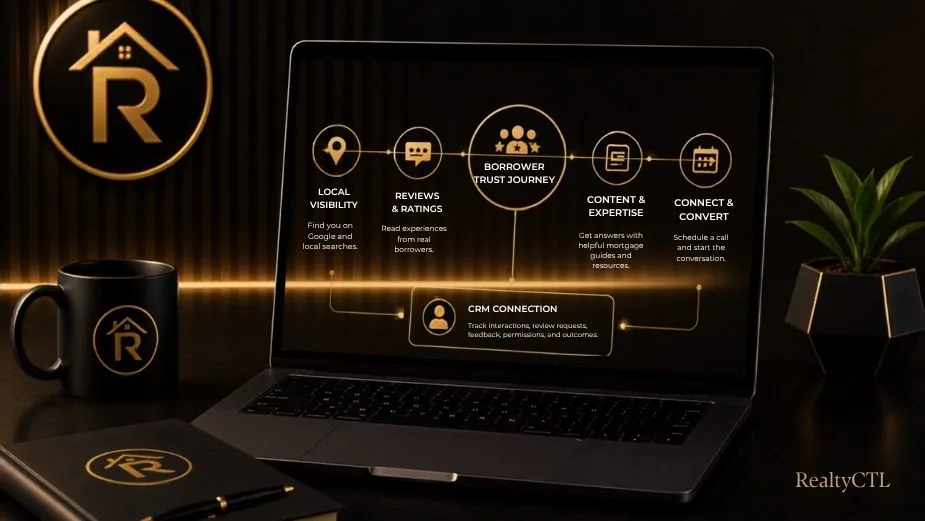
Reviews become more useful when they support a broader trust journey. A prospective borrower may discover a local profile, read a loan officer biography, visit a mortgage guide, examine testimonials, and then schedule an appointment.
Approved review excerpts may support websites, landing pages, educational resources, and social media marketing for mortgage brokers. Permission, context, accuracy, attribution, and current testimonial requirements should be checked before reuse.
Review quotes should not be edited in a way that changes their meaning. Screenshots, names, photos, property information, and transaction details may create additional permission and privacy considerations.
The CRM can record who received a request, which channel was used, whether the person opted out, whether feedback was received, whether a complaint requires escalation, and whether permission exists for testimonial use. It can also connect reputation touchpoints with website inquiries, past-client engagement, booked calls, and assisted conversions.
Realtor feedback and borrower feedback should remain separate because the relationships and claims differ. RealtyCTL can support real estate lead generation and partner trust through coordinated content, referral workflows, and performance reporting.
How Should Mortgage Reputation Performance Be Measured?
Average star rating alone does not show whether a profile is current, trusted, professionally managed, or connected to business activity. A profile with recent detailed feedback and consistent responses may tell a different story from a profile with the same rating but no recent reviews.
Useful measures may include total reviews, review recency, rating distribution, request volume, completion rate, source distribution, response coverage, response time, sentiment themes, complaint categories, resolution status, profile views, website clicks, calls, branded search visibility, appointments, referral engagement, assisted conversions, and pipeline movement.
Which Questions Should Reputation Reporting Answer?
- Which borrower stages produce the most useful feedback?
- Which request timing creates stronger completion?
- Which profiles contain outdated or conflicting information?
- Which positive service themes appear repeatedly?
- Which complaint themes require operational improvement?
- Which profiles receive views but few website actions?
- Which reputation assets assist appointment bookings?
- Which responses require management or compliance review?
A hypothetical report might show 100 eligible borrowers, 60 approved requests, 18 completed reviews, 16 public responses, two escalated concerns, and four later appointments assisted by reputation touchpoints. These figures are illustrative and should not be treated as benchmarks.
Reporting should compare review source, borrower stage, request date, response timing, sentiment, and conversion path. This provides more useful information than assuming every review directly causes a lead.

How Should Mortgage Reputation Compliance and Accuracy Be Managed?
Mortgage reputation activity may include reviews, testimonials, endorsements, emails, SMS messages, Google Business Profile descriptions, complaint responses, borrower names, loan-program information, rate comments, approval language, licensing details, and referral relationships.
Reviews and testimonials should reflect genuine experiences. Teams should consult the FTC endorsement and review guidance when developing standards for testimonials, endorsements, and material relationships.
The FTC Consumer Reviews and Testimonials Rule guidance should also be reviewed before using incentives, suppressing feedback, purchasing review services, or publishing testimonials. Current official guidance and qualified review are necessary because requirements can change.
Local targeting, imagery, review requests, and public responses should be assessed for Fair Housing and fair-lending concerns. Teams can reference HUD Fair Housing Act guidance and CFPB Regulation B and ECOA requirements while consulting qualified reviewers.
Loan officer, branch, and company information should accurately identify the business and licensed professionals. NMLS Consumer Access licensing information may assist verification, but required disclosures should be confirmed for each jurisdiction and communication channel.
Public responses should avoid confirming whether a reviewer applied, submitted documents, discussed credit, received a rate, was approved, or completed a transaction. Complaint and review records should be handled under approved privacy, access, security, and retention procedures.
AI-assisted response drafts should be checked for invented facts, admissions, insensitive wording, privacy exposure, unsupported promises, and repetitive language. Human approval is especially important when a review raises discrimination, licensing, fraud, pricing, approval, privacy, or legal concerns.
What Should Mortgage Professionals Look for in a Reputation Management Partner?
A reputation partner should understand mortgage borrower journeys, Google Business Profiles, local SEO, review policies, CRM automation, privacy, complaint escalation, testimonials, and reporting. Generic review software may send requests without accounting for mortgage-specific stages or risks.
Ask how the provider handles neutral review invitations, monitoring, response approval, suspicious reviews, private complaints, testimonial permission, AI-generated drafts, branch coordination, and past-borrower nurture. Administrative support should remain separate from decisions requiring licensed, legal, privacy, compliance, or management judgment.
Reporting should show more than rating changes. A useful partner should explain request volume, completion, recency, response coverage, common feedback themes, local profile activity, referral engagement, appointment influence, and attribution limitations.
RealtyCTL may fit mortgage professionals who need a connected system instead of random review requests, generic responses, isolated profile work, or star-rating-only reporting. Virtual assistant support for reputation workflows may also help with approved monitoring, CRM updates, permission records, profile maintenance, and reporting tasks.
No provider should promise guaranteed ratings, review removal, local rankings, reviews, leads, referrals, appointments, applications, funded loans, or ROI. Results depend on borrower experience, profile eligibility, review authenticity, market conditions, competition, response quality, compliance, and consistent execution.
What Should Mortgage Professionals Know About Reputation Management?
What is Mortgage Reputation Management?
Mortgage Reputation Management is a structured process for managing business profiles, genuine reviews, public responses, complaints, testimonials, local trust, CRM workflows, and performance reporting. It connects borrower experience with accurate and professional communication.
How can loan officers get more genuine reviews?
Loan officers can create a consistent neutral request process tied to approved borrower milestones. Requests should invite honest feedback, avoid pressure or rating instructions, respect opt-outs, and follow current platform, company, legal, and compliance requirements.
When should mortgage professionals request borrower reviews?
Timing should match the completed borrower experience and company policy. Purchase, refinance, past-borrower, and Realtor relationships may require different timing, wording, channels, and follow-up limits.
How should loan officers respond to negative reviews?
Responses should remain calm, concise, and privacy-aware. The business should avoid debating loan details publicly, acknowledge the concern appropriately, invite private communication, and escalate sensitive issues through its approved complaint process.
Can AI manage mortgage reviews and responses?
AI may help monitor reviews, organize sentiment, and prepare drafts. Qualified humans should approve final responses, especially when the content involves privacy, discrimination, complaints, licensing, rates, approvals, financial claims, or legal concerns.
Should loan officers hire a Mortgage Reputation Management partner?
A partner may help when a team lacks time, local SEO expertise, CRM automation, monitoring capacity, response standards, or reporting. Evaluate mortgage experience, ethical review practices, privacy controls, human oversight, compliance-aware workflows, and realistic expectations.
Last Updated: 27th June 2026
Reviewed By: Abdullah Al Maruf
Written By

Abdullah Al Maruf
Co-founder, NextCTL
Co-founder of NextCTL who leads growth and product, with 16+ years across software and marketing, an MS in Data Science and AI and an MBA in Marketing.