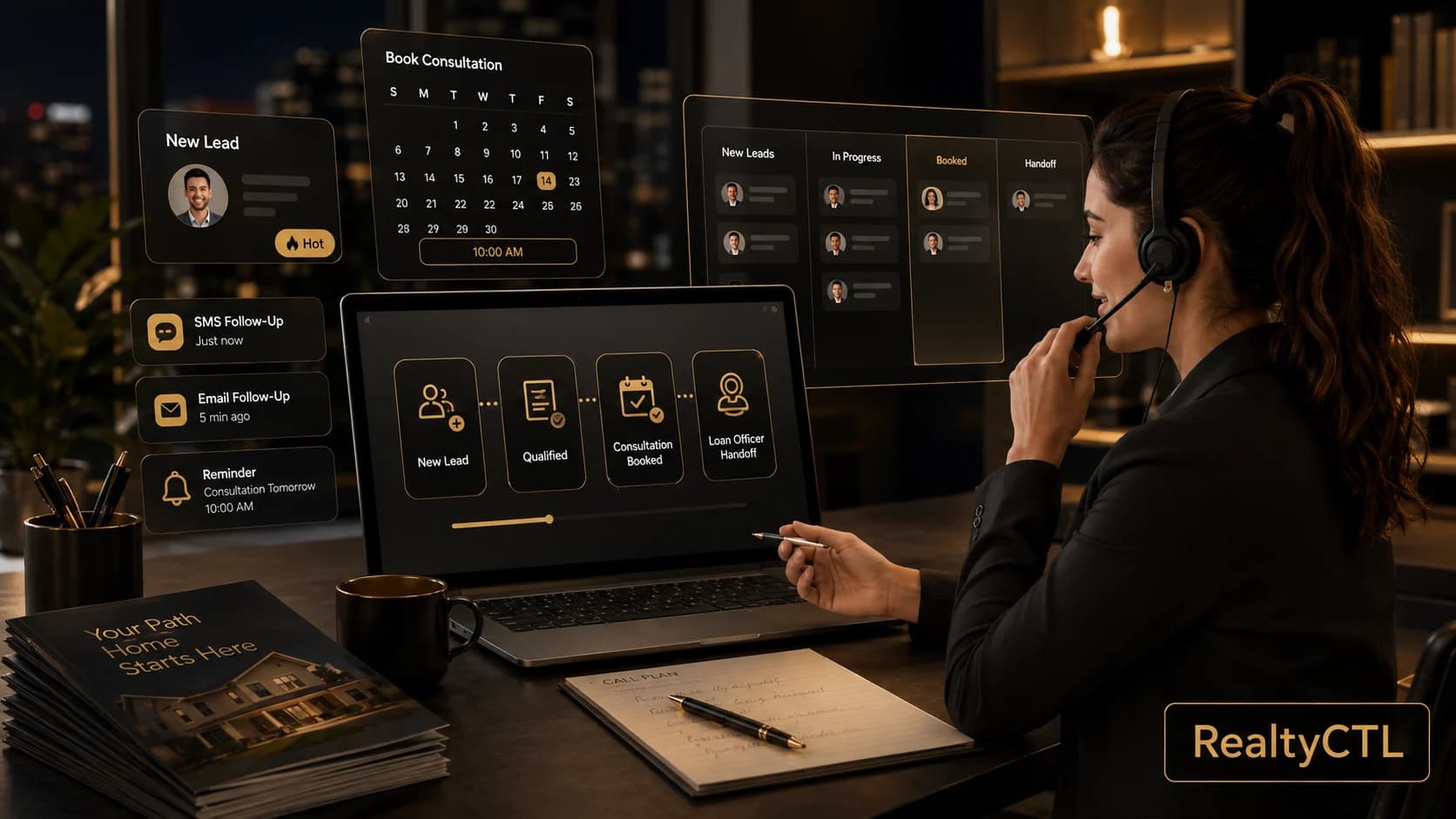
Mortgage Email Marketing Made Simple for More Sales
Grow your pipeline with Mortgage Email Marketing that automates outreach, revives cold leads, and creates more qualified loan applications. Start today.

Mortgage Email Marketing can help loan officers stay connected with new leads, long-term prospects, Realtor referrals, and past borrowers without relying on memory or one-time outreach. The challenge is that many mortgage professionals still send generic newsletters, promotional messages, or isolated follow-ups that are not connected to borrower intent, CRM stages, appointment booking, or pipeline reporting.
A useful system goes far beyond sending monthly updates. It connects lead-source tracking, CRM data, borrower segmentation, educational content, automated nurture, SMS support, human follow-up, database reactivation, appointment reminders, sender authentication, reporting, and compliance-aware communication. When these pieces work together, email can support qualified conversations and appropriate next steps instead of becoming another disconnected marketing activity.
This guide explains how purchase, refinance, FHA, VA, USDA, conventional, first-time buyer, Realtor referral, and past borrower contacts should be approached differently. It also covers email deliverability, database reactivation, appointment workflows, campaign measurement, AI-assisted support, and the role of a connected growth partner such as RealtyCTL mortgage growth infrastructure.
Results are never guaranteed. Performance varies based on market conditions, contact quality, lead source, borrower intent, offer, segmentation, message quality, sender reputation, timing, automation quality, compliance review, and the loan officer’s execution.
What Is Mortgage Email Marketing?
Mortgage Email Marketing is the permission-based use of email to educate, nurture, follow up with, reactivate, and guide mortgage contacts toward an appropriate next step. It combines relevant messaging with CRM data so that a first-time buyer, refinance prospect, Realtor referral, and past borrower do not all receive the same sequence.
Contact storage is not an email strategy. A generic newsletter sends the same message to a broad list, while a basic drip campaign sends prewritten emails according to a schedule. Manual one-to-one outreach may feel personal, but it becomes difficult to maintain when lead volume grows. AI-generated messages can speed up drafting, but they still require accurate inputs, compliance review, and human judgment.
A complete mortgage email conversion system connects contact source, borrower intent, CRM stage, email content, reply handling, appointment scheduling, task creation, and reporting. For example, a website pre-approval inquiry may need a fast confirmation and booking path, while an old refinance contact may need a softer re-engagement message and longer educational nurture.
Loan officers may need campaigns for Google Ads leads, Facebook leads, mortgage calculator users, website forms, rate quote requests, purchase inquiries, refinance inquiries, Realtor referrals, past clients, and inactive CRM contacts. The best system connects email with calls, SMS, appointments, and pipeline updates instead of treating every channel as a separate project.
Why Do Mortgage Email Campaigns Often Fail?
Many campaigns fail because the data, message, and follow-up process do not match. A loan officer may have thousands of contacts, but those records may lack lead source, loan interest, timeline, consent status, or the date of the last meaningful conversation. Without that context, automation becomes generic.
Email performance also weakens when the first message arrives too late, the subject line sounds promotional, or the content asks for an application before trust has been established. A contact who downloaded a first-time buyer guide may need education, while a Realtor referral may expect quick and professional personal outreach.
- Contacts are stored without useful segments or CRM stages.
- Lead-source and purchase-versus-refinance tags are missing.
- The first email is delayed or disconnected from the inquiry.
- Subject lines are vague, exaggerated, or overly promotional.
- No follow-up occurs after the first unanswered message.
- Replies do not trigger a new task, stage, or human handoff.
- There is no appointment link, reminder, or no-show workflow.
- Inactive contacts remain on the list without a reactivation plan.
- Reporting stops at sends, opens, and clicks.
Purchase leads, refinance prospects, FHA borrowers, VA borrowers, first-time buyers, Realtor referrals, and past clients have different questions and levels of urgency. Sending the same message to every contact may reduce relevance and increase unsubscribe or complaint risk.
Another common problem is separating acquisition from nurture. A mortgage lead generation campaign can attract inquiries, but the value of those inquiries depends on what happens after the form submission. Email automation should protect the opportunity until a licensed professional can provide the right guidance.
What Should a Complete Mortgage Email Marketing System Include?
A complete system begins with permission-based contact capture and clear source tracking. Each contact should enter the CRM with useful fields such as campaign source, requested topic, purchase or refinance intent, contact date, borrower timeline, assigned loan officer, and consent information where applicable.
Segmentation should then determine which content and cadence the contact receives. New inquiries may need immediate confirmation, a short educational sequence, and an appointment option. Long-term prospects may need monthly education. Past borrowers may benefit from annual mortgage reviews, homeownership content, and carefully timed referral requests.
Strong systems typically include new lead response emails, educational nurture, plain-text check-ins, appointment confirmations, reminders, no-show follow-up, re-engagement campaigns, past borrower sequences, Realtor partner communication, suppression handling, bounce monitoring, and campaign attribution. They also update CRM stages when a contact replies, books, cancels, applies, or becomes inactive.
Email should remain connected to a connected mortgage lead conversion system that includes SMS, phone activity, appointments, task reminders, and reporting. An email click without a next step is less useful than a reply that triggers a timely, qualified conversation.
A mortgage email campaign is valuable when it helps turn borrower interest into a useful reply, qualified conversation, scheduled appointment, application step, or appropriate long-term nurture path.
How Should Different Mortgage Contacts Be Nurtured by Email?
Different contacts require different message angles, timelines, and calls to action. The contact’s source, age, stated goal, engagement level, and CRM stage should shape the sequence.
How Should Purchase Leads Be Nurtured?
Purchase leads often need timely guidance about preparation, pre-approval steps, documents, and buying timelines. A recent inquiry may receive an immediate confirmation, a short explanation of the next step, and an invitation to schedule a conversation. Longer-term buyers may need education about credit preparation, down payments, and planning rather than repeated requests to apply.
How Should Refinance and Cash-Out Contacts Be Nurtured?
Refinance contacts may be exploring rather than ready to act. Their sequence can focus on review factors, goals, timing, and questions to discuss with a licensed mortgage professional. Cash-out refinance contacts may need clear education about purpose, equity, documentation, risks, and alternatives without promises about savings or approval.
How Should FHA, VA, USDA, and Conventional Prospects Be Nurtured?
Loan-type interest can guide educational content, but emails should avoid making qualification assumptions. FHA prospects may need general information about down payment and documentation. VA prospects may need guidance about benefit eligibility and next steps. USDA prospects may need property and location context, while conventional prospects may need general comparisons based on goals and financial profile.
How Should First-Time Buyers Be Nurtured?
First-time buyers often need more explanation before they feel ready to book. A sequence can break the process into smaller steps, answer common questions, explain terminology, and provide a low-pressure way to speak with a loan officer. Clear education can reduce confusion without pushing the borrower into an application prematurely.
How Should Realtor Referrals Be Nurtured?
Realtor referrals require fast, professional communication because the experience can affect both the borrower relationship and partner trust. The first email should acknowledge the referral source, explain the next step, and make it easy to schedule. Coordinated real estate lead generation and partner workflows can help keep both sides informed without exposing private borrower details.
How Should Past Borrowers and Old Database Contacts Be Nurtured?
Past borrowers should not receive the same sequence as new leads. They may benefit from annual reviews, homeownership education, milestone messages, and referral communication. Old database contacts usually need a permission-based reactivation campaign that confirms interest before placing them into a longer nurture sequence.
Large databases may also require cleanup, tagging, scheduling support, and follow-up tasks. Mortgage follow-up and administrative support may help teams execute these tasks consistently while licensed conversations remain with the appropriate mortgage professional.
| Contact Type | Best Email Stage | Recommended Email Approach | Main Risk |
|---|---|---|---|
| Purchase lead | New inquiry or ready to schedule | Fast confirmation, timeline education, and appointment option | Slow response or premature application pressure |
| Refinance lead | Education or long-term nurture | Goal-based review content and periodic check-ins | Unsupported savings or rate claims |
| Cash-out refinance lead | Needs education | Purpose, documentation, risks, and consultation CTA | Presenting cash-out as automatically suitable |
| FHA or VA lead | Program education | General eligibility and next-step education | Implying guaranteed eligibility or approval |
| Realtor referral contact | Immediate personal follow-up | Referral acknowledgment and fast scheduling path | Damaging partner trust through delay |
| Past borrower database contact | Annual review or re-engagement | Homeownership education and permission-based review | Over-emailing inactive contacts |
How Should Segmentation, Timing, and Automation Work Together?
Segmentation decides who receives a message, timing determines when it is sent, and automation ensures the next action occurs consistently. These decisions should reflect the contact’s CRM stage and actual behavior rather than relying only on a fixed schedule.
A new inquiry may receive an immediate confirmation and a short follow-up sequence. An engaged contact who clicks and replies should leave the generic automation and enter a human follow-up path. A borrower who books should receive confirmation and reminders, while a no-show should receive a respectful rescheduling option.
Useful lifecycle stages include new inquiry, attempting contact, engaged, needs education, ready to schedule, appointment booked, appointment completed, application started, document collection, in process, closed borrower, past borrower, long-term nurture, inactive, unsubscribed, and suppressed.
Email is well suited to education, next steps, appointment links, document preparation, and long-term nurture. Permission-based SMS may support timely reminders. Phone calls remain important for direct conversations. AI can assist with drafting, summarizing, tagging, routing, and identifying basic intent, but a human must handle licensed guidance, pricing, qualification, approval questions, and financial recommendations.
Automations should include reply detection, task creation, loan officer assignment, stage changes, unsubscribe handling, appointment reminders, no-show follow-up, and long-term nurture. The system should also preserve notes and conversation history so the borrower does not have to repeat information.
What Mortgage Email Campaign Examples Can Loan Officers Use?
Message quality often determines whether automation feels useful or impersonal. The best examples are short, clear, relevant to the inquiry, and focused on a simple next step.
What Could a New Purchase Inquiry Email Say?
“Would it help to review your home-buying timeline and the steps involved in preparing for pre-approval?” This angle acknowledges the borrower’s goal without assuming readiness or qualification.
What Could a Refinance Inquiry Email Say?
“Would a brief mortgage review help you compare your current loan with the options that may be available?” The message invites a conversation without promising savings, a lower payment, or a specific rate.
What Could a Cash-Out Refinance Email Say?
“Would you like to discuss whether a cash-out refinance may fit the goal you shared?” This keeps the message focused on suitability and professional review.
What Could a First-Time Buyer Email Say?
“I can help explain the next mortgage step in clear language and answer your initial questions.” A reassuring tone is often more useful than urgency for contacts who are still learning.
What Could a VA Loan Email Say?
“Would you like to review general VA loan options and the next steps for your situation?” The message avoids assuming benefit eligibility or approval.
What Could a Realtor Referral Email Say?
“I received your information from your real estate professional and can help you understand the next mortgage step.” The follow-up should be timely and should identify the sender clearly.
What Could a Past Borrower Email Say?
“Would an annual mortgage review be useful for you this month?” This approach is service-oriented and avoids implying that a refinance is necessarily beneficial.
What Could a Database Reactivation Email Say?
“Are you still considering a home purchase, refinance, or mortgage review, or would you prefer not to receive follow-up?” This gives the contact control and helps identify records that should remain inactive.
What Could an Appointment Reminder Email Say?
“This is a reminder of your scheduled mortgage conversation. Please reply if you need to reschedule.” The message should include the correct time, contact details, and any required preparation instructions.
These examples should be adapted to contact source, consent, company policy, state requirements, licensing language, and the borrower’s stated goal. They should avoid approval guarantees, rate promises, misleading subject lines, exaggerated urgency, discriminatory language, or unsupported financial claims.
Which Mortgage Email Marketing Metrics Matter Most?
Email open rates can be useful as directional data, but they should not be treated as a precise business outcome. Privacy protections, automatic image loading, image blocking, and email-client behavior can inflate or suppress tracked opens.
Stronger indicators include delivery, bounces, complaints, unsubscribes, replies, positive replies, clicks, appointment bookings, qualified appointments, show rate, application starts, document completion, loan officer handoff, database reactivation, past borrower engagement, and pipeline movement.
Loan officers should ask which sources produce replies, which emails lead to appointments, which contacts enter application stages, and which campaigns create complaints or unsubscribes. They should also identify inactive segments that need to be paused, cleaned, or suppressed.
Cost per qualified appointment can be more informative than cost per lead because it reflects a deeper step in the process. However, attribution still requires clean campaign data, CRM stages, appointment records, and consistent team execution.
Teams with large databases may need virtual assistant support for database execution, including cleanup, tagging, scheduling, and reporting preparation. Any work involving borrower information should follow company privacy and access controls.
How Should Mortgage Email Deliverability and Compliance Be Managed?
Useful content cannot create business value when messages are rejected, delivered to invalid addresses, filtered as spam, or ignored because the sender is unfamiliar. Deliverability management combines technical authentication, list hygiene, sending behavior, content quality, and recipient response.
SPF identifies permitted sending servers, DKIM supports message authentication, and DMARC adds alignment-based policy and reporting. These controls do not guarantee inbox placement. Mortgage teams should review current Google email sender guidelines, the related Google bulk sender requirements and FAQ, and Yahoo sender best practices before launching higher-volume campaigns.
Teams should monitor hard bounces, soft bounces, complaints, unsubscribes, invalid addresses, sender identity, sending volume, domain reputation, links, and mobile rendering. Repeatedly emailing inactive contacts can create avoidable risk, even when those addresses originally came from a legitimate database.
Commercial email should be reviewed against current FTC CAN-SPAM compliance guidance. Sender information should be accurate, subject lines should not be deceptive, and recipients should have a functional way to unsubscribe. Opt-outs should be suppressed according to applicable requirements and company policy.
When email campaigns connect with automated texts or calls, teams should also review 47 CFR 64.1200 communication requirements and current FCC Telephone Consumer Protection Act information. Consent expectations can vary by channel, technology, context, and jurisdiction.
Mortgage messages should also be reviewed for fair and accurate communication. Teams should consider current HUD Fair Housing Act guidance and CFPB Regulation B and ECOA requirements when creating targeting, eligibility language, follow-up questions, and advertising claims.
Loan officer identity and licensing information should be confirmed through appropriate company records and, where relevant, NMLS Consumer Access licensing information. Testimonials, endorsements, and review requests should be checked against current FTC endorsement and review guidance.
Current sender rules, mortgage advertising requirements, platform policies, and state requirements can change. Subject lines, email sequences, AI-assisted content, claims, testimonials, forms, disclosures, data practices, and workflow logic should be reviewed by the appropriate lender, broker, compliance professional, licensing reviewer, or legal reviewer before launch.
What Should Mortgage Professionals Look for in an Email Marketing Partner?
A qualified partner should understand mortgage lead sources, borrower timelines, purchase and refinance intent, CRM stages, email automation, appointment workflows, deliverability, and compliance-aware messaging. Generic copywriting experience alone is not enough.
Ask how the partner handles contact segmentation, lead-source tracking, new inquiry response, long-term nurture, past borrower communication, database reactivation, appointment reminders, reply routing, and human handoff. Review how campaign performance is reported and whether replies, appointments, applications, and pipeline movement can be connected to the original source.
The partner should also explain how list hygiene, authentication, bounce handling, suppression, and inactive contacts are managed. Realistic expectations matter. No responsible provider should promise guaranteed inbox placement, guaranteed appointments, guaranteed applications, or guaranteed ROI.
Mortgage professionals who rely on Realtor partners may also benefit from connected Realtor lead generation systems that coordinate referral intake, borrower follow-up, and partner communication. RealtyCTL is positioned for teams that need email, CRM automation, lead generation, appointment booking, reporting, and execution support connected into one operating system.
What Should Loan Officers Know About Mortgage Email Marketing?
What Is Mortgage Email Marketing?
Mortgage Email Marketing is the use of permission-based, segmented, and CRM-connected email campaigns to educate, nurture, reactivate, and guide mortgage contacts toward an appropriate next step.
Why Do Loan Officers Need an Email Marketing System?
A structured system helps loan officers follow up consistently, match content to borrower intent, maintain past-client relationships, and track meaningful outcomes beyond the number of emails sent.
What Should a Mortgage Email Campaign Include?
It should include clear segmentation, relevant content, an appropriate CTA, CRM stage logic, reply handling, appointment workflows, unsubscribe management, deliverability monitoring, and compliance review.
Can Email Automation Replace a Loan Officer’s Follow-Up?
No. Automation can organize and support communication, but licensed mortgage guidance, pricing discussions, qualification questions, approval decisions, and relationship-building require appropriate human involvement.
How Should Loan Officers Measure Email Marketing Performance?
They should review delivery, bounces, complaints, unsubscribes, replies, appointments, show rates, application activity, database reactivation, lead-source performance, and pipeline movement.
Should Loan Officers Hire a Mortgage Email Marketing Partner?
A partner may be useful when a team lacks the time or expertise to connect segmentation, content, CRM automation, deliverability, appointments, reporting, and campaign execution. The provider should have mortgage experience and avoid unrealistic promises.
Last Updated: 29th June 2026
Reviewed By: Abdullah Al Maruf
Written By

Abdullah Al Maruf
Co-founder, NextCTL
Co-founder of NextCTL who leads growth and product, with 16+ years across software and marketing, an MS in Data Science and AI and an MBA in Marketing.