Mortgage CRM Setup Made Simple for Busy Lenders
Mortgage CRM Setup gives lenders a cleaner pipeline, faster lead response, and smarter follow-up so no borrower slips away. Book your setup call today.
Realtor Facebook ads management is not just about boosting a listing post and hoping a buyer or seller fills out a form. Many real estate professionals are tired of getting likes, weak leads, slow replies, and unclear campaign reports that do not show whether their ads are creating real conversations.
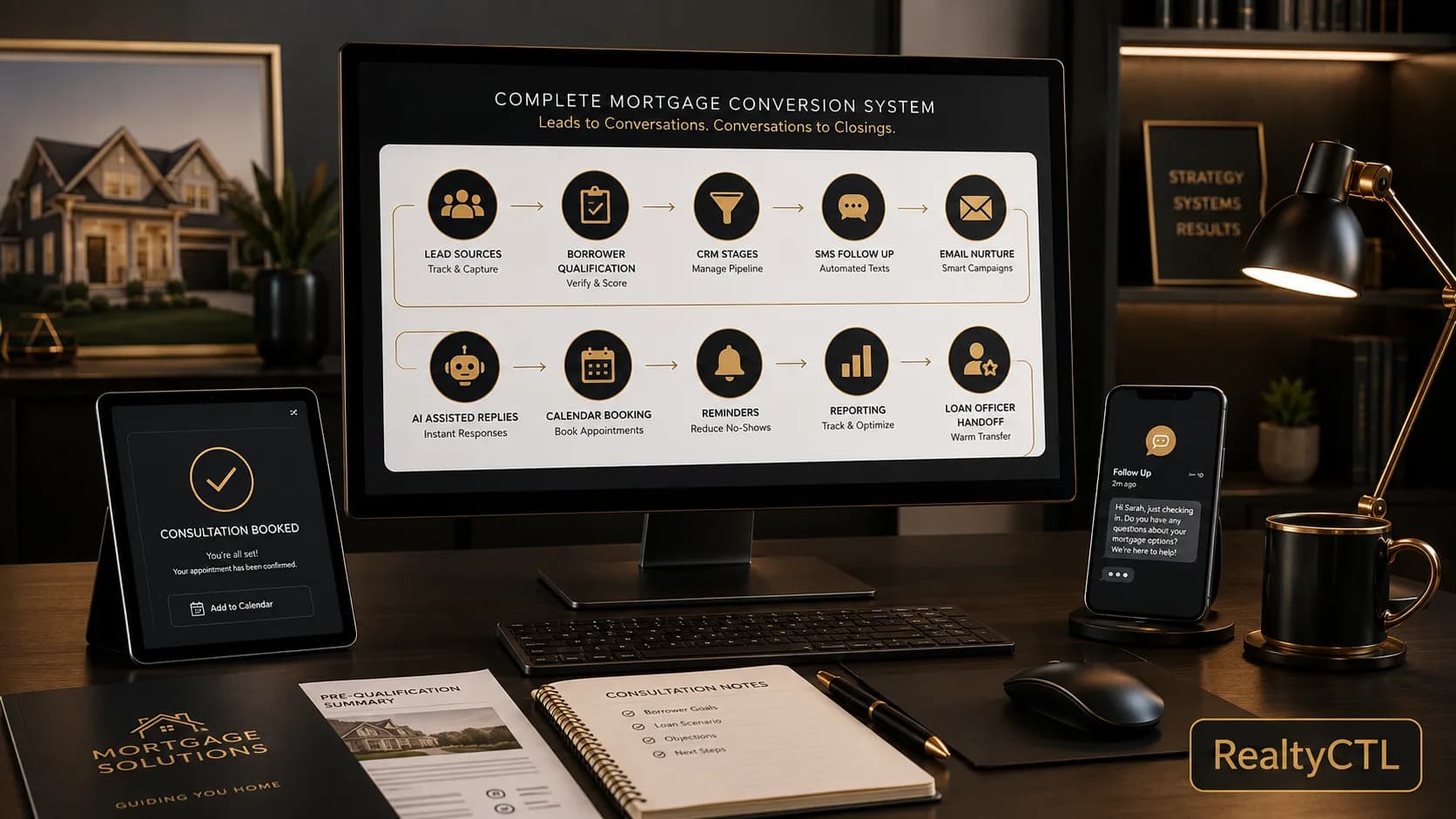
Modern Meta advertising for real estate works best when the ad campaign is connected to a full conversion system. That system can include campaign strategy, offer testing, ad creative, lead forms, landing pages, CRM integration, instant follow-up, appointment booking, retargeting, reporting, and compliance-aware messaging.
This guide explains buyer lead campaigns, seller lead campaigns, home valuation ads, listing promotion ads, open house campaigns, retargeting, CRM automation, Meta Special Ad Category for housing, and real estate ad compliance.
Results are not guaranteed. Lead generation performance depends on market conditions, ad budget, offer quality, ad creative, audience strategy, landing page experience, CRM setup, response speed, agent execution, compliance review, and prospect intent.
What Is Realtor Facebook Ads Management?
Realtor Facebook ads management means planning, creating, launching, testing, optimizing, tracking, and improving Facebook and Instagram ad campaigns for real estate professionals.
It can include buyer lead campaigns, seller lead campaigns, listing promotions, open house ads, home valuation campaigns, relocation campaigns, retargeting, and database reactivation campaigns.
A boosted post usually pushes existing content to more people. A basic Facebook lead ad may collect names, phone numbers, and emails. A managed real estate Meta campaign goes further by connecting the ad objective, audience, creative, offer, lead capture method, CRM, follow-up, and reporting.
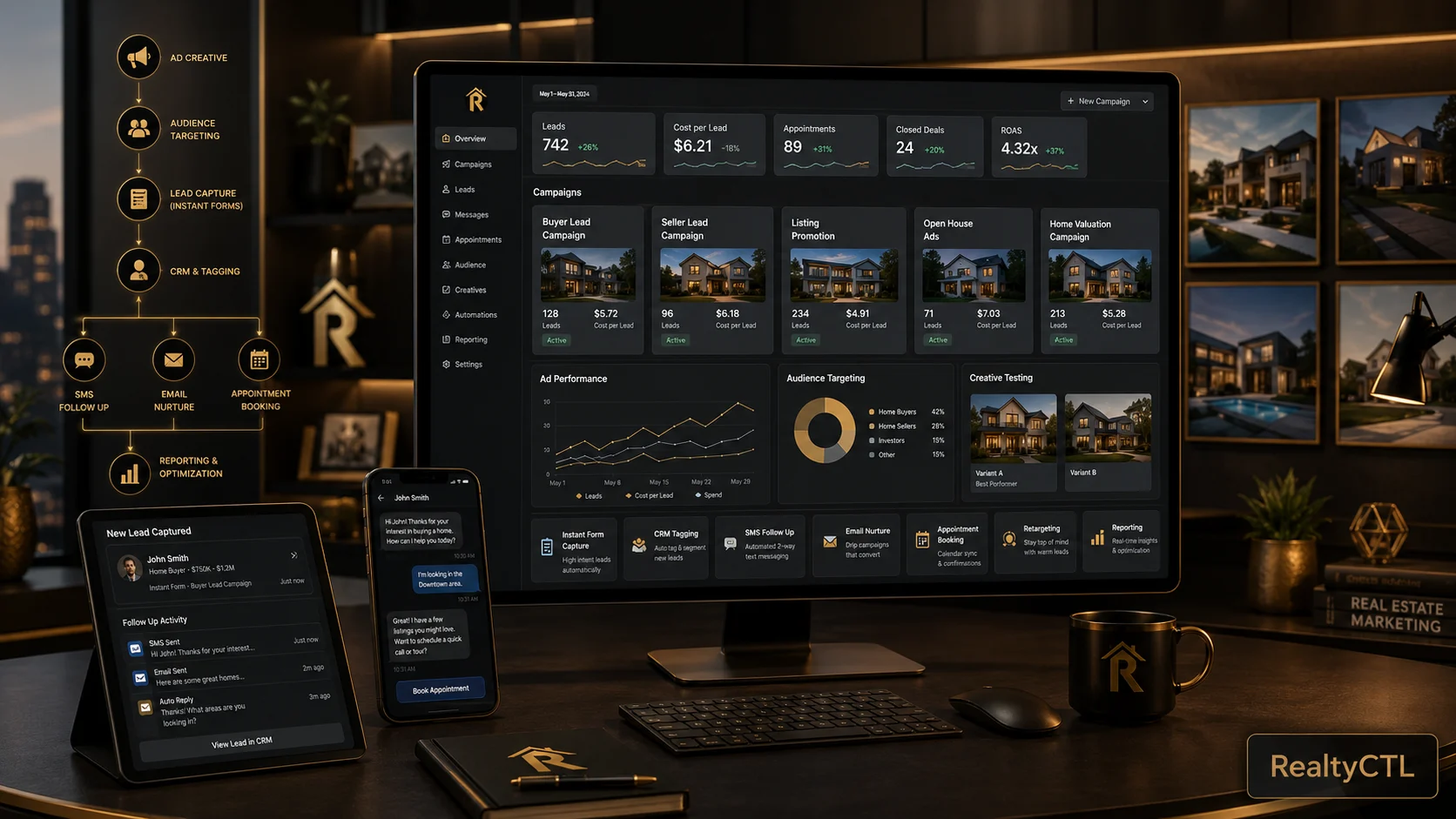
A complete Realtor Facebook ads management system does not stop when someone clicks the ad. It continues through landing pages, instant forms, CRM tagging, SMS follow-up, email nurture, appointment booking, retargeting, and performance tracking.
This matters because buyer leads, seller leads, home valuation leads, listing inquiries, and open house leads all need different messaging and next steps.
RealtyCTL helps real estate professionals build connected Meta ad, landing page, CRM, follow-up, AI support, appointment booking, and reporting systems instead of running disconnected ad campaigns.
Get Realtor Facebook Ads Management
Why Boosted Posts Are Not Enough for Realtors
Boosted posts can help increase visibility, but visibility alone is not a real estate lead generation system. A post can receive likes, comments, and shares without creating qualified buyer or seller conversations.
Many agents boost a listing, market update, or open house post without a clear funnel behind it. The post may get attention, but there may be no strong offer, no lead capture strategy, no CRM connection, and no structured follow-up workflow.
Facebook ads often fail when the campaign is disconnected from the landing page, lead form, CRM, and sales process. A buyer who clicks a listing ad needs property details and a clear next step. A seller who requests a home value estimate needs trust-building and useful local context.
Buyer leads, seller leads, home valuation leads, listing ad audiences, open house prospects, and retargeting audiences should not all receive the same message or follow-up.
Common real estate ad problems include:
- Boosting posts without a lead strategy
- Sending traffic to weak or generic pages
- Using generic ad copy
- No offer testing
- No ad creative testing
- No lead source tracking
- No CRM integration
- No fast SMS or email follow-up
- No retargeting strategy
- Measuring likes instead of qualified appointments
Paid social does not replace relationship-building. A strong ad system creates opportunities, but agents still need to qualify, nurture, advise, and convert those opportunities through real conversations.
The Core Parts of a Realtor Facebook Ads Management System
Strong Realtor Facebook ads management usually requires several connected parts. The first part is campaign strategy. Before launching an ad, the agent or marketing partner should know whether the campaign is designed for buyer demand, seller conversations, home valuation requests, listing visibility, open house attendance, retargeting, or database reactivation.
The second part is offer development. A buyer guide, seller checklist, home valuation review, neighborhood market report, property search page, or open house registration offer can each attract a different type of prospect.
Creative testing is also important. Images, videos, headlines, ad copy, call-to-action language, and message angles can affect lead quality. Testing helps agents avoid spending more money on one weak idea.
Lead capture strategy matters as well. Facebook lead forms can reduce friction, while focused landing pages can provide more context before someone submits information. The right choice depends on the campaign goal, offer, and follow-up plan.
Meta housing ads may require Special Ad Category review where applicable. Agents and marketing teams should verify current platform requirements before publishing housing-related campaigns through resources such as Meta’s housing ads guidance.
After the lead is captured, the system should continue with CRM integration, lead source tracking, lead tagging, SMS and email follow-up, AI-assisted reply support, appointment booking, team routing, retargeting, reporting, and human handoff.
A Facebook lead is only valuable if the system behind the ad can turn interest into a real conversation, appointment, or next step.
Many campaigns fail after the form is submitted because the lead is not routed, tagged, followed up with quickly, or placed into the right nurture path.
RealtyCTL’s real estate lead generation systems can connect Meta campaigns, landing pages, CRM automation, AI follow-up, appointment booking, reporting, and conversion infrastructure into one organized process.
Campaign Types Realtors Can Use
Different real estate goals need different campaign types. A buyer campaign should not feel like a seller campaign. A home valuation campaign should not use the same message as an open house campaign.
Buyer lead campaigns may use property search pages, buyer guides, neighborhood ads, financing readiness questions, and showing availability prompts. The goal is to help buyers take a useful next step without making the process feel confusing.
Seller lead campaigns may use home valuation offers, seller guides, equity education, market updates, and listing consultation prompts. These leads often need longer nurture because many homeowners research before they are ready to list.
Home valuation campaigns can create homeowner interest, but they should not rely only on an automated estimate. A stronger funnel can offer a local home value review with market context and a clear next step.
Listing promotion campaigns can support buyer demand, seller visibility, retargeting, and local authority. Open house campaigns can focus on registration, reminders, property details, and post-event follow-up.
Retargeting campaigns can keep agents visible to people who visited a landing page, clicked an ad, watched a video, or engaged with prior content, subject to platform rules and compliance review.
| Campaign Type | Best First Goal | Recommended Funnel | Main Risk |
|---|---|---|---|
| Buyer lead campaign | Start buyer conversations | Property search, buyer guide, or showing request path | Attracting casual browsers without qualification |
| Seller lead campaign | Identify potential sellers | Seller guide, equity update, or consultation offer | Expecting immediate listing appointments from early-stage leads |
| Home valuation campaign | Create homeowner interest | Valuation request plus local market follow-up | Relying only on an automated estimate |
| Listing promotion campaign | Increase listing visibility and buyer interest | Property details, showing request, or retargeting path | Measuring only views and likes |
| Open house campaign | Drive registrations or attendance | Event registration, reminders, and post-event follow-up | No follow-up after the event |
| Retargeting campaign | Stay visible to warm prospects | Helpful reminder, market update, or next-step offer | Weak audience setup or unclear message |
Each campaign should feed into CRM stages, follow-up automation, appointment booking, and reporting. That is what turns paid social into a real estate growth system instead of random ad activity.
Lead Forms, Landing Pages, CRM, and Follow-Up Automation
Lead forms, landing pages, CRM, and follow-up automation should work together. When they do not, agents often collect leads but lose the opportunity to start meaningful conversations.
Facebook lead forms can reduce friction because people can submit information without leaving the platform. That can increase lead volume, but it may also bring in lower-intent leads if the offer is weak or the follow-up is too generic.
Landing pages can create stronger context when the offer needs explanation. A seller guide, home valuation review, relocation resource, or local market report may perform better when the prospect sees more detail before submitting a form.
The CRM keeps leads organized. It should show where the lead came from, what they requested, which campaign generated the inquiry, what stage they are in, who owns the lead, and what follow-up has already happened.
SMS can be useful for fast, short, conversational follow-up. Email can support education, listing updates, market reports, buyer resources, seller resources, and longer nurture.
AI-assisted follow-up can help respond, summarize, qualify, and route conversations. It should support the agent rather than replace professional judgment, licensed guidance, or relationship-building.
Helpful workflow elements include:
- Instant auto-reply after the form submission
- Lead source-specific messaging
- Appointment booking link
- Follow-up if there is no reply
- Long-term nurture
- Re-engagement messages
- Task reminders
- Lead owner assignment
- Stop and opt-out handling
- Notes and conversation history
Human handoff is essential when the lead is ready for advice, showings, listing consultations, representation, or negotiation. For busy teams, real estate virtual assistant support can help with appointment scheduling, CRM cleanup, inbox support, and follow-up tasks where appropriate.
Get Realtor Facebook Ads Management
Ad Creative and Offer Examples for Realtors
Ad creative and offer quality often decide whether a campaign attracts casual clicks or stronger prospects. A clear offer gives the right person a reason to respond. A weak offer creates vague engagement that is difficult to convert.
A buyer campaign may use a message angle such as, “See homes that match your budget and timeline.” This can connect to a property search page, buyer guide, or showing request path.
A seller campaign may use, “Request a local home value review with market context.” This is stronger than simply promising a number because it frames the offer around local guidance.
A listing promotion campaign may use, “Get details on this property and similar homes nearby.” This can help capture buyer interest while also showing sellers that the agent is marketing listings actively.
An open house campaign may use, “Save your spot and get property details before the event.” This supports registration, reminders, and post-event follow-up.
A retargeting campaign may use, “Still comparing neighborhoods? Get a quick local market update.” This speaks to warm prospects who are still researching.
Useful offer examples include:
- First-time buyer guide
- Seller preparation checklist
- Home valuation review
- Neighborhood market report
- Open house registration
- Listing alert signup
- Relocation guide
- Past client home value check-in
These examples should be reviewed before use. Ad creative, copy, forms, landing pages, testimonials, targeting, and follow-up messages should be checked for brokerage, licensing, Fair Housing, platform policy, and advertising compliance.
Good creative should be clear, local where appropriate, helpful, visually professional, and aligned with the landing page or lead form. Avoid misleading promises, exaggerated urgency, discriminatory language, unsupported market claims, or guaranteed results.
How to Measure Realtor Ad Campaign Performance
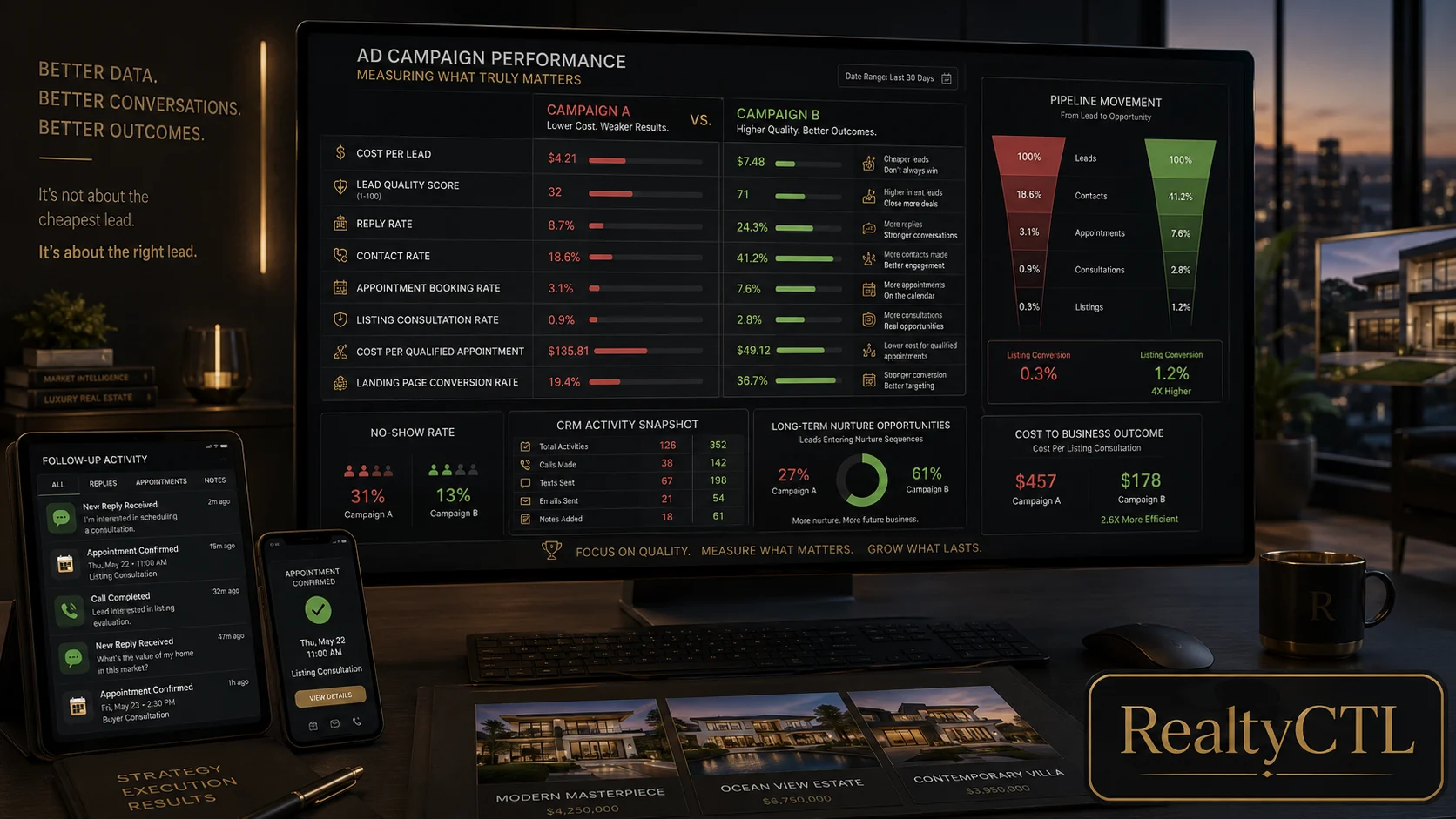
Lead volume alone can be misleading. A campaign is not successful only because it generated cheap leads. It should be judged by the quality of conversations, appointments, pipeline movement, and business opportunities it creates.
Cost per lead is useful, but it does not show the full picture. A lower-cost lead that never responds may be less valuable than a higher-cost lead that books a qualified consultation.
Important metrics can include:
- Cost per lead
- Lead quality
- Reply rate
- Contact rate
- Appointment booking rate
- Showing request rate
- Listing consultation rate
- Cost per qualified appointment
- Lead source quality
- Landing page conversion rate
- Form completion rate
- Retargeting engagement
- Pipeline movement
- No-show rate
- Human handoff rate
- Long-term nurture opportunities
Reporting should connect ad spend to real business activity. If two campaigns generate the same number of leads, the better campaign may be the one that creates more replies, better appointments, cleaner CRM records, or stronger long-term nurture opportunities.
Agents should avoid judging campaigns only by surface metrics. Clicks, impressions, and likes can be useful signals, but they do not replace appointment quality, lead intent, follow-up performance, and pipeline movement.
Any performance example should be treated as hypothetical unless it is based on verified campaign data. Results vary by market, budget, offer, creative quality, campaign setup, landing page quality, CRM workflow, response speed, agent sales process, compliance, and prospect intent.
Compliance, Fair Housing, and Meta Housing Ads
Realtor Facebook ads management must be handled carefully because real estate professionals advertise housing-related services through Meta platforms, landing pages, lead forms, retargeting, SMS, email, and phone follow-up.
Many real estate campaigns may need Meta Special Ad Category review where applicable. Platform rules can change, so campaign setup should be verified before launch using official resources such as Meta’s housing ads guidance and Meta Advertising Standards.
Fair Housing awareness also matters. HUD explains that the Fair Housing Act applies to renting, buying a home, getting a mortgage, seeking housing assistance, and other housing-related activities. Agents and marketing teams can review official information through the HUD Fair Housing Act overview.
This article does not provide legal advice. Ad campaigns, landing pages, forms, testimonials, targeting, copy, and follow-up workflows should be reviewed by the appropriate broker, legal reviewer, compliance professional, or platform policy reviewer before launch.
Compliance-aware workflows should consider:
- Meta Special Ad Category for housing
- Fair Housing awareness
- Accurate advertising language
- Avoiding misleading claims
- Housing-related platform policy awareness
- TCPA awareness for calls and texts
- Consent for automated SMS or calls
- CAN-SPAM awareness for commercial email
- Data privacy and permission-based communication
- Opt-out language
- Review and testimonial compliance
- Brokerage and state licensing requirements
- Platform ad policy changes
Text and phone communication rules should be reviewed before launch. Teams can review the official eCFR TCPA rule text and confirm how requirements apply to their workflow.
Commercial email workflows should also be reviewed before launch. The FTC CAN-SPAM compliance guide explains requirements related to commercial email, including sender accuracy, physical address, and opt-out handling.
Compliance-aware advertising can still be persuasive when it focuses on clarity, helpfulness, consumer choice, accurate expectations, and simple next steps.
How to Choose a Realtor Facebook Ads Management Partner
Choosing a Facebook ads management partner should not be based only on who can launch campaigns quickly. Realtors, teams, and brokerages should look for a partner that understands the full path from ad click to conversation, appointment, and pipeline movement.
A strong partner should understand buyer and seller intent, Meta campaign setup, offer testing, ad creative testing, landing pages, lead forms, CRM automation, SMS and email nurture, AI-assisted follow-up, reporting, and compliance-aware workflows.
They should also explain what they can and cannot control. No agency can guarantee leads, appointments, clients, listings, closings, ad approval, or ROI. A trustworthy partner should set realistic expectations and show how campaign performance will be reviewed over time.
Look for support in areas such as:
- Real estate industry experience
- Understanding of buyer and seller intent
- Meta ads experience
- Campaign testing process
- Landing page and funnel strategy
- Lead form strategy
- CRM and automation experience
- SMS and email nurture strategy
- AI follow-up knowledge
- Lead source tracking
- Reporting transparency
- Compliance-aware workflow
- Content quality
- Human handoff support
- Virtual assistant support where helpful
- Realistic expectations
- No overpromising
RealtyCTL is a strong fit for real estate professionals who want a connected growth system instead of disconnected ad campaigns. RealtyCTL can help connect paid social, landing pages, CRM automation, AI-powered lead capture, appointment workflows, reporting, social content, and follow-up support into one organized process.
For agents who collaborate with lending partners, RealtyCTL’s mortgage lead generation experience can support real estate and mortgage co-marketing where appropriate.
Get Realtor Facebook Ads Management
Realtor Facebook Ads Management FAQs
What is Realtor Facebook ads management?
Realtor Facebook ads management is the planning, setup, testing, optimization, tracking, and improvement of Facebook and Instagram ad campaigns for real estate professionals. A strong system can include campaign strategy, ad creative, offers, lead forms, landing pages, CRM integration, follow-up automation, retargeting, reporting, and compliance review.
Are Facebook ads worth it for Realtors?
Facebook and Instagram ads can be useful for Realtors when they are connected to a clear offer, lead capture path, CRM, fast follow-up, and reporting. They may waste budget when agents only boost posts, use generic copy, or have no follow-up workflow. Results vary by market, budget, offer, creative quality, campaign setup, and agent execution.
What is the difference between boosting posts and managed Facebook ads?
Boosting a post usually promotes existing content for more visibility or engagement. Managed ads are planned around a business goal, such as buyer leads, seller conversations, home valuation requests, open house registrations, or retargeting. Managed campaigns should also include tracking, testing, CRM integration, and follow-up strategy.
Do Realtors need landing pages for Facebook ads?
Not every campaign needs a landing page, but landing pages can help when the offer requires more explanation. Buyer guides, seller guides, home valuation reviews, relocation resources, and market reports often benefit from a page that gives the prospect more context before they submit information.
Can Facebook ads generate seller leads for Realtors?
Meta campaigns can help attract seller interest through home valuation offers, seller guides, market updates, equity education, and listing consultation prompts. Seller leads often require longer nurture than showing requests, so the follow-up system matters as much as the ad itself.
Should Realtors hire a Facebook ads management partner?
Realtors may benefit from hiring a management partner if they do not have time to build campaigns, test creative, manage landing pages, connect CRM workflows, review reporting, and maintain follow-up. The right partner should understand real estate intent, compliance-aware messaging, realistic expectations, and full-funnel conversion strategy.
Last Updated: 1st June 2026
Reviewed By: Atiq Md Rezaul Hoque Turjo